Category: Blog

  • 30 Intriguing Real Estate Statistics to Know in 2024

    30 Intriguing Real Estate Statistics to Know in 2024

    The real estate market is known to fluctuate very often. Most of these fluctuations result from current events, changing seasons, and shift in supply and demand.

    Such volatility makes it difficult for buyers and sellers to determine the price during negotiations. When this happens, buyers, sellers, and agents rely on real estate statistics to gain insights into the real estate industry and make predictions. 

    Informative Statistics on Real Estate (Editor’s Choice)

    • The value of US homes reached $36.2 trillion in 2020.
    • The national median price for homes in March 2021 reached $370,000
    • The bottom 20% of earners spend 40.3% of their income on housing
    • Only 8% of homeowners regret buying a home instead of just renting
    • 64% of realtors are women
    • Only 38.5% of people under 35 are homeowners

    ​Real Estate Prices

    The real estate market is just like any other market. Prices fluctuate based on supply and demand. When the demand is high, and the supply is low, prices are bound to rise and vice versa. When the demand is low and the supply is high, prices will drop. Below are some of the latest real estate price trends in the country. These statistics can help us understand consumer behavior and the real estate market as a whole. 

    1. The value of US homes reached $36.2 trillion in 2020. 

    (Zillow)

    The US’s real estate industry has been growing exponentially in the past decade, after the biggest housing downturn in the country’s history. In fact, the most recent real estate industry statistics show that the value of all homes combined reached $36.2 trillion in 2020, marking a $2.5 trillion increase in value in 2020 only. 

    According to Zillow, the growth in real estate’s value results from people reevaluating housing options because of remote work during the pandemic. 

    ​2. The average sale price of luxury homes climbed by 1.6% year-over-year to reach $1.63 million in Q4 of 2019. 

    (PR Newswire)

    The luxury housing prices statistics show that this increase marked the highest gain since Q3 of 2018. Still, despite this increase is an improvement from the 4% drop in Q1 of 2019, it still hasn’t returned to the growth recorded in recent years. 

    3. The average interest rate for a 15-year fixed-rate mortgage dropped to 2.22% toward the end of 2020.

    (Freddie Mac)

    The year 2020 saw a downward trend in average interest rate for 15-year fixed-rate mortgages in the US. According to real estate market statistics, the average interest rate dropped to 2.22% toward the end of the year. This is one of the lowest interest rates recorded in the past 30 years.

    ​4. The national median price for homes in March 2021 reached $370,000.

    (Norada Real Estate)

    In March 2021, the national median price for housing increased by 15.6% compared to the previous year’s median price. The increase in prices is the result of tight inventory and growing demand among millennials. However, keep in mind that the median price may vary per state. It’s vital to check out the real estate statistics by zip code when deciding to purchase real estate. For example, San Jose, California’s real estate prices grew by 10.8%, whereas Harrisburg, Pennsylvania only saw a 3.8% growth in prices.

    5. The bottom 20% of earners spend 40.3% of their income on housing. 

    (BLS)

    Research shows that low earners in the US spend most of their income on housing. In fact, according to real estate statistics, they spend as much as 40.3% of their salary on housing. This is a massive chunk of the household income. Furthermore, they spend 31.2% of their income on food and transportation, 2.5% on personal insurance and pension, 9.6% on healthcare, and 2.6% on apparel and services. 

    On the other hand, top earners spend less on housing. More precisely, this income group spends 29.7% of the household income on rental fees or mortgages.

    Real Estate Demographics

    Understanding real estate buyers’ demographics is crucial. By doing research, we obtain vital information on potential buyers like age, gender, income, and other preferences. We get to answer what percentage of buyers belong to the working class or what percentage might buy a vacation home.

    All this additional information can help sellers and agents gain insights into consumer buying behavior in the real estate industry. Furthermore, it shows agents the current real estate trends, allowing them to close deals faster. Below are some latest statistics on buyers’ demographics. 

    ​6. Only 38.5% of people under 35 are homeowners.

    (Statista)

    The more older people get, the more concerned they become about having a property to their name. Only 38.5% of people under 35 are homeowners. On the other hand, 61% of people aged 35–44 and 69.8% aged 45–54 own houses. The biggest percentage of homeowners are people over 65, standing at 80.2%. 

    ​7. US real estate stats show that 38% of homeowners purchase new homes to avoid renovations.

    (NAR)

    The National Association of Realtors Research Group published in its report the reasons why homeowners purchase new homes. About 38% of all new homeowners bought their new homes to avoid the cost of renovations and any possible issues with plumbing or electricity. This is the most predominant reason for buying a new house, followed by designing the house (31% of buyers) and amenities (21% of buyers). 

    ​8. 29% of young buyers regret rushing the process of purchasing a house, according to US home buying statistics.

    (Forbes)

    The process of buying a house is often tedious and stressful. There are many details to consider, like mortgage payment and interest rates. Because of the overwhelming amount of information, many young buyers make the mistake of rushing the buying process. Making an overnight decision about spending that much money without thinking the whole thing through is seldom the right choice. Statistics even show that 29% of young homeowners eventually regret their purchase decision. 

    Following real estate trends is essential to buyers, sellers, and agents for many reasons. For example, these trends allow buyers to identify the perfect time to purchase properties. On the other hand, it gives sellers information about their target market or potential buyers’ preferences. Also, trends help agents and realtors find properties for lease or sale according to the customers’ needs and emerging trends in real estate. 

    ​9. There was a 5.6% increase in US real estate sales from 2019 to 2020.

    (Norada Real Estate)

    Despite the pandemic that affected multiple industries in the US, the real estate industry ended the year 2020 strong. There was a 5.6% increase in overall sales in 2020, which translates to 5.64 million sold homes and properties.

    10. The homeownership rate in Q2 of 2020 was 67.9%, which was the highest rate since 2008. 

    (Housing Wire)

    Real estate statistics show that the homeownership rate increased to 67.9% in Q2 of 2020 from 65.3% in the previous quarter. This growth resulted from low interest rates that allowed more Americans to qualify for mortgages. That enabled Americans to buy more houses than in the past 13 years. 

    ​11. 50% of all buyers found the home they purchased on the internet, according to housing market statistics.

    (NAR)

    The first step in the buying process in real estate nowadays is to look for properties through different channels. Looking for properties online allows buyers to get a glimpse of the homes they consider purchasing. As such, it’s crucial for websites showcasing properties to have high-resolution photos to entice buyers. This proves to be an effective way to close deals since 50% of homeowners found their homes on the internet. 

    (The Balance)

    Homebuyers who receive loan pre-approval tend to close on a house faster than usual. The closing time for those with pre-approval depends on the underwriting process, but this usually takes a week. However, for those who take the regular route, closing on a house happens within 30 days. And for first-time homebuyers with a loan application for a down payment, approval can take anywhere between 35 and 50 days.

    13. The latest home buying statistics show an 8.2% increase in houses sold in February 2021 compared to the previous year’s figures.

    (US Census Bureau)

    A joint report from the US Census Bureau and the US Department of Housing and Urban Development shows that approximately 775,000 houses were sold in February 2021. Although this marks an 18.2% decline from January’s sales, it’s still higher than the previous year’s sales for the same period.

    14. Older millennials are more inclined to use websites for house-hunting. 

    (NAR)

    According to real estate statistics in 2019, 98% of older millennials use online websites to search for homes. By contrast, only 72% of the silent generation use websites for home search. Furthermore, data shows that 73% of potential buyers use mobile websites or apps for their search.

    ​15. Only 8% of homeowners regretted buying a home instead of just renting.

    (Forbes)

    A survey on homeowners regarding their real estate purchase shows that a very few regret buying their current homes. In fact, housing market stats indicate that only 8% of buyers wish they were renting houses instead. Of those who were disappointed with their purchase, the most common reason for dissatisfaction is the costs incurred in repairing all the damages. If renters encounter a problem with the property, they can simply report it to their landlords to have it fixed.

    ​16. The California real estate market accounts for 21.4% of the nation’s housing value.

    (Zillow)

    Real estate statistics by state clearly show California’s contribution to the market. Apparently, 21.4% of the country’s real estate value comes from California. That means that homes in this US state have a cumulative value of $7.8 trillion. This amount equals the British and European stock exchanges’ market cap combined. 

    17. Approximately 44% of buyers use the internet first when they start looking for houses. 

    (NAR)

    The real estate market trends of the past are entirely different from the trends of today. Back then, homebuyers would go through the ads in newspapers to find listed homes. The way we look for houses has changed over time because buyers can now find everything they need by tapping on their phone screens or clicking the mouse button. Today, about 44% of buyers check listed properties online first when looking for new homes. 

    (Zillow)

    According to Zillow, homes spent about 25 days on the market in 2020 before they went under contract, down from 30 days the previous year. Once the seller accepts the offer for the property, the closing period usually takes 30 to 45 days. Overall, it takes 55 to 70 days to sell real estate in the US.

    ​19. According to real estate sales statistics, 88% of buyers find websites helpful in looking for properties. 

    (Properties Online)

    Most buyers consider online sites the most helpful resource in searching for homes. In fact, 88% of buyers deem websites very helpful in providing information about real estate. The second most beneficial source of information for buyers is the real estate agent, with 79% of buyers appreciating agents’ assistance.

    Real Estate Agent Statistics 2019 and 2020

    Realtors and agents are essential to closing a sale in real estate. They serve as a bridge between sellers and potential buyers. For that reason, agents have access to both buyers and sellers, which means working with them will speed up the whole process of buying a property. 

    Most agents are also skilled in negotiating the terms and conditions of a contract so that buyers and sellers can get what they expect after closing the sale. Here are some of the latest real estate agent statistics.

    ​20. 64% of realtors are women.

    (NAR)

    NAR’s latest report shows that as of 2020, the association has 1,451,031 members. Of that number, more than half, or 64%, are women. According to NAR, the median age of realtors is 55 years old, so your realtor is likely a 55-year-old woman who is a homeowner and has a college degree. 

    ​21. Real estate agent stats indicate that 41% of all buyers found their real estate agent through referrals.

    (NAR)

    Most buyers find their real estate agents through referrals. Buyers who are satisfied with their agents recommend them to their relatives, friends, or neighbors. NAR reports that 41% of home buyers found their real estate agents through referrals. Only 5% of buyers met their agents during an open house visit, and only 3% met them through personal contact by the agent using email and telephone.

    ​22. About 90% of buyers are willing to recommend their agents to others.

    (Pipedrive)

    According to real estate agent sales data, the referral rate is one of the most critical aspects of a real estate career. Fortunately, most buyers are comfortable with recommending agents to their friends and family. In fact, 90% of buyers say they would either use their agents again or recommend them to other buyers. This shows the importance of providing a seamless sales experience where both buyers and sellers have confidence in their real estate agents. When this happens, a single sale can turn into multiple selling opportunities.

    ​23. Real estate agent turnover rate in the country is 88%. 

    (Realty Times)

    It’s difficult to know for sure what the turnover rate is for real estate agents, but it currently stands at around 88%. Many agents debate over the possible explanations for this high and troubling number. But some of the most common reasons are stiff competition and lack of mentors for new agents.

    24. According to the latest realtor statistics, real estate agents assisted 89% of sellers during the sale.

    (NAR)

    It appears that the majority of home sellers depend on their real estate agents when selling their homes. Agents assisted approximately 89% of sellers during the closing process. A closer inspection of the data by NAR found that 41% of sellers found those agents through friends’ and family’s referrals. 

    ​25. Real estate brokers and agents earn approximately $82,447, according to national real estate statistics.

    (Data USA)

    The latest data on real estate agents’ salaries shows that brokers and agents earn $82,447 on average. The data also shows a substantial gap between the average income of male and female real estate agents. Records show that men earn $103,470 on average, while women make only $64,643.

    26. 48% of firms think they will have difficulty keeping up with technological advances in the next two years.

    (NAR)

    Real estate marketing statistics are used to identify the top tools firms use for their leads generation. These tools are social media platforms, multiple listing service sites, brokerage websites, and listing aggregator sites. Despite the advantage real estate companies can gain by using these tools, 48% still believe they will have difficulties keeping up with technology.

    27. 73% of homeowners prefer to list their properties with agents who use videos for advertising property. 

    (Record-Bee)

    Drone photography, one of the real estate technology trends, seems to be an effective home-selling tool. The striking visuals allow agents to showcase homes differently from how they advertised several years ago. Apparently, properties with aerial shots tend to sell 68% faster than those with regular images. This is why 73% of homeowners say they prefer agents who take advantage of digital video technology. 

    ​28. 82% of agents want to improve their social media presence.

    (Social Media Today)

    Today, real estate trends are leaning more and more toward technology, and social media seems to be leading the pack. A survey conducted among real estate agents shows that most agents want to improve their social media presence in 2021. There’s a good reason for this strategy. Apparently, 44% of agents attracted new clients the year before because of their social media posts.

    Real estate predictions are among the most crucial aspects agents and investors need to consider in the real estate business. These predictions are based on many factors, such as trends, technology, consumer needs, and help real estate agents adjust their strategy accordingly. Let’s see what 2021 will bring. 

    29. Home prices increased by 11.2% by January 2021.

    (Wall Street Journal)

    According to real estate statistics by city, even small cities like Bridgeport in Connecticut will see high prices unlike any realtor has seen in about 15 years. According to the S&P CoreLogic Case-Shiller Index, the national price growth was 11.2% towards the end of the year that ended in January. This widespread price growth implies fierce competition among buyers for the limited supply of homes.

    30. Researchers predict a 2.7% increase in home prices for 2021.

    (PR Newswire)

    Researchers expect US real estate statistics to report increasing figures for home prices in 2021. The new estimates are now at 2.7%, which is a significant increase from the 0.9% experts initially predicted for 2021. This is by far the most optimistic forecast from experts since the first quarter of 2018.

    ​Conclusion

    Real estate prices often fluctuate. Several factors affect the price change, but the most common reason is supply and demand.

    Change isn’t limited to prices; we can see from real estate data how the buying and selling process has also changed over the years. What was once a popular way of doing things is now obsolete. Case in point, the internet has made newspaper ads for real estate marketing a thing of the past. Now, realtors and agents turn to social media and websites for advertising.

    The ever-evolving market of real estate is the reason why agents, sellers, and buyers need to know the latest statistics. By understanding the current trends, all parties get the most out of every closed sale. 

    People Also Ask

    ​What percentage of realtors are female?

    Real estate was once a male-dominated industry; we rarely saw women in this line of work. When NAR was founded in 1908, the association designed the policies so that membership was limited to men. But times are changing, and more women are entering the world of real estate. In fact, NAR reports that around 64% of realtors in the US are women.

    ​How do you find out how many homes a realtor has sold?

    Many online resources provide data and information on real estate agents and realtors. Some examples are Realtor.com, Zillow, and Trulia. Typically, sites like these have search bars where you can type in the realtor’s name and location. Once you do that, the sites will give you a list of all profiles that match the name. When you click on a profile, the site will provide you with relevant real estate agent facts and information.
    The problem with these sites is that they don’t include all licensed and practicing real estate agents. Some don’t even have accounts and profiles on the mentioned sites. So, if the realtor you’re looking for doesn’t seem to have an online account, the best way to find them is to contact them personally. Another option is to ask the people they have worked with previously.

    What percentage do most realtors charge?

    Realtors don’t earn salaries; their compensation comes from their commissions after selling properties. While the commission they receive varies because it usually depends on the property’s location and type, it’s typically at 5% to 6% of the home’s selling price. The good thing about this is that some realtors only charge their clients when the deal is closed, which is only good for the client.

    ​Will real estate prices go down in 2021?

    Based on expert analysis, it’s unlikely that real estate prices will go down this 2021. On the contrary, data suggests that home prices will continue to increase during the year. In fact, the latest statistics show that the median sales price rose to 16% year-over-year. Furthermore, some regions like the West will see as much as a 21% surge in prices.

    ​Will mortgage rates go up in 2021?

    The previous year saw record-breaking lows in mortgage rates, but 2021 will be different. According to experts, we will see rising mortgage and refinance rates in the next couple of months. As the overall economic outlook is positive because of people going back to work, long-term bonds, which are vital indicators for mortgage rates, will become higher. Based on recent real estate statistics, mortgage rates already increased by 0.5% at the start of the year, and we can only expect them to go higher. But this doesn’t necessarily mean the increases will be drastic.

  • Worrying Cyber Warfare Statistics – Is This World War C?

    Worrying Cyber Warfare Statistics – Is This World War C?

    The cyber warfare statistics are hard to get by due to the secrecy that this type of conflict implies. With no tanks and airplanes or visible death tolls and destruction to catch the public’s eye, the cyberwar manages to slip underneath our radar. However, it is global and influences our lives considerably.

    What makes cyberwar interesting is that there are no clear favorites and underdogs here. Instead, countries that wouldn’t dream of openly confronting their much stronger opponents are equal on this battlefield. And that is what makes cyberwar so unpredictable.

    To help you better understand the current situation on the cyber battlefield, we have collected some interesting statistics.

    Important Cyber Warfare Stats – Editor’s Choice

    • Ray Tomlinson, the inventor of email, created the first computer worm in 1972
    • 40% of global cyber espionage happens in the finance, information, and healthcare sectors
    • 3% of all data breaches in 2020 can be attributed to cyber espionage
    • Colonial Pipeline had to pay a $4.4 million ransom to get control of its pipeline network back from the hackers
    • Colonial Pipeline paid a $4.4 million ransom to get control of its pipeline network back from the hackers
    • NotPetya ransomware caused more than $10 billion in damages
    • Yahoo breaches left more than 3 billion records exposed
    • Iran claims it has more than 120,000 cyberwar volunteers at its disposal

    Cyber Warfare: Attacks That Shaped the World We Live In

    Every journey begins with a small step, and cyber warfare’s story isn’t very different. Although these first attacks look naive compared to today’s massive nationwide attacks, they paint a picture of how cyberattacks and cyberwar evolved over the years. As the digital devices became more advanced and innumerable, so did the attacks.

    1. Ray Tomlinson, the inventor of email, created the first computer worm in 1972.

    (Avast)

    It was not a malicious worm, as it was designed to catch Creeper, a program running around the ARPANET network (the internet’s predecessor) and leaving breadcrumbs. We have to mention that computer worms and viruses are entirely different types of cyberattacks. 

    While the virus needs your computer’s resources, programs, and sometimes even your actions to become active, the worm is entirely independent. It has everything it needs to hit the ground running and start replicating as soon as it reaches the host device.

    2. The first DDoS attack affected about 10% of all computers on the internet, and it was completely unintentional.

    (WeLiveSecurity)

    In 1988, Robbert Morris wanted to know how big the internet was, so he created a worm that would go from one device to another, replicate, and then send a pingback. Since there were no antivirus programs at the time, the software (later named Morris Worm) could run free and cause havoc. 

    The cyberattack statistics show that it had infected tens of thousands of computers, which was about 10% of the internet back then. When Morris saw that the pings clogged the network, he sent out warnings across the internet, and it took experts from Berkeley and Purdue three days to stop the worm.

    3. One of the first hacking attacks happened in 1976 when a 16-year-old boy hacked into Ark, one of the most advanced computers at the time.

    (Avast), (The Register)

    This attack has a prominent place in hacking statistics because of the perpetrator’s age and the method used. Namely, Kevin Mitnick used social engineering to gain developer access to the Ark, the central computer at Digital Equipment Corporation. 

    By listening to the company’s calls, he managed to get enough information to convince the people in the company that he works as a developer there, and they’ve given him the passwords he needed.

    4. 1989 witnessed one of the first ransomware cyberattacks, and stats show that it had affected medical research facilities across 90 countries.

    (Digital Guardian)

    Joseph Popp, Ph.D., an AIDS researcher, created and distributed malware that later became known as AIDS Trojan or PC Cyborg Virus. He sent out 20,000 floppy disks to AIDS research facilities across the globe, claiming that they contained important research material. 

    The malware was set up to activate after the computer was turned on 90 times. After activation, it would encrypt all the data and show a message demanding that $189 be sent to a Panama P.O. box.

    5. One of the first examples of cyber warfare happened in 1986 when a hacker broke into the Pentagon’s computers.

    (IFSEC Global)

    German computer hacker Marcus Hess hacked his way into the US Army mainframe and was able to access 400 military computers, some of them belonging to the Pentagon. Fortunately, he was stopped before he could steal confidential data and sell it to the Russians. 

    Even though it was prevented, the attack was a sign that security had to be improved. It is no surprise that the following year both eastern and western blocks had their first commercial antivirus software, NOD32 and McAfee.

    Contemporary Cyber Security Statistics

    6. The US budget for cybersecurity is planned at $18.78 billion, which is a decrease from 2020.

    (Statista)

    Despite the increasing threats, the national cybersecurity budget has decreased in 2021, from $18.79 to $18.78 billion. This is also surprising because the budget was constantly rising from 2017 when it was just $13.15 billion. Understandably, the government wants to save money due to the high cost of Covid-19 relief programs. However, this decision could also reduce the US cyber warfare capabilities.

    Still, increasing cybersecurity and awareness about the importance of cybersecurity could save billions of US taxpayers’ money. Namely, a considerable percentage of ID frauds in the past two years were related to the government’s Covid-19 relief program. The cybercriminals would set up false identities and get the government’s payments.

    7. The Federal Agencies registered 30,819 cybersecurity incidents in 2020, which is an 8% increase from 2019.

    (FISMA), (Statista)

    Even though the numbers are high, they are still far below the record-breaking 2015, when 77,183 cyber incidents were reported. Unfortunately, cyber warfare statistics for 2022 will likely show much higher numbers because they will include cyber incidents related to the massive breach at SolarWinds that was first registered in December.

    8. SolarWinds’ breach in December 2020 left more than 18,000 companies and government organizations exposed.

    (Business Insider)

    The latest (known) significant data breach happened in December 2020. Among the 18,000 affected organizations were the Pentagon, the Department of Homeland Security, the State Department, Microsoft, Cisco, Intel, and Deloitte.

    The attack began in early 2020 when hackers found their way to SolarWinds’s mainframe. The company provides IT services to more than 30,000 clients, and cybersecurity statistics show that the attackers gained access to many Fortune 500 companies and government institutions. After an investigation, the US accused a Russian hacker group backed up by the Russian government of being responsible for the incident.

    9. The biggest data breach so far is the Yahoo cyberattack, with more than 3 billion records exposed.

    (Statista)

    What enabled the hackers to access so many records was the fact that the breach was discovered in 2017, four years after the company’s security was compromised. This was not, however, the only significant attack on the company. 

    For example, in the 2014 breach (which was discovered in 2016), more than 500 million records were exposed. This cyber warfare attack is believed to be state-sponsored.

    10. 40% of global cyber espionage happens in the finance, information, and healthcare sectors.

    (Statista)

    According to the 2020 data, there were 147 cyber espionage attacks in the finance sector. It is followed by information and healthcare sectors, with 145 and 119 attacks, respectively. The safest industries were accommodation and administrative, with 11 and 10 events. 

    Results like these are to be expected. The statistics on cyber warfare show that cyber espionage follows the money, and the highest-grossing sectors are the most tempting targets.

    11. The top two methods of identifying cyber espionage are suspicious traffic detection and antivirus programs, with 48% and 23%, respectively.

    (Verizon)

    Emergency response teams and law enforcement agencies are far behind on the list, with 7% and 4%, respectively. The numbers differ very much when it comes to detecting all data breaches. Here, law enforcement and fraud detection services discover almost half (47%) of this kind of cybercrime.

    Global Cyber Warfare Statistics

    It is challenging to determine if cyberattacks are state-sponsored or done independently by some interest groups who are after financial gains. But it’s not hard to imagine that plenty of independent groups out there are allowed to work by their governments in return for occasional services and a promise of not attacking the national interests. Something like privateers during the colonial era.

    12. With more than 65,000 startups in 2019 and $135 billion investments in the high-tech sector, the USA is unmatched when it comes to cyber power.

    (IISS)

    According to the International Institute for Strategic Studies, the United States is unmatched in cyber power and its ability to conduct cyber warfare operations. It’s the only country in the Tier 1 group.

    Countries like China, Russia, Australia, Canada, France, and Israel are placed in the Tier 2 group. The Tier 3 group is populated by North Korea, Iran, India, Indonesia, and Japan.

    The research also suggests that even though countries like Russia, China, Iran, and North Korea have pretty limited cyber defenses, their ability to conduct attacks is very high. This is because their budgets are directed at developing different types of cyber warfare attacks rather than defensive capabilities.

    13. Iran claims it has more than 120,000 cyberwar volunteers at its disposal.

    (CSIS), (The Record)

    Furthermore, Teheran constantly increases its cyber budget and has allocated an extra $71.4 million to cyberspace programs in 2021. According to experts, Iran is a classic example of how a medium-sized actor can become a considerable opponent when he invests enough determination and money. 

    The Iranian government claims it has more than 120,000 cyber warfare volunteers. With that kind of manpower, it could conduct thousands of cyberattacks per day.

    Although experts believe the numbers are exaggerated, they still confirm that the Iranian government has an enormous recruitment pool in universities and religious schools.

    14. 64% of experts agree that there was a worrying escalation of tension in 2020.

    (HP)

    Around 75% of them agree that Covid-19 presented a great opportunity for some nation-states to exploit. Experts also note that countries and organizations must concentrate on cyber warfare preparation. Statistics back their recommendation, as the latest data show a cyberweapon stockpiling. Namely, 10-15% of purchases on the Dark Web are done by agents acting on behalf of other clients, presumably nation-states.

    15. 35% of all cyberattacks in India in 2019 came from China.

    (Subex Secure), (Indian Defense Review), (Business Standard)

    In total, there were 50,000 cyberattacks against India in 2019 originating from China. Cyberattacks follow important geopolitical and local events. To illustrate the point, India was the most attacked country in the world during the spring of 2019. 

    During that period, it had limited armed conflict with Pakistan, local elections, and state-changing laws approved in the Parliament. Cyber warfare stats show that for the rest of the year, the US held the title of the most attractive target.

    16. The US, UK, and EU accused China of sponsoring the Microsoft Exchange attack in 2021, which affected at least 30,000 organizations worldwide.

    (BBC)

    The episode started in January, when Hafnium, a Chinese-linked hacker group, started exploiting a weakness in Microsoft Exchange. The attack was targeted against the group’s usual marks, such as defense contractors, universities, and think tanks. 

    The breach was discovered and contained relatively quickly (in March), but not before more than 250,000 companies and organizations were exposed, and at least 30,000 were compromised. The Chinese government denies any involvement..

    17. Chinese cyberattack statistics show that the country has been a target of more than 2,700 sophisticated cyberattacks in the past few years.

    (Global Times)

    The representative of 360, a Chinese cybersecurity company, stated that it identified more than 40 high-level hacker organizations and over 2,700 sophisticated cyberattacks against China and its interests. 

    Unfortunately, the reports don’t show how many attacks were there in total. Still, considering that the majority of attacks (in general) are low-level, we can assume that the total number is much higher.

    18. World cyber warfare statistics show that 42% of all cyber espionage data breaches in the last six years happened in the Asia-Pacific region.

    (Verizon)

    It is followed by Europe, Middle East, and Africa region with 34%. Surprisingly, North America is in third place with just 23%. The perspective changes when we look at the total data breaches numbers. Here, the North American region takes first place with 65% of all data breaches globally. 

    This clearly shows that most financially motivated data breaches happen in wealthy regions. In contrast, classic cyber espionage mostly happens in “unstable” and “underdeveloped” parts of the world.

    It is tough to distinguish if high-level cybercrimes are done for financial gain or to weaken a country’s economy. That’s because the financial loss that the company suffers is never the only consequence — it always causes market tremors on a national level, thus weakening a country’s economy. No one can say where financially motivated cybercrime ends and cyber warfare begins.

    19. The average cost of a data breach is around $3.86 million.

    (Insurance Information Institute)

    A recent study showed that the average cost of one global cyberattack data breach is $3.86 million. But the study included only the direct costs like regulatory, legal, and technical expenses. 

    The cost and damages of the clients whose data was stolen were not calculated. That said, we can say that the total numbers are probably much higher than what the study suggests.

    20. China has the highest rate of DDoS attacks, more than 800 million per day.

    (Carnegie)

    However, most of these attacks (about 97%) came from domestic hackers. The cybercrime statistics show that the percentage of overseas attacks is small, but the experts state that it is rising. They mostly came from the US, South Korea, and Japan. As expected, the attacks that came from abroad primarily targeted government and financial organizations.

    21. 3% of all data breaches in 2020 can be attributed to cyber espionage.

    (Verizon)

    Overall, cyber espionage ranks as the 7th most common data breach reason, and the number is declining. For instance, in the period 2014-2020, the percentage was much higher, standing at 11%. 

    However, the latest numbers in cyber espionage statistics may not tell the whole story. Namely, this type of attack is challenging to detect because it goes after a limited amount of important data and leaves a much smaller trail.

    22. 39% of cyber espionage breaches are discovered after one or more years.

    (Verizon)

    Since most attacks of this type are conducted by highly skilled professionals, they are well planned and executed. That makes them very difficult to detect. What’s worrying is the fact that 56% of the attacks discovered required several weeks to several years to be contained.

    23. Cyberattack statistics by year show that the ransomware victims paid $350 million in 2020.

    (Institute for Security and Technology)

    This is a 311% increase from 2019. The average ransom payment also went up and reached $313,493 in 2020, which is a 171% increase from the previous year. As the ransomware’s quality increases, so does the ransom amount. 

    Unfortunately, that is not the only expense victims have to pay. They often have legal and reimbursement expenses and long-term damage such as loss of reputation. On average, it takes 287 days for a company to recover from a ransomware attack.

    24. Cybercrime will cost the global economy $6 trillion annually, and it will be more profitable than the illegal narcotics trade.

    (CyberCrime Magazine)

    Whatever the immediate causes of cyber warfare may be, it all comes down to money. By definition, cyber warfare involves attempts to weaken or destroy a rival country through computer technology. However, the attackers, in this case, aren’t destroying data — they’re stealing it. 

    They’re accumulating so many assets that experts predict cybercrime will soon become more lucrative than the drug trade. What’s more, if cybercriminals had a country of their own, it would be the world’s third-largest economy, just behind the US and China.

    25. When it comes to nation-state cyber warfare, the statistics show a 100% increase in state-sponsored major attacks between 2017 and 2020.

    (HP)

    Interestingly, only about 20% of the attacks involved sophisticated and custom-made malware. Instead, more than half of the attacks were conducted using simple and low-budget tools sold on the dark web. 

    There are different explanations for these numbers. But since the statistics record just episodes that are discovered, the most plausible is that hackers who use sophisticated tools don’t get caught that often.

    Important Cyber Warfare Attacks

    Even though millions of cyberattacks are happening in the world every day, a tiny percentage is actually successful. But, unfortunately, when they occur, they affect countless people, companies, and organizations. They cause substantial damage, influence public opinion, and instill a sense of insecurity in the country’s population.

    26. In June 2021, Chinese hackers targeted MWD of Southern California, which operates several water plants and provides water to 19 million people.

    (LA Times)

    June witnessed one of the most dangerous cyber warfare attacks on the US. Statistics show that attacks often follow important local events, and this incident just goes to prove that claim. For example, during one of the worst drought seasons in California, the attackers gained access to Pulse Connect’s mainframe and, through it, targeted MWD.

    Luckily, they were stopped on time due to the early warning of possible cyberattacks sent out by Homeland Security. So far, US cyber warfare statistics show that there is no immediate damage from the attacks.

    27. The most devastating cyberattack to date is NotPetya, a ransomware that caused more than $10 billion in damages.

    (Business Insider)

    The experts assume that the malware started off as a tool in Russia’s attempt to damage Ukraine’s economy during their unofficial conflict. But, in time, it became a global threat. It crippled companies across the world and caused $10 billion in damages. Data breach statistics show that, ironically, it even affected Rosneft, the Russian national oil and gas company.

    28. In early 2021, the Colonial Pipeline had to pay a $4.4 million ransom to get control of its pipeline network back from the hackers.

    (Bloomberg)

    The attacks on the infrastructure are one of the many types of cyber warfare. This ransomware attack was conducted by a Russian hacker group called DarkSide, and it lasted six days – until the ransom was paid. It led to fuel shortages across the East Coast and sent shockwaves across the industry, primarily because of the way it was done. 

    It wasn’t a sophisticated attack that you would expect when a company of this caliber is involved. Namely, the hackers used login credentials they found on the Dark Web. Even though the person using them was no longer a company employee, his account wasn’t shut down. This attack can easily be filed under the category of cyberterrorism, as statistics show that millions of people and thousands of companies were left for days without fuel.

    Conclusion

    The reality of the world we live in is that it’s all connected. We enjoy the benefits of being connected all the time, but there are also dangers we aren’t actually prepared for. Many of the attacks could have been prevented if simple cyber hygiene rules had been followed. 

    Unfortunately, as we saw in the article, some vital organizations fail to follow them. It’s incredible how a simple oversight can have such dramatic consequences.

    The latest cyber warfare data shows that you no longer need ICBMs to reach and hurt countries across the globe. And if you want to steal your competitor’s secrets and research, there is no need to send a person to their HQ and make them go through laser beams and retina scans. All you need to do is to hack their account.

    A simple code can achieve more in a split of a second than thousands of pieces of hardware could in years. So in a sense, it’s proven once more that the pen is mightier than the sword.

    People Also Ask

    How common is cyber warfare?

    Cyber warfare is a cheap, easy, and effective way for a country to reach its goals. That’s why more and more countries are turning to this way of waging war. Although it’s not in plain sight and we can’t see airplanes and tanks, the battlefield is global and constantly active.
    For instance, the US Federal Agencies registered 30,819 cybersecurity incidents in 2020. China, which has the highest rate of DDoS attacks globally, reports more than 800 million DDoS attacks per day, and 24 million of them originate from foreign countries.

    How many cyber attacks were there in 2020?

    Many cyberattacks go unnoticed, and successful data breaches are sometimes discovered after months and even years. That’s why keeping track of cyberattacks is challenging. But according to the latest data, US agencies had registered 30,819 cybersecurity incidents in 2020, which is approximately 84 per day or one every 17 minutes. Chinese agencies report even higher numbers – 800 million DDoS attacks per day.

    What are the five major impacts of cyber warfare?

    Cyberattacks have a much more significant effect on our lives than we think. The most significant impacts are:
    – Financial – Cyberattacks cause massive financial damages, both short-term and long-term.
    – Consumer mistrust – Businesses and organizations lose credibility and reputation.
    – Psychological effects – Because we are all connected, and the attack can happen without any warning, it instills a sense of insecurity.
    – Widespread disruption – Attacks on organizations that provide utility or other essential services can completely disrupt a country’s economy and the everyday life of its residents.

    How often do cyberattacks occur in 2021?

    In the first half of 2021, McAfee counted 668 threats per minute on average. The company also discovered more than 2.3 million new malware threats during the first quarter of 2021 alone. The other data that illustrates the situation in cyberspace comes from Microsoft Azure. The company stated that the average number of DDoS attacks in 2021 is 1,392 per day. This is a 25% increase from last year.

    Is cyber warfare a serious problem?

    Yes, cyber warfare is a serious problem, and it is very likely to become one of the most significant global problems in the future. There are no boundaries, no frontline, and anyone can be attacked anywhere. It is a cheap and effective way to hurt your opponent and steal money along the way.
    The latest data show that the countries are stockpiling cyber warfare tools and information, with 10% to 15% of the information on the dark web being purchased by agents presumed to work for different countries.

    What is the future of cyber warfare?

    The line between financially motivated cyberattacks and cyber warfare is blurry. There was a 100% increase in state-sponsored major cyberattacks between 2017 and 2020. In addition, attacks on infrastructure are no longer taboo—the attack on the Ukrainian power grid in 2015, the Colonial Pipeline ransomware attack, and the prevented attack on California’s leading water supplier in 2021 are the best proof.
    However, experts believe that the latest cyber warfare statistics imply that the line has to be drawn somewhere. They believe we may soon witness a cyber peace conference, where some basic rules of engagement will be established.

  • 16 Devastating Medicare Fraud Statistics: How Bad Is It?

    16 Devastating Medicare Fraud Statistics: How Bad Is It?

    Medicare fraud statistics show that billions of dollars are wasted every year due to scams and corruption. The damage to the entire healthcare system is irreparable, as that money could have been invested in a range of legal medical services.

    Enormous expenses of fraudulent practices result in Medicare costs escalation. These scams also increase the risks of harming patients who undergo a range of unnecessary procedures. 

    Medicare fraud includes intentionally covering up the truth with the aim of obtaining illegitimate benefits. Paired with abuse, which involves practices that don’t adhere to authorized fiscal and medical practices to increase expenses, healthcare scams severely harm both the state and the federal medical system.

    Latest Medicare Stats and Facts (Editor’s Picks)

    • 18.1% of people in the US have Medicare
    • In 2020, the Medicare improper payment rate was 6.27%
    • Medicare spends almost $700 billion on its services
    • Due to a single fraud, Medicare lost $2 billion 
    • In 2028, the US healthcare expenditures are projected to reach 6.2 trillion
    • By investigating inaccurate payments, Medicare could have saved $367 million 
    • In 2028, Medicare expenditures are forecast to reach $1.5 trillion

    Medicare Fraud Stats

    According to federal law, frauds are recognized as criminal acts. They don’t harm only the organization they are targeted at. They may have a much wider impact and harm the entire industry or system, and therefore its direct and indirect beneficiaries. In terms of healthcare fraud, users and taxpayers bear the highest costs, according to healthcare fraud statistics.

    1. The Medicare program spends nearly $700 billion on its services. 

    (Politifact)

    The primary beneficiaries of Medicare services are people 65 years of age and older. The program also serves millions of disabled US citizens. Namely, almost $700 billion is spent every year on Medicare services, while the Medicare fraud estimates put the cost off fraudulent activities at around 7% of that sum. The program itself makes payments to 1 million entities.

    Medicare Fraud - 1

    2. 18.4% of Americans had some form of Medicare in 2020.

    (Statista)

    In 2019, over 18% of US residents were covered by its programs, accounting for almost 60 million people.

    Medicare includes four major parts, with the first offering hospital coverage and the second medical coverage. The third provides an optional way to obtain Medicare benefits, whereas the fourth offers medicine prescription coverage. Medicare fraud stats suggest that all parts of the insurance scheme are vulnerable to scams and abuse, with roughly 3–4% of insurance claims being fraudulent.

    3. Medicaid has an improper payment rate of 14.90%.

    (CMS)

    Inconsistencies in payments may not necessarily mean fraud or abuse, but do indicate a human error. The Medicare fraud rate shows that the program has the highest improper payment rate among its peers, at nearly 15%. In cash, this amounts to $57.36 billion. 

    Medicare FFS has an improper payment rate of 7.25% ($28.91 billion), Medicare Part B of 7.87% ($16.73 billion), and CHIP of 15.83% ($2.74 billion). Medicare Part D has the lowest rate of only 0.75% which amounts to $0.61 billion.

    4. The rate of Medicare FFS improper payments was 6.27% in 2020. 

    (CMS)

    That translated to almost $26 billion in improper payments. In 2019, the improper payment rate was 7.25%, leading to $28.91 billion in improper payments. In such cases, a health insurance fraud investigation process is required.

    5. US doctors believe overtreatment is common, with 20.6% of procedures being obsolete.

    (Pacific Prime)

    Healthcare fraud and abuse statistics indicate that doctors deem more than a fifth of all prescribed procedures, tests, and medications unnecessary. Nearly 85% of doctors believe the main reason for overtreatment is a fear of being sued for malpractice. However, around 70% of physicians believe their colleagues are more likely to do unnecessary procedures when they can gain profit from it. 

    Medicare Fraud - 2

    6. Healthcare fraud may result in 10-year imprisonment. 

    (Oberheiden P.C.)

    According to the federal law on medical frauds, a common offense carries a prison sentence of up to 10 years. In the case that there was a bodily injury involved, the sentence increases to up to 20 years. Should the fraud result in death, life imprisonment is an option. 

    False claims typically result in criminal or civil penalties. The former requires hundreds of thousands of dollars to be paid, whereas the latter involves paying a fee of $21,000 per false claim.  

    How does fraud and abuse impact the costs of healthcare?

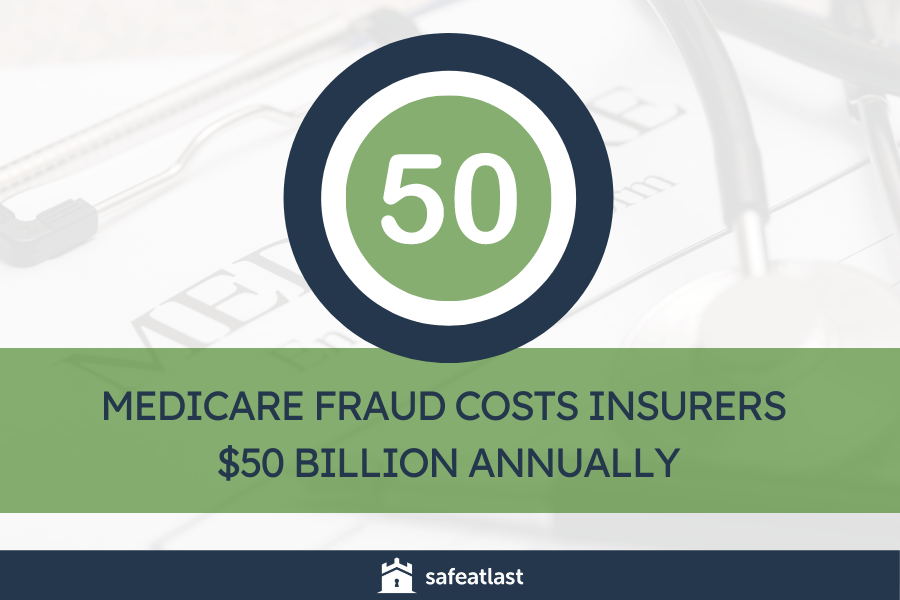
    7. Medicare fraud costs insurers $50 billion annually.  

    (Politifact)

    Scams are extremely expensive. An inconceivable amount of cash is wasted, without any alternative to rebound it. Medicare fraud costs are estimated at a whopping $50 billion a year. In other words, this is $1 billion per week spent.

    Medicare Fraud - 3

    8. The US lost $487 billion due to scams and human error.

    (Gray Matter Analytics) 

    The Coalition Against Insurance Fraud estimates that medical frauds, as well as human error, cost America $487 billion annually. This figure makes up about 10% of the overall healthcare expenditure. In addition, the Medicaid error rate was about 9.8% with total spending of $300 billion in 2015. That’s a pretty huge amount of money lost to scams and human error.

    9. Medicare programs lost $2 billion to just 1 fraud.

    (Gray Matter Analytics)

    Two years ago, 600 fraudsters (the majority of whom were healthcare workers) across 58 federal districts participated in a historical multi-agency scam. The scheme was focused on the distribution of opioids and other hazardous drugs. This Medicare fraud cost its crucial programs a colossal $2 billion. 

    10. Medicare could spare $367 million by checking improper payments. 

    (Health Payer Intelligence)

    Medicare fraud waste and abuse statistics allege that 61% of Medicare payments for outpatient treatment claims were inadequately filed. Research showed that out of 300 sample claims, only 116 were filed correctly. Such an error cost the insurer almost $367 million. 

    11. Medicare spent $160.8 million on medications covered by hospices. 

    (Health Payer Intelligence)

    The authorities discovered yet another instance of healthcare fraud and abuse with Medicare. Namely, Centers for Medicare and Medicaid Services paid over $160 million on medications for Medicare Advantage. The issue here is that hospices already cover those drugs. 

    12. In 2020, America spent $4.1 trillion on medical care.   

    (CMS)

    That equated to $12,350 worth of costs per person. A great deal of the sum the US invests in health care is often used to compensate for health insurance claims. But, medicare fraud and abuse statistics suggest that there is a high number of fraudulent claims. 

    As false claims, frauds, and abuse may cost up to $300 million, one can’t help but conclude that such false claims are highly expensive, regardless of the fact they might make up only a small portion. 

    13. The US government spendings on healthcare will be $6.2 trillion in 2028.

    (CMS, Tax Policy Center)

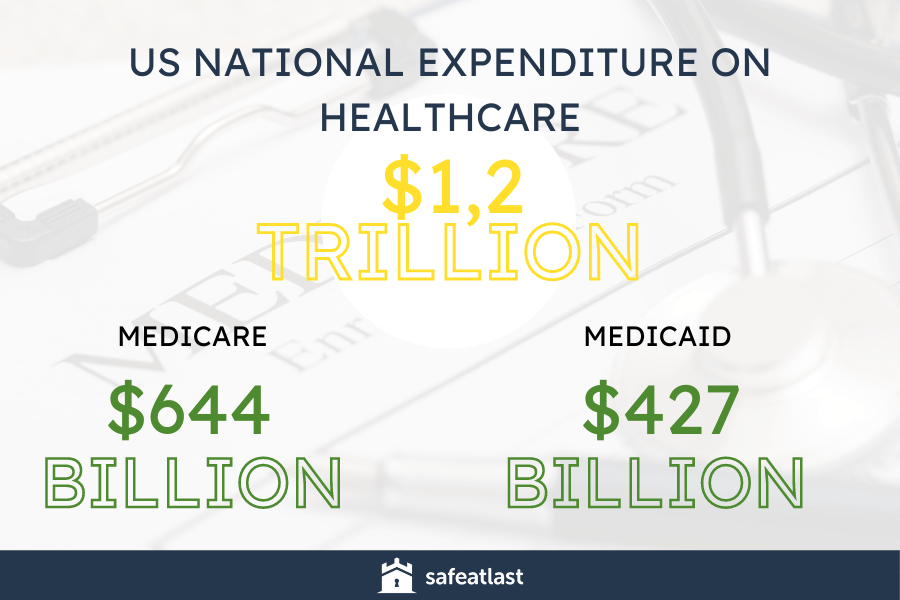
    National expenditure on healthcare amounted to $1.2 trillion in 2019. Out of that amount, $644 billion and $427 billion were assigned to Medicare and Medicaid & the Children’s Health Insurance Program, respectively. 

    In 2028, the national spendings are expected to reach a whopping $6.2 trillion, so the cost of Medicare fraud shouldn’t be discounted.   

    Medicare Fraud - 4

    14. Fraud and abuse comprise between 3% and 10% of total healthcare spendings. 

    (NHCAA)

    The National Healthcare Anti-Fraud Association estimates that health care scams incur billions of dollars of losses every year, as much as 10% of annual healthcare spendings. In figures, this can equal to over $300 billion every year. This can lead to higher premiums, reduced benefits, and out-of-pocket costs for clients.

    15. Around $1.4 billion was given back to Medicare Trust Funds.

    (GAO)

    Medical fraud statistics reveal that the Office of Inspector General at HHS and the US Department of Justice managed to return nearly $1.4 billion to Medicare Trust funds via fines, forfeits, and recoveries. These departments actively fight healthcare and insurance frauds and prosecute perpetrators.

    16. Medicare costs are expected to rise to $1.5 trillion in 2028.

    (GAO, CMS)

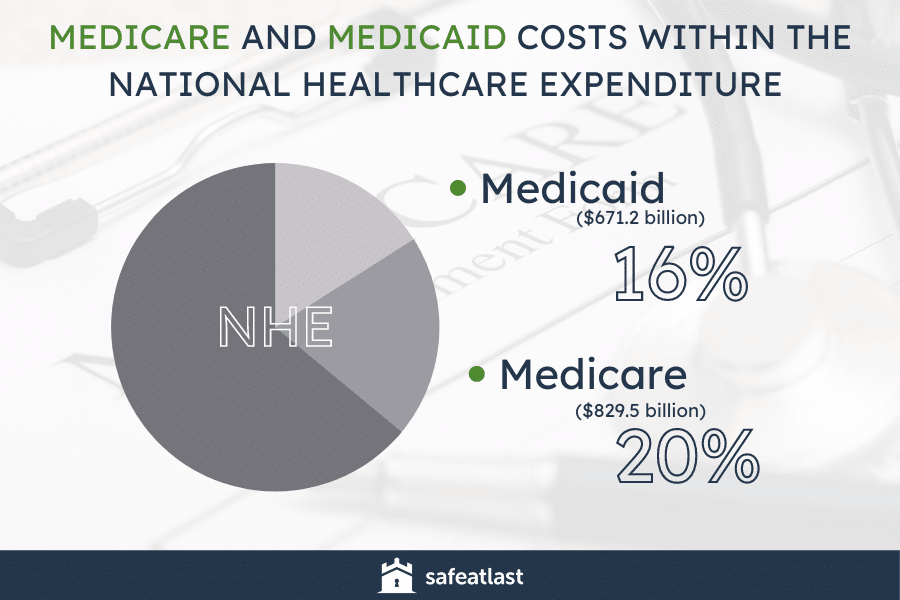
    In 2020, Medicare expenditure amounted to $829.5 billion, which stands for 20% of the national healthcare expenditure (NHE). Medicaid accounted for 16% of the overall NHE, or $671.2 billion. 

    As for Medicare fraud trends, these expenditures are bound to reach $1.5 trillion by 2028, i.e., 5.1% of GDP and 21.9% of federal spendings.

    Medicare Fraud - 5

    The Bottom Line: How Much Fraud Is There in Medicare

    Medicare covers around 60 million people in the US, which accounts for over 18% of the population. The program is funded by users’ premiums, payroll tax, and general revenues, so the Medicare fraud numbers are nothing to be scoffed at. Considering the fact that the US investments in healthcare increase annually — from $3.6 trillion in 2018 to an estimated $6.2 trillion in 2028 — it’s not surprising that the medical system is an easy target for fraud, waste, and abuse.

    On a yearly basis, Medicare spends nearly $700 on its services. Taking that colossal amount into consideration, it doesn’t come as a surprise that it’s a favorite target for frauds and abuse. As Medicare fraud statistics unveil, it loses $50-$60 billion dollars every year to scams and false claims. What’s more, in only one multi-agency fraud, it lost $2 billion. 

    However, such frauds aren’t treated lightly. An array of law enforcement agencies collaborate with the FBI on investigating medical frauds. The punishments vary from a fee to a prison sentence, depending on the level of involvement in the final outcome.

    People Also Ask

    What are the common types of Medicare fraud?

    There are numerous scams and frauds concerning Medicare that are wasting client and taxpayer money. Major categories of healthcare fraud and abuse include deeds such as:
    – Submitting claims for services that patients never underwent or received
    – Falsifying diagnoses and claims
    – Offering free services, goods, or any other reimbursement to get others’ Medicare number
    – Billing Medicare for equipment or supplies that are never received
    – Using somebody else’s Medicare number or card
    – Offering a patient a Medicare medication plan that is not approved
    – Giving false information to a patient in order to sign them up for a Medicare plan
    – Taking part in unlawful kickback or referrals
    – Prescribing unneeded drugs
    – Upcoding for pricey and unwarranted services

    Who commits the most Medicare fraud?

    Perpetrators may vary, from large corporations and organizations created just to commit fraud to patients and individual providers. However, the most frequent participants and offenders include medical providers who tend to submit claims for unnecessary or unprovided services, Medicare fraud and abuse statistics show.
    Suppliers are also among frequent perpetrators, as they may choose to bill items or equipment they don’t provide. Companies, especially non-healthcare ones, may give unapproved plans or mislead prospective clients to join them. Lastly, beneficiaries can also commit fraud by allowing third-parties to use their Medicare card or giving their ID number for money or other incentives, Medical fraud stats indicate.

    What is considered Medicare fraud?

    A Medicare fraud happens when individuals intentionally deceive Medicare to get paid when they are not supposed to. Also, they may go in for a higher payment compared to the one they should receive. Anyone can participate in or commit a fraud — physicians or any other medical staff, suppliers, and Medicare clients. It’s essential to note that such fraud is illegal and will be prosecuted. Additionally, it’s important to note the high cost of Medicare fraud and abuse, which is a burden on taxpayers.

    Who investigates Medicare fraud?

    The FBI is the central law enforcement agency responsible for exposing any kind of healthcare fraud. It has jurisdiction over both federal and private insurance programs. Medical fraud and abuse are regarded as a top priority within the Complex Financial Crime Program. Therefore, every of the Bureau’s offices employs staff whose assignment is to investigate medical fraud and abuse cases, so as to lower Medicare fraud rates.
    The FBI collaborating with other agencies as well, such as the Office of Inspector General at Health and Human Services (HHS OIG), the FDA and the DEA, the Defense Criminal Investigative Service (DCIS), and the Internal Revenue Service-Criminal Investigation (IRS-CI). Medicaid Fraud Control Units from other states and state and local law enforcement agencies are also included.

    What are the penalties for Medicare fraud?

    Federal agencies may charge civil or criminal penalties. In general, civil cases include unintentional fraud allegations. On the other hand, criminal cases demand evidence that the perpetrator intentionally filed a fraudulent claim for Medicare compensation.
    Civil penalties involve paying a fine amounting to $21,000 per a fraudulent claim, reimbursement for overbilled amounts, and treble damages. Criminal cases require paying a fine amounting to hundreds of thousands of dollars, and carry a prison sentence of between 5 and 20 years, and can sometimes even include a lifetime prison sentence.

    How much Medicare fraud is present in the United States?

    Taking into account the money lost to fraud and abuse (over $50 million a year), as well as millions lost to improper payments, while the exact Medicare fraud amount is hard to determine, it could be concluded that Medicare fraud is relatively frequent. Not all scam instances are intentional, though — some are committed unknowingly.

    What is the difference between Medicare fraud and abuse?

    Medicare fraud involves intentional and calculated deception or misstating of services an individual is aware of are false. Such a case may result in additional and illegal remuneration or payments to a practice.
    Medicare abuse is regarded as a lesser offense that happens when medical offices do not adhere to correct coding and billing regulations and guidelines. Generally, abuse refers to matters or practices that don’t comply with established healthcare, business, or fiscal procedures.
    According to Medicare fraud statistics, fraud can also involve identity theft in some cases, whereas abuse generally does not.

  • Car Theft Statistics & How to Avoid Becoming a Victim

    Car Theft Statistics & How to Avoid Becoming a Victim

    Wait. Didn’t I park right here? Maybe a bit further down the block? No. The car’s not here. If this has happened to you, you’re probably part of the car theft statistics.

    However, in this case, it’s not just your car that has disappeared. The paperwork for tomorrow’s client meeting is missing, and your company laptop is gone too. You have the sudden urge to cry, but instead, you dial 911.

    Unfortunately, this is a frequent occurrence considering that a car is stolen every 36 seconds in the US. It’s important to note that you can take some steps to reduce the risk of your car getting stolen. 

    However, for now, let’s look at the statistics for one of the most common property crimes in the United States and hopefully raise some awareness. 

    Auto Theft Statistics in America (Editor’s Choice)

    • The national average car theft rate in 2020 was 246 per 100,000 residents
    • The number of car thefts increased by 10.9% in 2020
    • There were 880,595 motor vehicle thefts nationwide in 2020
    • New Year’s Day is the holiday with the most number of vehicle thefts
    • Ford Full-size Pick-up Truck is the most frequently stolen car in the US
    • 1% of car thefts are committed by the owners’ grandparents
    • About a third of the US car thefts in 2019 happened in California, Texas, and Florida
    • Teslas are almost 90% less likely to be stolen than the average car

    Car Theft Statistics in the United States

    1. The number of car thefts increased by 10.9% in 2020 over 2019.

    (USA Today, NICB)

    The number of car thefts spiked in 2020. From 794,019 in 2019, it increased to 880,595 in 2020. Authorities believe it was primarily due to the economic downturn, depleted social and educational programs, and law enforcement realignment. 

    However, owner complacency remains one of the biggest risk factors. Even though a car is a significant investment, owners don’t always do enough to protect it.

    2. There were 880,595 motor vehicle thefts nationwide in 2020.

    (Kelley Blue Book)

    Grand theft auto statistics show that it’s one of the most common property crimes in the US. The definition of such an offense is stealing a motor vehicle with no intention of returning it to the owner. 

    It differs from theft for joyriding, wherein the perpetrator handles the vehicle without the owner’s permission but has no intention of stealing it. Grand theft auto is the theft of motor vehicles with or without the use of weapons. It’s a felony in every state.

    3. The national car theft rate in 2020 was 246 per 100,000 residents.

    (Statista)

    In 2019, the rate was 220.8, and it was around 230 the year before. Even though these car theft rates seem high, they are a significant improvement from 658.9 in 1991. Since then, the rates have been steadily declining, primarily due to advanced car alarms and other anti-theft equipment.

    4. Car thefts caused $7.4 billion in losses in 2020. 

    (Insurance Information Institute)

    The average loss per incident of theft was $9,166. It’s evident that car theft is a significant burden, both for victims and the economy in general. With car prices increasing in 2022, the average loss is bound to rise as well. 

    5. The average stolen car recovery rate in 2020 was 56.4%.

    (Statista)

    Contrary to the common belief that stolen cars never get found, more than half of them are actually brought back to their owners. Out of all stolen properties, cars have the best recovery percentage. In comparison, household goods are recovered in only 39% of cases, while TVs and jewelry have an under 5% chance of being found. Unfortunately, although the vehicles are recovered, they don’t always come back in one piece.

    6. The best chance of recovering a stolen car is within 72 hours after it gets stolen.

    (The Motley Fool)

    Automobile theft statistics indicate that the best chance of recovering a stolen vehicle is within three days after the theft. Still, statistics reveal that many people never see their stolen cars again. Instead of sitting and waiting for the police to find your car, you can help them by collecting valuable information. 

    If you have one of the best GPS trackers on your car, you can find out its location and have the police check corresponding security cameras. Talk with cab drivers — they are observing, reliable witnesses.

    Carjacking and Car Burglary Statistics

    7. In 2020, almost half of the stolen cars in New York City were stolen while they were left running. 

    (The New York Times)

    The Big Apple saw 6,858 vehicle thefts in 2020, up from 3,988 the year before. Remarkably, 3,450 of them were stolen with the keys left inside or with the engine running. NYPD’s records show that there were 1,634 instances of such auto theft in 2019, which was around 40% of the total figures. 

    Car theft statistics show that the percentage has risen significantly. The authorities believe that it’s due to the pandemic, where people were in a hurry to pick up or drop off supplies, thereby forgetting their keys inside the car.

    8. Teslas are almost 90% less likely to be stolen than the average car.

    (CNBC)

    Great news for Tesla owners — they are not very popular among car thieves. Looking at car theft rates by model, you’ll see that this applies to all-electric vehicles in general. Experts believe that it’s because these cars are mostly parked near the owner’s home and very often in garages for recharging. 

    Additionally, thieves can’t know how much of the battery power is left and how far they can go before it runs out, and they can’t really make a quick stop at a gas station. Lastly, many of them have advanced GPS tracking devices that are interconnected with the system and can’t be disabled.

    9. The number of carjacking cases in Minneapolis rose by 537% in 2020.

    (PEW, Chicago Tribune, ABC News)

    Unfortunately, carjacking facts show that Minneapolis is not the only city affected. Chicago PD reported a 135% increase, while Washington DC and New Orleans reported an increase of 116% and 126%, respectively. 

    Unfortunately, no national data is available yet because many police departments list this crime differently (violent crime, robbery, auto theft, etc.). This problem also prevents the authorities from centralizing data and generating carjacking statistics by state.

    Experts believe that one of the reasons for this spike is that wearing masks on the street is the new normal, and victims no longer react when they see a masked person approaching their car. With crime spikes like this, having the best pepper spray for self-defense might be a good idea.

    10. In 2020, the total number of thefts from cars in LA surpassed the number of stolen vehicles by about 20%.

    (LAPD, Cincinnati.com) 

    LAPD reported 40,678 stolen vehicles and 51,731 total thefts from vehicles in 2020. Car break-in statistics show that this is a widespread crime. For instance, it accounts for 11% of all crimes in Cincinnati. 

    Police say this is one of the most preventable crimes, as simple precautions like locking the doors and hiding valuables can dramatically reduce one’s chances of becoming a victim.

    11. 57% of Americans don’t worry that their cars could be stolen or broken into.

    (Statista)

    Even though a car is stolen every 36 seconds in the US, car owners generally think that their vehicles are safe. Only less than half of Americans find auto theft statistics worrying and fear their car might be stolen or burglarized. Americans seem to worry more about cybercrimes and identity theft. A little over 70% of US residents fear these crimes the most.

    12. Every 36 seconds, a motor vehicle is reported stolen in the United States.

    (NICB)

    Stolen car data shows that you should worry. Auto theft is a very profitable crime, and despite new car alarm systems, statistics show that any vehicle can be a target for thieves. Every day, these offenders find new and sophisticated ways to steal vehicles. Most cars are stolen for transportation, but many are stripped and sold for parts, so even older cars are not safe.

    Interesting Motor Vehicle Theft Statistics

    13. 74.5% of stolen vehicles are cars. 

    (FBI, Statista)

    Thieves steal trucks, buses, motorcycles, and all other types of vehicles, but FBI statistics reveal that cars are at the greatest risk, accounting for 74.5% of all vehicle thefts. Considering that cars make up only about 60.5% of all registered vehicles in the US, the percentage of stolen cars is very high. 

    14. The number one stolen car in America is the Ford Full-size Pick-up Truck.

    (NICB)

    Motor vehicle thieves seem to have their favorite car model, and it’s not the Range Rover, Ferrari, or Lexus. For the second year in the row, the Ford Full-size Pick-up Truck tops the list, with the Chevrolet Pick-up Truck as the runner-up. 

    Of the ten most stolen vehicles, six are Japanese models. The Honda Civic, once the most common stolen car, is now in the third spot, closely followed by the Accord.

    15. New Year’s Day is the holiday with the most number of vehicle thefts. 

    (Insurance Information Institute)

    The latest statistics recorded 2,320 car thefts during New Year’s Day, making it the US holiday with the most instances of vehicle thefts. Celebrations turn daily life upside-down, and that can work to the thieves’ advantage. Burglaries are common around the holidays because the police are busy breaking up rowdy parties. 

    In addition, owners tend to be a bit carefree during the holiday season, which increases the theft rate. According to auto theft stats, other US holidays with the most vehicle thefts are Labor Day and Presidents’ day, with more than 2,000 motor vehicle thefts reported during each of these days. 

    16. 3% of car thefts are committed by boyfriends and girlfriends.

    (FBI)

    The FBI analyzed more than 91,000 car theft cases in 2020 and concluded that romantic partners are responsible for 3% of car thefts. However, other people close to us can also be responsible because the FBI also discovered that 6% of car thefts in 2020 were committed by parents and friends (3% each). 

    Furthermore, stolen car statistics show that 8% of vehicles were taken by the owner’s acquaintance. Even grandparents are not an exception, with 1% of all car thefts in 2020 being committed by them. 

    17. 74% of carjackings involve some kind of weapon.

    (Bureau of Justice Statistics)

    Auto thefts that include violence are still happening. According to gun violence statistics, 45% of carjackings involve firearms. Additionally, 11% involve knives, and 18% involve other weapons. In such a dangerous situation, the police say that the proper course of action is to hand over your keys.

    Auto Theft Statistics By State

    18. Colorado has the highest car theft rate in the US.

    (Statista)

    Per 100,000 residents in Colorado, 524.3 cases of auto theft were recorded in 2020. The state is closely followed by the District of Columbia and New Mexico, with theft rates of 476.8 and 427.6, respectively. 

    In comparison, the national average is 246, and when it comes to car theft statistics by city, Bakersfield, California, has the highest cases at 905.41 per 100,000 inhabitants. 

    19. Vermont has the lowest car theft rate in the US. 

    (Statista)

    The state has a car theft rate of only 42.4 per 100,000 residents. That’s pretty low compared to the national average of 246. The other safest cities are Maine and New Hampshire, with theft rates of 63.8 and 76.4, respectively. 

    20. In 2020, New York had a car theft rate of 101.7. 

    (The New York Times, Statista)

    Car theft data from 1990 shows that there were 2,000 stolen cars per 100,000 residents in New York. However, that figure is significantly lower today. Burglary statistics show that car theft had an impressive drop in the last 30 years, mostly due to new car models that are more difficult to steal and traffic jams that make a quick getaway almost impossible.

    21. New York car thieves love Hondas the most. 

    (NICB)

    Data from 2020 show that around 1,850 Honda Civics, Accords, and CR-Vs were stolen in the state. Pick-up trucks are thieves’ favorites on a national level, but the most stolen cars differ by state. For example, in states where most residents live in urban communities, thieves primarily target sedans and family cars.

    Results from New Jersey show similar trends—Honda Civics and Accords were the most stolen models there too. The explanation is simple: pick-up trucks are less common in these states, so they’re less likely to be stolen. They also don’t blend in easily, are faster for the police to track down, and are generally harder to resell. 

    22. Car theft statistics by state show that nearly a third of US car thefts in 2020 happened in California, Texas, and Florida.

    (Insurance Information Institute)

    Of the 810,400 motor vehicle thefts reported nationwide in 2020, 290,870 happened in these three states. California holds the highest number, with 168,323 recorded car thefts that year. It’s shocking to think that this figure is even greater than the combined numbers from Texas and Florida (84,276 and 38,271, respectively). 

    23. California has had a surprisingly high car recovery rate—89% in the last two years.

    (CHP, CHP)

    Another interesting car statistic from California is that even though it’s the state with the most recorded incidents of car theft, it’s also the state with one of the highest car recovery rates. For example, data from 2019 and 2020 show that law enforcement agencies managed to recover more than 89% of stolen vehicles. Furthermore, about two-thirds of them were recovered intact or in drivable condition.

    Conclusion

    According to Consumer Reports, the average price of a new car in the US is $45,000. Meanwhile, the prices of used vehicles are also on the rise. So, we can all agree that a car is a significant investment. 

    However, when it comes to car thefts and car break-ins, statistics still show that a large percentage of them could have been easily prevented by simply locking car doors, rolling down windows, and taking the keys out of ignition. Car theft is most often a crime of opportunity, and if we don’t give thieves a chance, it will significantly reduce the number of thefts. So, the next time you park your car, go through the safety measures you can take to avoid theft. 

    People Also Ask

    What is the reason most cars are stolen?

    There are plenty of reasons cars get stolen. In 2020 and 2021, a large percentage of vehicles were stolen just for joyriding. Car theft is a crime of opportunity, and we provide thieves with the chance when we leave our key fobs in the car or hop out to do some errand and leave the engine running.
    The New York Police Department stated that half of the vehicles stolen in 2020 had their engine running. The less “benign” reasons are stripping for parts, resale, and export (especially in the border states). Sometimes cars also get stolen to be used in another crime later.

    What are the chances of my car being stolen?

    The chances of your car being stolen depend on where you live. Colorado has the highest car theft rate in the country, with around 524 stolen vehicles per 100,000 residents. This means that your chance of becoming a victim of car theft in Colorado is 1:2,000. On the other hand, people in Vermont are much better off, as theft rates are much lower—just 42 per 100,000 residents. That’s 13 times lower than Colorado’s rate and six times lower than the national average.

    What percentage of stolen vehicles are cars?

    Thieves steal bikes, buses, and other vehicles, but the latest data show that cars are at the greatest risk. Even though they account for only 60% of all registered vehicles in the US, they account for almost 74.5% of all vehicle thefts. A large percentage of thefts are just for the purpose of joyriding, and large trucks and buses are not that tempting. Also, most thieves don’t know how to operate them.

    How do police track stolen cars?

    The police have several ways of tracking stolen cars. The most obvious one is GPS tracking. Some smart thieves, however, have ways of disabling and removing GPS trackers. Other methods include tracking devices the victim might have left in the car. Phones, tablets, and other digital devices can be tracked even when they are turned off. Whenever they pass a local base station, they ping their location. Non-Wi-Fi equipment can also be helpful. For instance, the police can also use toll detectors to track down stolen vehicles.

    What are the hardest cars to steal?

    In general, electric cars with advanced autopilots are the hardest to steal. They are mostly parked in home garages for recharging. They have advanced GPS features that are closely intertwined with the car’s system and are hard to disable without disabling the car, making them very easy to track. Also, electric vehicles have fewer parts than traditional cars, which makes chopping them for parts unprofitable.

    How common is car theft in the US?

    Theft rates vary depending on the state. The national average car theft rate is 246 per 100,000 residents. This means that one car is stolen per 406 residents. If we look at the numbers, we can see 109 million registered cars and over 537,000 car thefts in 2019. This means that one in 202 cars was stolen that year. Car theft statistics also show that about a third of US car thefts in 2020 happened in California, Texas, and Florida.

  • 20+ Unbelievable Insurance Fraud Statistics You Need to Know

    20+ Unbelievable Insurance Fraud Statistics You Need to Know

    Fraud in insurance may happen at any point, from the second a client’s application is filed all the way up to claims. Insurance fraud statistics estimate that insurers lose a colossal $80 billion to frauds.

    Nowadays, scams and abuse are becoming more frequent and omnipresent. The emergence of new technologies helps insurance fraud evolve, while, at the same time, fraudsters become more imaginative and refined.

    Modern technology and perpetrators’ creativity make it more challenging for experts to uncover fraud. Although insurance companies have anti-fraud units, only a small portion decides to prosecute, which fraudsters readily take advantage of.

    It might not be possible to protect the company, but it doesn’t mean that there shouldn’t be any attempt to prevent fraud. Just like the fraudsters, insurers ought to implement advanced tools and technologies.

     Intriguing Data About Insurance Fraud in the US (Editor’s Pick)

    • Nearly 2% of insurance frauds are prosecuted
    • Every year, insurers earn more than $1 trillion in premiums
    • Insurance costs in the US amount to over $40 billion annually
    • 3%–4% of insurance claims are false
    • 22% of insurers detect prospective fraud by using machine learning
    • When dealing with frauds, 7% of insurers wouldn’t include law enforcement 
    • Medical fraud expenses account for 3% of the total sum invested in healthcare programs
    • Insurers suffer the loss of $1.5 million per fraudulent case

    General Stats and Fact on Types of Insurance Frauds 

    Insurers classify frauds into several major categories: soft and hard, low-tech, and high-tech. Regardless of type, they can occur at any client touchpoint. Soft frauds aren’t typically planned and involve little to no degree of a criminal act.

    Hard frauds, on the other hand, come as a result of a deliberate criminal act. They can be committed by individuals, organizations, and even providers. In terms of legislation, insurance fraud is regarded as a severe criminal offense. 

    1. Insurance fraud costs in America exceed $40 billion every year.

    (Insurance Information Institute)

    FBI insurance fraud statistics estimate that insurance scam costs surpass $40 billion annually. Scams may be carried out by insurance applicants, policyholders, insurers, or third-party claimants at various points in the insurance transactions. Typical scams involve inflating real claims, misinterpreting facts in an application, filing claims for injuries or harm that never happened, and faking accidents. 

    2. International insurers lose $80 million due to fraudulent claims every year.

    (RGA)

    Scams are happening everywhere on the globe. The Coalition Against Insurance Fraud assesses the overall cost of insurance fraud at $80 billion, though the actual amounts might be even higher. The modern technology era helps advance scams and makes it easier for fraudsters to commit crimes. Besides, they have become much subtler, preventing experts from unveiling them on time. 

    3. Less than 2% of scams end in prosecution.

    (RGA)

    What drives scammers to pursue this type of crime is the fact that insurers are unwilling to prosecute offenders. According to insurance fraud in the US stats, only a tiny portion — not even 2% — of frauds are prosecuted. The reasons for avoiding prosecution include high trial expenses and unpredictable outcomes. But even though it might be costly and demanding, the prosecution may serve as a plausible threat and thus deter fraudsters.

    4. Between 3% and 4% of insurance claims are fraudulent.

    (RGA, The Balance)

    At the global level, approximately 1 in 30 claims is false. Such a figure further indicates that between 3% and 4% of insurance claims are fake. The most typical insurance frauds examples include health insurance scams, car insurance frauds, life insurance frauds, false thefts, and faked deaths.

    Some fraudsters even commit identity theft, which had risen by 16.7M in 2017.

    5. Insurance scams cost US families between $400 and $700 in premium expenses annually. 

    (TransUnion)

    The insurance industry represents a collection of over 7,000 companies that gain quite a fat profit on an annual basis. However, it is among the most vulnerable sectors in terms of scams. Namely, every year, insurance scams impose expenses on US families amounting to between $400 and $700 in premium costs. 

    6. Healthcare scam costs make up around 3% of national funds invested in healthcare programs.

    (BCBSM) 

    With trillions of dollars invested in the healthcare system annually, this sector is an easy target for scams. Health insurance fraud statistics show that this type of fraud, along with unnecessary medical tests or procedures, is yet another type of most frequent scams.

    To add to that, the total expenses of healthcare scams amount to $68 billion every year, according to medical insurance fraud statistics. It is the entire nation that bears those costs as they comprise nearly 3% of the government’s $2.26 trillion of investments in healthcare. What’s more, some experts estimate that the scam costs are even higher, reaching 10%, which is $230 billion of national taxpayers’ cash.

    7. Medicare scam costs are estimated at $50 billion per year. 

    (Politifact)

    This federal health insurer is a frequent victim of scams and abuse. As Medicare fraud stats denote, the insurer loses at least $50 billion dollars to false claims, frauds, and abuse every year. Considering the fact that the US government assigns over $700 billion to Medicare every year, these costs may not seem that massive. Unfortunately, they are repaid from the taxpayers’ pockets.

    8. Two executives were imprisoned due to participation in fraud. 

    (Constantine Cannon)

    Private health insurance isn’t immune to scams either. Namely, private health insurance fraud statistics recorded a case in which two Primera Medical Group executives were involved. The duo submitted fraudulent invoices worth over $8.5 million to private insurance companies. They filed allergy testing and immunotherapy procedures that were unnecessary and were never carried out. The former executives were charged with fraud and sentenced to prison. 

    9. The US government regained more than $2.2 billion from false claims in 2020.

    (US Department of Justice)

    More specifically, health insurance frauds cases accounted for more than $1.8 billion. The best example that the False Claims Act is applicable and of great importance to the US is the fact that over 30 states have established state versions of it. 

    Since it was signed into law, the False Claims Act has turned into the most successful anti-fraud act in the US. 

    10. 7% of insurers refuse to engage law enforcement.

    (RGA)

    Insurance fraud statistics suggest that insurers aren’t quite willing to involve law enforcement agencies when dealing with scams. Only 1 out of 3 agents would contact legal authorities, whereas 7% would refuse to report the fraud. This could be the reason why there is only 1.7% of successful prosecutions of identified scams. The great majority of those cases are related to health and living benefits. 

    Conversely, 33.3% of insurers stated they would always report the fraud, whereas 59.7% would hesitate to do so.

    Insurance Fraud Statistics (1)

    Insurance Fraud Statistics Involving Monetary Loss & Gain

    11. Insurance companies lose $1.5 million per fraudulent case.

     (Linkedin, Spivey Insurance Group)

    Every year, insurance organizations lose 5% of their revenue to the most common fraud cases. Translated into cash, this percentage amounts to a whopping $1.5 million per case. The figures further show that a median loss per case is $125,000. 

    Here are the top 10 insurance frauds:

    1. Minor vehicle damage scams
    2. Premeditated home fires
    3. False thefts
    4. False stolen vehicle claims
    5. Car accident frauds
    6. Natural disaster damage scams
    7. Health insurance frauds
    8. Unnecessary medical testing and procedures
    9. Renter’s insurance scam
    10. Faked death

    12. Insurance organizations earn over $1 trillion in premiums every year.

    (TransUnion)

    The whole insurance industry, consisting of over 7,000 organizations, gains a handsome profit of more than $1 trillion annually. Taking into account the vast amounts of cash circulating through the sector, it’s no wonder why the national rate of insurance fraud is continually increasing. It’s the second-favorite target of fraudsters, immediately after banking. 

    13. The size of the international insurance scam detection market may rise to $7.9 billion by 2024.

    (Globe Newswire)

    The worldwide insurance fraud detection market is predicted to increase from $2.5 to $7.9 billion in 5 years through 2024 at an annual growth rate of 25.8%. Since cyber-attacks on the insurance industry became more sophisticated, they tend to impose huge industry losses. Thus, the need to expand the entire insurance fraud detection market is not surprising. Still, not all organizations seem to be aware of the significance of fraud detection. 

    14. 22% of insurance organizations implement machine learning to fight fraud.

    (RGA)

    New trends in insurance fraud detection reveal that insurers started to implement AI to combat scams. Over 20% of organizations actively use machine learning to determine possible fraud. Such an approach is more frequent in the Asia Pacific region, specifically in markets that have high fraud incidences. Individuals can also protect themselves from identity theft fraud by using the best ID theft protection services on the market. 

    Find out how to deter identity theft.

    15. 48% of companies discovered that their agents participated in frauds.

    (RGA)

    Insurance fraud sometimes requires an “inside job.” Almost half of insurance organizations uncovered instances where their agents participated in scams. Depending on the organization, the percentage of such cases varies from very low to very high. Some reported that only 5% of their agents participated in frauds. Others have totally divergent reports, stating that about 50% of insurers were involved in scams. 

    The participation rate also varies depending on the premium type. Life insurance fraud cases show a low participation ratio of 7%. However, mortality benefits come with the highest occurrence that reaches even 60%.

    16. Car insurance scams may amount to $29 billion annually.

    (Simple Insights)

    Scams are much more expensive than ordinary people may think. The reason is quite simple — car insurance premium users bear the costs of frauds amounting to even $29 billion. In percentage terms, this accounts for 14% of a standard car insurance premium that beneficiaries are supposed to pay, as car insurance fraud stats uncover. 

    Worldwide Insurance Fraud Stats

    17. The average value of a false claim in the UK amounted to £12,000 in 2020.

    (ABI)

    The value represented a 6% increase from the year before. 

    However, the number of detected fraudulent claims (96,000) was lower than in the previous 13 years. Moreover, it showed a 10% decrease from 2019. 

    18. Every day during the first half of 2021, fraudsters stole over £4 million on average in the UK.

     (BBC)

    The UK seems to be among the countries with the highest rate of insurance fraud. Compared to the first half of 2020, fraud when people are deceived into giving money, and personal details rose by 71%. However, banks refunded less than 50% of the money. 

    All in all, fraudsters had stolen £754 million up to June 2021, which was a 30% rise compared to the same period in 2020. 

    The fraudsters were not only organized criminals, but some of them were teenager thieves without previous convictions. On top of that, more than two-thirds of the fraud occurred through online platforms. 

    _Insurance Fraud Statistics #2

    19. Property frauds in the UK fell to 24,000 in 2020.

    (ABI)

    The UK insurance fraud statistics reveal a considerable jump in property frauds. Namely, the number fell by 10% compared to the previous year. Moreover, their value was £111 million, dropping 9%. 

    Comparatively, false climbs reached the figure of 27,000 in 2019. The worth of such frauds in cash was £124 million, 30% more in figures, and 8% in value compared to the year before. 

    20. Household insurance scams grew by 52% in the UK.

    (This is Money, Spivey Insurance Group)

    Household frauds, specifically home fires, natural disasters, and renter’s scams, are among the most common insurance frauds that scammers try to commit. Across the UK, there has been an increase in insurance scams by 27%, Out of that percentage, more than 50% are household scams. 

    21. In Canada, 5% to 15% of car insurance premiums are used for covering undetermined false claims. 

    (Insurance Institute)

    Taxpayers and insurance premium clients are those who actually cover undetected false claims. In Canada, between 5% and 15% of auto insurance premiums are assigned to covering such claims. This is yet another burden for Ontario drivers, already plagued by high insurance premiums.

    22. Car insurance frauds rose by 45% in the UK.

    (This is Money, Spivey Insurance Group) 

    Another increase is present in auto insurance fraud statistics. Car insurance scams seem to be the next favorite among the UK fraudsters, according to the figures. Such frauds typically include minor damage schemes, false stolen vehicle claims, and car accident frauds.

    The Bottom Line: Is Insurance Scam a Perfect Crime?

    Insurance fraud might be a perfect crime. The risk is minimal, while the reward potential is quite high. Even if the experts manage to detect fraud, the chance to administer punishment or a penalty is quite small. 

    A much better way to combat insurance scams is to prevent them even before they happen. This further implies strengthening portfolios or using machine learning to detect and inspect high-risk policies. Such an approach is bound to give much better results than taking legal actions or pursuing prosecution.

    People Also Ask

    Which insurance company denies the most claims?

    Some companies tend to deny the majority of insurance claims, even though they were valid. They do so in order to enhance their financial balance. They even take quite a strange approach to reward their agents who denied claims successfully. What’s even worse, they dismiss those who wouldn’t comply with those orders so as not to harm the victims. As the final move, they participate in outright scams to bypass paying clams. Those notorious organizations include, but are not limited to, Allstate, AIG, and State Farm.

    How many states make insurance fraud a crime?

    As an offense that happens when a perpetrator tries to deceive an insurance company with the aim of gathering money that doesn’t belong to them, insurance fraud is considered a crime in all 50 US states. In fact, most of the states have founded fraud bureaus whose main task is to detect and inspect scam incidents. In the majority of states, fraudulent claims are regarded as either a felony or a misdemeanor, based on the extent and nature of the committed scam. Specific types like health care frauds are considered crimes under federal law.

    How is insurance fraud dangerous for the economy?

    Insurance scams impact insurance premiums and policyholders to the greatest extent. To recover the money they lose on false claims, insurance organizations have to increase the price of premiums. That way, they pass the expenses of both the fake claim and the combat against the fraud on common policyholders. What’s more, insurance fraud statistics warn that colossal costs of health care scams are paid solely by the US taxpayers’ cash. The same could also be said for welfare fraud cases.

  • 20 Employee Theft Statistics You Need to Know in 2024

    20 Employee Theft Statistics You Need to Know in 2024

    Corporations and businesses lose millions every year due to employee theft. While it might not seem like a prime financial concern, it can cripple a company if it gets out of hand.

    To understand this problem better, take a look at this list of employee theft statistics. We’ve collected the data that best highlights how harmful employment theft is for individual businesses and on a larger scale.

    Here, you’ll learn about the costs of employee theft, embezzlement, insider data breaches, and much more. This article will illustrate how dangerous it can be to lose control over employees’ wrongdoings.

    Staggering Workplace Theft Statistics (Editor’s Choice)

    • Over 90% of all businesses have dealt with employee theft
    • Employee dishonesty costs US businesses $50 billion annually
    • On average, embezzlers steal over $350,000
    • Businesses generally recover almost 40% of embezzled funds
    • Six out of ten dentists are victims of embezzlement.
    • Time theft leads to companies losing around $400 billion a year
    • On average, dishonest restaurant employees steal $1,900

    Stats on Employee Theft Cases

    1. Over 26,000 employees were apprehended for stealing in 2020.

    (Jack L. Hayes International)

    Employee theft statistics 2020 reveal a significant decrease in such incidents — 20.3% less than in 2019. In these cases, $32 million were recovered. 

    “Essential” retailers, however, report 2.7% more dishonest employees than the previous year.

    2. 95% of all businesses suffer employee theft.

    (CompareCamp)

    Almost every business in the US has reported employee theft cases. In over 50% of the instances, the loss was in office supplies or the use of company equipment for personal benefit.

    3. Every year, US businesses lose $50 billion to employee dishonesty.

    (Embroker, ISN)

    On a national level, the US suffers staggering losses because of employee dishonesty (stealing, being unproductive, etc.). Employee theft statistics show these losses aren’t distributed evenly. Research suggests that one in three business failures happens due to internal theft.

    4. In the US and Canada, noncash assets made up 18% of all asset misappropriation cases in 2020.

    (ACFE)

    The term “asset misappropriation” describes a wide range of activities — cash larceny, unauthorized expense reimbursements, skimming, and more.

    Some of the most frequent schemes with the highest embezzlement incident rate in Canada and the US are corruption (33%), billing (26%), and expense reimbursements (19%).

    Embezzlement Statistics

    5. Embezzlement costs a company $357,650 on average.

    (Embroker)

    Embezzlement schemes can go undetected for a very long period while draining the organization’s funds. Employee theft statistics show that the average embezzler works for eight years for the company before getting caught.

    6. 33% of embezzlement perpetrators work in accounting or finance.

    (The Balance SMB)

    Accounting fraud statistics show that one-third of embezzlement cases involve someone from this department or from finance as the perpetrator. Meanwhile, 85% of the cases involve someone at a manager level or higher.

    Employee Theft Statistics

    7. 70% of embezzlement cases last longer than a year.

    (The Balance SMB)

    At the same time, employee embezzlement statistics show that around 30% of embezzlement cases last three years or longer.

    8. On average, businesses recover 39% of embezzled funds.

    (The Balance SMB)

    According to the employee theft stats, businesses typically get back less than half of their stolen money by restitution, settlements, or insurance.

    9. Church crime would account for over $80 billion by 2025.

    (Brotherhood Mutual)

    Fraud occurs in all kinds of religious institutions, and almost anyone with influence can divert a part of the church’s funds to themselves.

    Church embezzlement statistics show an increase in wrongdoings by 6% every year, and 80% of such cases go unreported to law authorities.

    10. Three out of five dentists are victims of embezzlement.

    (Dental Town)

    According to the most recent dental embezzlement statistics, most practicing dentists will become victims of embezzlement at least once in their careers.

    The average scheme lasts between two and five years and results in over $100,000 loss for the practice. 

    11. 79% of embezzlement incidents involve more than one person.

    (The Balance SMB)

    Embezzlement schemes are usually complex. The perpetrator often convinces others to cooperate to stay undetected, as shown by employee data on theft statistics.

    12. Cash makes up 34.5% of all asset misappropriation in nonprofit organizations.

    (MIP)

    The top three kinds of fraud are asset misappropriation, financial statement fraud, and corruption. Of these, misappropriation with cash, such as skimming, larceny, and register disturbances, are by far the most common, nonprofit embezzlement statistics reveal.

    Annually, nonprofit organizations lose a median of $168,000 to employee theft. Embezzlement and check fraud account for $158,000.

    Costs of Internal Theft Statistics 

    13. As per The 2020 National Retail Security Survey, shrink represented 1.62% of a retailer’s bottom line.

    (NRF)

    In retail, shrink refers to inventory loss due to employee theft, shoplifting, damage, or inventory mismanagement. 

    The shrink mentioned in the statistic above resulted in $61.7 billion worth of costs for the industry. Furthermore, 70% reported a shrink rate of over 1%. 

    Retail employee theft statistics confirm that almost 50% of the increase was noticed in in-store-only sales. Comparatively, 26.1% was detected in online-only sales. 

    14. Time theft costs companies around $400 billion every year.

    (Connecteam)

    Time theft is a big issue well worth addressing. A business that doesn’t keep track of employee productivity can lose tremendous amounts of money.

    According to employee time theft statistics, it affects 75% of the companies in the US and accounts for $400 billion in losses every year.

    15. Walmart loses $1.5 billion to shoplifting and employee theft.

    (Forbes)

    Walmart is the biggest retail chain in the US. The retailer loses around 1.4% of sales revenue to shrinkage, accounting for $1.5 billion per year. 

    Diving further into the Walmart employee theft statistics, 38% of the losses are due to shoplifting, 35% — employee theft, and administrative make up 27%.

    Employee Theft Statistics 2

    16. The median loss caused by employee fraud in the banking industry is $110,000.

    (ACFE)

    Statistics on bank employee theft point to a high median cost. For comparison, the median cost in retail is $50,000 and in education — $68,000. There are 366 fraud cases in the banking industry every year. 

    The communications and publishing sector has only 24 cases yearly but the highest median cost of $525,000.

    Data on Employee Theft by Industry

    17. 60% of data breaches happen because of insider threats.

    (Security Intelligence)

    Over half of cyber breaches originate from the inside. That means an employee either intentionally helps cybercriminals or makes a mistake they can exploit.

    According to workplace theft statistics, the costs of insider threats add up to $8.76 million annually.

    18. Occupational fraud accounts for $7 billion in losses worldwide annually.

    (ACFE)

    According to the most recent employee theft research, there are approximately 2,690 cases of fraud around the world, with a median cost of $130,000.

    19. The average dishonest restaurant employee steals $1,900.

    (DIGIOP)

    Restaurant employee theft facts show that the most used fraud is refund for cash or POS fraud. It involves reporting a refund for a meal even though no customer asked for it and taking the money.

    Dishonest restaurant employees can get away with stealing nearly $2000 before anyone notices. 

    20. There were 453 arrests for internal mail theft in the US postal service October 2020–September 2021.

    (USPS OIG)

    The US Postal Office theft statistics show they conducted 1,472 investigations. Consequently, there were about 1,042 administrative actions against dishonest employees. On top of that, over $162,000 was returned to the Postal Service. 

    Conclusion

    Worker theft is a silent yet deadly issue that can end many businesses. Sadly, it doesn’t get nearly enough time under the spotlight, allowing most perpetrators to get away with it.

    The reasons people steal from their employer are numerous — insufficient salary and unpleasant work environment are among the prime ones. All the same, realizing how common the problem is in the first place is pivotal to addressing it. 

    While some industries are more affected, employee dishonesty is widespread, resulting in over $50 billion in losses yearly.

    Therefore, businesses should heavily consider installing a security camera system in place to deter or identify the perpetrators.

    People Also Ask

    How common is employee theft?

    Employee theft is prevalent — 95% of all businesses have had workers stealing from them. These incidents result in $50 billion in losses every year.
    Cash asset misappropriation is a widespread kind of employee theft. It comprises around 34.5% of all instances, while noncash makes up 21%.

    What percentage of shrink is employee theft?

    Employee theft and shoplifting cause the vast majority of shrinkage overall.
    The available data reveals that around two-thirds of inventory shrinkage happens because of employee theft. On the other hand, between 30% and 40% of shrink is due to shoplifting.

    How does employee theft affect other employees?

    Employee theft usually causes the management and other employees to feel tense and don’t trust each other. It can slow down productivity and make it difficult for the staff to concentrate on their given tasks.
    The psychology of employee theft tends to be contagious. Such instances can inspire more workers to join in or steal on their own. This trend tends to die off suddenly whenever management notices the theft or finds the culprit(s).

    Do employees steal more than customers?

    The difference between how much customers and employees steal varies from one industry to the next. In many instances, however, employees are the ones stealing more.
    That applies to industries with common occurrences of shoplifting. For instance, employee theft statistics in retail highlight that workers are responsible for more inventory shrink than customers. More precisely, around 60% is attributable to employee theft, while 30-40% is due to shoplifting.