Category: Blog

  • 24 Devastating Cyberbullying Statistics to Be Mindful Of

    24 Devastating Cyberbullying Statistics to Be Mindful Of

    The internet has improved our lives in many ways, but it has also brought about unexpected changes. Cyberbullying statistics show that classroom bullying has now moved to the cyberworld. Sadly, it has turned many people’s lives into a nightmare.

    Even though it takes place online, cyberbullying can have a tremendous negative impact on the victims, especially at a young age.

    The following stats and facts will help you understand the seriousness of this problem and tell you more about the often horrifying consequences it can have. Let’s take a look.

    Top Cyberbullying Facts (Editor’s Choice)

    • 50% of people check their former or current partner’s phone and search history
    • Cyberbullying is most prevalent among middle school students
    • 36.5% of middle and high schoolers in the US have experienced cyberbullying at least once
    • Half of LGBTQ teens have experienced cyberbullying
    • 20% of tweens (9 to 12-year-olds) experienced cyberbullying in 2020
    • 11% of Americans have cyberstalkers
    • Victims of cyberbullying are almost twice more likely to attempt suicide
    • Almost 10% of cyberbullied students experience harassment every day

    Worrying Online Harassment Statistics

    1. 11% of Americans have cyberstalkers.

    (Pew Research Center)

    This percentage, however, is not the only worrying thing.

    What’s really disturbing is that the intensity of insults has increased. Cyberharassment has moved from simple name-calling to more severe forms, such as physical threats, sexual harassment, stalking, etc.

    All of these categories have doubled in percentages in the last three years. For instance, 14% of cyberbullied people report receiving physical threats, and 11% have stalkers.

    2. 36.5% of middle and high schoolers in the US have experienced cyberbullying at least once.

    (Cyberbullying.org)

    It’s clear that there we have a problem with cyberbullying in schools. Statistics show that 17.4% of kids say that they have been cyberbullied in the previous month.

    As far as bullies are concerned, 14.8% of teens admitted to bullying others at least once. Teens are more likely to experience cyberbullying than traditional bullying.

    The latter one is time-restricted, as teens spend a limited time in school or on the street. However, they are constantly online, making it much easier for them to become victims. Also, the harassment can last 24/7. 

    3. A cyberbullying survey shows that 20% of tweens (9 to 12-year-olds) have experienced cyberbullying.

    (Cyberbullying.org)

    Cyberbullying affects children too, since many parents allow their kids to use smartphones and computers. They know how to surf the internet before they learn to tie their shoes. With limited useful knowledge of the world around them and undeveloped social skills, they become easy prey in the online world. 

    4. Almost 25% of teens have seen mean and hurtful posts about them online.

    (Cyberbullying Research Center)

    Cyberbullying statistics reveal that mean comments are the most common type of cyberbullying. Online rumors are also widespread, with 22% of teenagers saying they’ve experienced them. Impersonation is another dangerous form of cyberbullying, and 10.1% of teenagers have been victims of it.

    5. 44% of US adults experienced online harassment in 2020.

    (Statista)

    Teenagers aren’t the only ones who experience cyberbullying. Cyberbullying research showed that 37% of US adults were called offensive names online, while 28% were intentionally embarrassed by others.

    Severe forms of online harassment are also common. For example, 15% of adults said they were threatened with physical violence, 12% were stalked or sexually harassed online, and 11% were repeatedly harassed by the same person.

    6. 52% of LGBTQ teens have experienced cyberbullying.

    (Cyberbullying Research Center)

    Even though the US has made significant progress in promoting LGBTQ rights in recent years, online bullies still frequently target LGBTQ teens. Studies on cyberbullying show that 52% of LGBTQ teens nationwide have experienced online bullying, much more than 35% of non-LGBTQ teens who have been cyberbullied.

    The authors note that male non-heterosexual students aged 12–17 (30%) are more likely to experience online bullying than non-heterosexual females (25.8%).

    However, the most common targets are transgender students. 33.3% of them said they were bullied online in the past, while a staggering 66.7% said they had been cyberbullied within the previous 30 days.

    Social Media Cyberbullying Statistics

    7. Almost 10% of cyberbullied students experience harassment every day.

    (Ditch the Label)

    Furthermore, more than 20% of students say they are cyberbullied once or several times a week. What’s worrying, especially nowadays when we’re promoting diversity, is that 47% of victims say they are harassed because of their clothes and appearance.

    8. 75% of all cyberbullying victims have experienced online harassment on Facebook.

    (Statista)

    Facebook is the most popular social network in the world, so it’s only natural that online harassment happens there. However, it’s also present on other social media platforms. When it comes to cyberbullying on social media, statistics show that 24% of users who reported cyberbullying were victimized on Twitter and Instagram.

    (American Psychology Association)

    Furthermore, the study has shown that women fall victim to “revenge porn” much more frequently than men. They are also much less likely to distribute non-consensual adult material. The research also shows that female victims have physical and psychological consequences more than male victims.

    The Effects of Cyberbullying on Mental Health

    10. Victims of cyberbullying are almost twice more likely to attempt suicide.

    (Science Daily)

    Cyberbullying victims under the age of 25 are twice more likely to attempt suicide or harm themselves than their peers who haven’t experienced online harassment. According to the authors, young males were more at risk of suicidal behavior.

    The study also shows that perpetrators are at higher risk of having suicidal thoughts. It shows that the problem is complex and that cyberbullies could benefit from professional help.

    What is the cause and effect of cyberbullying?

    The truth is that cyberbullies don’t need a reason. Most of the cyberbullying victims reported that their physical appearance, sexual orientation, and sometimes even political views were the motives for cyberharassment.

    The effect cyberbullying has on the victims depends on the severity of bullying. Almost a third of people reduced or changed their online activities, 25% reported incidents to platforms or the police, while a worrying 11% developed depressive and suicidal thoughts.

    11. 36% of young cyberbullying victims develop depression.

    (Ditch the Label)

    Furthermore, 44% of cyberbullying victims become anxious. These aren’t the only adverse effects of cyberbullying, as statistics also show that 12% of cyberbullying victims become antisocial after the incident.

    Another 12% of young victims gradually develop an eating disorder, 8% turn to drugs and alcohol, while 3% engage in risky sexual behavior.

    12. 47% of teens say cyberbullying has had a severe impact on their self-esteem.

    (Ditch the Label)

    According to the same survey, 26% of teens say that a cyberbullying incident has had an extreme impact on their self-esteem, while another 21% say the effect was significant. When it comes to the relation between cyberbullying and depression, statistics show that 37% of bullied students have experienced reduced optimism.

    In 46% of the cases, online harassment has had a massive impact on teens’ future ambitions. The effects of bullying have also spilled over into their lives at home and school. More precisely, 51% of students say cyberbullying has negatively impacted their studies, while 46% say their home life has suffered, too.

    13. Only 20% of US minors get treatment for their mental health problems.

    (CDC)

    Even though more than 20% of US minors experience mental health problems due to social trauma and cyberbullying, data reveals that only one in five of them receive the professional care they need to get better. This happens for a variety of reasons, including a lack of providers for a specific issue in a particular area and long waiting lists for some treatments. In addition, the lack of health insurance and high costs are other common reasons kids don’t receive professional care.

    Other Cyberbullying Statistics

    14. Cyberbullying is most prevalent among middle school students.

    (CDC)

    According to the CDC, 33% of US middle school students have reported being bullied online. Online harassment is almost as common in American high schools, where 30% of students have reported their own negative experiences.

    Furthermore, 20% of combined school students and 5% of primary school students have also reported cyberbullying.

    What are the social effects of cyberbullying?

    Cyberbullying victims may experience social anxiety, anger, and depression. It can even lead to substance abuse, eating disorders, self-harm, and in some cases, suicide. 

    According to surveys, 20% of cyberbullied students skip school due to their experiences, and 11% of cyberharassment victims experience intrusive or suicidal thoughts. Unfortunately, almost 30% of sextortion victims have attempted or committed suicide.

    15. More than half of parents with children aged 11–18 say their kids have been bullied.

    (Homeschooling Teen)

    In recent years, we’ve seen a disturbing trend emerging in statistics for cyberbullying and traditional bullying among school-age children. Namely, one research found that 59.9% of parents with children aged 14–18 said their kids were bullied either online or on the school premises. 56.4% of parents with children aged 11–13 and 47.7% with kids aged 6–10 said the same thing.

    16. Almost a fifth of all bullying happens on social media.

    (Homeschooling Teen)

    While most kids (82.8%) are bullied at school, it’s interesting to note that 19.2% also experience it on social media, as bullying facts reveal. Children are also commonly harassed on the school bus (32.5%) or at a location outside of school (17%).

    As for online bullying, apart from social media, most of it occurs in text messages (11%), through online games (7.9%), and on various websites (6.8%). Additionally, 3.8% of parents said their kids were harassed via phone. These disturbing statistics urge parents to think about internet safety for their kids.

    17. 20% of cyberbullied students skip school due to their experiences.

    (UNICEF)

    The latest UNICEF studies on cyberbullying say that 1 in 3 young people from 30 countries has experienced cyberbullying. Following this, 1 in 5 of them has decided to skip school due to harassment. 

    When asked to share their thoughts about whose responsibility it is to stop cyberbullying, 32% pointed fingers at the government. On the other hand, 29% said internet companies, including social media platforms, should be responsible.

    18. Cyberharassment statistics show that almost 25% of cyberbullied girls are victims of rumors.

    (Cyberbullying Research Center)

    In 2019, 38.7% of girls aged 12–17 admitted they were victims of cyberbullying. Gender doesn’t seem to be a determining factor, though, as 34.1% of boys also experienced cyberbullying. However, the way they were bullied was different.

    Most girls (24.8%) said someone spread negative rumors about them online, while most boys claimed someone threatened to physically hurt them, either in a text message (13.1%) or on social media (12.8%).

    Global Cyberbullying Stats 

    19. 33.5% of British teens are bullied in mobile games.

    (Mary Ann Liebert, Inc.)

    Mobile games can get very competitive, and it doesn’t take much for sore losers to become cyberbullies. Research shows that 33.5% of British teens experience bullying while playing mobile games. These are mostly isolated incidents, as only 9% say they’ve been bullied repeatedly.

    Although relatively low, these cyberbullying rates should still be taken seriously, as 39.4% of the bullied teens said the harassment they suffered made them feel very upset. Only 4.2% decided to report the incident to the gaming platform.

    20. 26% of survey respondents in Russia believe that sexual orientation is the primary motive for cyberbullying.

    (Statista)

    Cyberbullying is very common in Russia, and more than a quarter of internet users believe sexual orientation is the key motive. Furthermore, 24% of people cite a person’s physical appearance or the things they write online.

    Furthermore, 23% say that people behaving differently from others are common cyberbullying targets. A person’s financial status can also turn them into cyberbullying victims, statistics show. On that note, 21% of Russians say that people are ridiculed online for being either rich or poor.

    21. Since the beginning of the pandemic, there has been a 70% spike in hate speech during youngsters’ online chats.

    (L1ght)

    Due to lockdowns and the general fear of contracting coronavirus, people spend more time indoors and online.

    This, in turn, has increased their exposure to cyberbullying. Current online bullying facts and statistics show an increase of about 70% in hate speech between youngsters during online chats. Online gaming communities have also seen a significant rise (40%) in toxic communication.

    22. Almost a third of sextortion victims have attempted or committed suicide.

    (National Institute of Justice)

    Sextortion is one of the most terrible types of cyberharassment with severe consequences. A blackmailer typically threatens to expose a victim’s intimate pictures online if the victim doesn’t agree to a series of demands. Usually, the victim is asked to provide sexual favors or money. 

    To avoid being publicly shamed, the victim agrees with the blackmailer’s demands. Unfortunately, some victims even try to hurt themselves. FBI analyzed 43 sextortion cases, and its cyberbullying suicide stats show that 28% of victims attempted or committed suicide.

    23. 50% of people check their former or current partner’s phone and search history, making it the most common form of cyberstalking.

    (Statista)

    Even though it seems benign, this is still a form of cyberstalking. Not-so-benign forms are much rarer but still very much real. For instance, 9% of people create fake profiles to keep an eye on their partners’ activities. Cyberstalking statistics also say that a whopping 10% use apps to monitor their former or current partners’ messages, phone calls, emails, etc.

    24. 11% of cyberharassment victims experience intrusive or suicidal thoughts.

    (Statista)

    People react differently to cyberharassment. For instance, more than a third (36%) changed or stopped their online activities, while 25% started feeling anxious and depressed. More than 25% decided to act and contact social platforms, police, or attorneys. Unfortunately, some victims are severely traumatized. Regarding the relation between cyberbullying and suicide, statistics show that 11% of people start having suicidal thoughts.

    Conclusion

    With so many internet and social media users, cyberbullying is becoming more and more of a global problem. We are witnessing not only the rise in occurrence rates but also in the severity of cyberbullying. The number of sexual harassment, physical threats, and cyberstalking cases has spiked in the last few years.

    Cyberbullying facts and statistics show that anyone who uses social media or posts on message boards is a potential victim. Therefore, it’s important to raise awareness about this issue and its adverse effects on people’s mental health and sense of security. 

    If you experience cyberbullying, make sure to report it to the authorities or the online platform where it happened. That’s the best way to contribute to solving this problem once and for all.

    People Also Ask

    What was the percentage of cyberbullying in 2020?

    44% of internet users in the US reported being a victim of cyberharassment in 2020. What’s worrying is that almost 50% of them reported severe forms of harassment such as physical threats, cyberstalking, sexual harassment, and sustained harassment.
    The usual motives are sexual orientation, physical appearance, and general views on life. One of the latest additions to the list is politics. More than 20% of people who experienced cyberbullying were victimized because of their political views.

    Which country had the highest rate of cyberbullying in 2020?

    There is no global survey for 2020. The latest data available is from the Ipsos Global Advisor survey, conducted in 2018. India was most affected at the time, with 37% of parents reporting cyberbullying.
    India was followed by Brazil and the US, with 29% and 26% respectively. As for Europe, Romania had the highest percentage of cyberbullying, with 37.3% of internet users experiencing some form of cyberharassment. The country with the lowest rates was Spain, with just 13.3%.

    What is the frequency of cyberbullying?

    Cyberbullying in the US has been on the rise in the last few years. More than 95% of teens in the US have mobile devices and easy access to the internet, which is the most common medium for cyberbullying.
    Statistics show that 44% of adults and 34% of teenagers nationwide have experienced cyberbullying at some point in their lives. Teenagers are also often targeted for their sexual orientation, and 52% of LGBTQ teens have been victims of online harassment.

    When was the first case of cyberbullying?

    It’s impossible to say when the first cyberbullying case happened. Still, it’s safe to say that it was very soon after the internet became widely available. However, one of the first cases known to the public happened in 2007, when a 13-year-old Megan Meier took her life after being cyberharassed.
    It shocked the public and prompted many states to pass laws against cyberbullying. Unfortunately, it didn’t end cyberbullying, as more cases of suicide followed—Hope Witsell, Jessica Logan, and Tyler Clementi are some of the most famous ones. Cyberbullying statistics show that the problem is increasing, as 11% of victims have depressive and suicidal thoughts.

  • 20 Social Media Statistics You Need to Know After the Pandemic

    20 Social Media Statistics You Need to Know After the Pandemic

    In the new world after a global pandemic, much has changed, including social media statistics. Lockdown orders and social distancing measures completely changed the way that we relate to each other, going from meeting up at a local bar or restaurant, to interacting with friends and family through social media and zoom calls. 

    This increase in using phones and computers to salvage some sort of social life has shown some interesting effects in a post-pandemic world. For better or for worse, if social media wasn’t a big part of our lives before COVID-19, it is now.

    The Top 8 Social Media Statistics (Editor’s Choice)

    • During the pandemic, ad engagement increased by 15%
    • More than 4.14 billion people are actively using social networks
    • Over seven in ten marketers say social media marketing was effective for their business
    • During the pandemic, almost nine in ten users reported using social media more 
    • 72% of respondents regularly use Facebook
    • In 90% of the countries globally, Facebook is the leading social network 
    • In only a year, the use of memes has increased by 26% 
    • More than 210 million people worldwide suffer from social media addiction

    In 2020, new consumer needs appeared with the increase in social network usage. People are now, more than ever, using and engaging in social media platforms for communicating, watching, creating, and sharing with the networks of people they know, and don’t know. As a result, new trends are emerging about the modern, post-covid consumer. 

    1. The number of views of Instagram videos increased by 70% in just one month.

    (Oberlo)

    According to social media use statistics, from February to March 2020, Instagram video views increased by 70% in just that one month. Notably, videos are becoming a prevalent part of social media for viewers, content creators, and advertisers alike. The latest trends show that it pays to make videos on Instagram, with 55% of ad revenue on Instagram videos going to the creator. 

    2. 67% of respondents use email to communicate with brands.

    (Drift, Heinz)

    Social media data analyses point that more and more consumers are using social platforms to communicate directly with brands, and 45% of examinees prefer to use live chat. Users appreciate high responsiveness and helpful tone when communicating with businesses, making social media engagement important to many companies. 

    3. Ad engagement increased by 15% during COVID-19.

    (Marketing Dive)

    As a way to cope with boredom and staying at home many people have turned to their mobile screens since the worldwide lockdown happened. Increased usage has directly correlated to increased ad engagement, with women being the most likely to engage. 

    How Many People Use Social Media

    The number of social media users is steadily rising, and it looks like it’s going to stay that way. Additionally, the average person has a lot more social media accounts than ever before. Cross-platform use and sharing are becoming a normal part of internet life, with Instagram, Facebook, and YouTube ranking in the top three. 

    4. Over 4.14 billion people are actively using social networks.

    (DataReportal) 

    Recent stats on social media show that up to 53% of the global population is currently using social networks, and it continues to increase. 

    Over 450 million people joined social platforms from October 2019 to October 2020, which is a 12.3% growth in the number of new users compared to the previous year. Notably, 2 million people join social media every single day. 

    5. According to social network stats, an average user has 8.6 social media accounts.

    (Backlinko)

    There are various social platforms that range in popularity. From dating apps to Facebook to playing Second Life, people join social media for many different reasons. Over the last seven years, the average number of social media accounts has doubled. Today, India is the world leader, with 10.3 social media accounts per individual. 

    Social Media Marketing Statistics

    With the rise in social media usage, so does the drive to take advantage of this sophisticated marketing tool. With people spending almost 15% of their day on platforms, marketers and businesses are keen to take advantage of the attentive audience. 

    6. 73% of marketers say social media marketing was effective for their business. 

    (Buffer)

    Almost half of the surveyed marketers classified this type of marketing as ‘Somewhat effective’ for their business in recent statistics about social media. That being said, 29.6% of respondents labeled social media for advertising as ‘very effective.’ That means that up to 73% of marketers have found social media marketing benefits for their business, one way or another. 

    Still, it isn’t just about activating your business on social networks. It’s about finding your target group and creating engaging content. One of the growing social media trends is influencer marketing. The study indicates that 49% of consumers rely on influencer recommendations on social media platforms for what to buy.

    7. One in three users is frustrated by unresponsive brands.

    (Smart Insights)

    User engagement is primary for any advertising campaign, and social media is no different. Due to evolving consumer expectations, brand marketers need to be responsive to their followers. 

    Facts about social media indicate that one in three users gets frustrated by websites that are hard to handle or brands that aren’t cooperative and responsive. Other things that users find repulsive are monotonous online forms and lack of service outside of working hours.

    8. Nine out of ten users will support a brand with unique social media content.

    (Stackla)

    Creating compelling and engaging social media content is an ever adaptive skill. Social media stats show that nine out of ten users assert that authenticity is a significant factor when choosing which brand to support. 

    There is a discord between what businesses think is unique and what users engage with, however. More than 90% of brands believe they create truly original content, while 51% of consumers claim that most brands on social media don’t have authentic material. 

    9. 47% of consumers expect brands to take a public stand on social media.

    (Sprout Social)

    One of the biggest social media trends for 2020 is that consumers expect brands to take a public stance on social media regarding important topics. Notably, 55% of them claim they would disregard a brand whose point of view they disagree with, while 53% of them believe that companies take public stands simply to sell more products. Regardless, the modern consumer is becoming increasingly conscientious and expects businesses to be the same. 

    Social Media Usage Statistics

    The pandemic has changed the way we use technology, and smartphones and social media are a major component in that change. The prevalence of social media usage has drastically increased since COVID-19, and as a result, is a much bigger part of people’s lives.

    10. 88.1% of users reported using social media more during the pandemic.

    (Oberlo)

    Only 12% of people reported that they didn’t turn to social media as a way to kill time and stay more connected with family and friends during the coronavirus lockdown measures. Social media addiction statistics indicate, however, that as social distancing and quarantine measures continue to phase in and out, the increase of social media usage may very well become a new normal.

    11. An average user spends 2.5 hours on social media daily.

    (DataReportal)

    Out of 6 hours and 55 minutes spent online every day, an average user spends nearly a third of that time on social media: 2 hours and 29 minutes, to be exact. Social media facts show this now compares with television. People watch TV for 3 hours and 29 minutes each day on average and listen to streaming platforms for 1 hour and 39 minutes, making social media the world’s second favorite activity. 

    12. 72% of USA respondents regularly use Facebook as their primary social media platform.

    (MessengerPeople)

    Even though Facebook might seem outdated to Gen Z, social media statistics worldwide show that most still like this platform. 65% of US citizens use media sharing platforms, such as Instagram, Snapchat, or YouTube. On the other hand, for global messaging applications, WhatsApp comes first, followed by Facebook Messenger. Still, in the USA, Facebook Messenger takes the lead, Snapchat takes second place, and WhatsApp ranks third. 

    13. The use of memes has increased by 26% in just a year.

    (Talkwalker)

    With the increased time spent on social media during lockdown, a popular internet trend also increased. Meme usage increased by 26% from August 2019 to July 2020, peaking during lockdown in April 2020. An interesting fact about social media users and memes is that 55% of social media users aged 13 to 35 use and exchange memes weekly. The ‘meme industry’ is a massive trend that seems to be ever-expansive. 

    14. Nine out of ten respondents use social media to connect with their colleagues.

    (DataReportal)

    Even though millennials are very active on social media, they don’t practice using it for communicating with colleagues. On the other hand, social networking statistics found that people who belong to the so-called Gen Z (born after 1995) are more likely to use social platforms for business purposes. 

    Statistics reveal that nine out of ten respondents younger than 25 use these platforms every week for business communication. Comparatively, 68.7% to 79.2% of people from 25-34 years old (millennials) use social platforms exclusively for socialization and entertainment.

    Social Media Usage Statistics by Country

    Social media is a global phenomenon, and these days, it’s hard to find someone who isn’t on a social platform. The way individuals use social, however, varies depending on the country. From the amount of time spent daily to how many citizens have an account, social media is influenced by where you live. 

    15. China is the biggest social media market in the world.

    (Statista)

    China accounted for almost a billion of the world’s social media users in 2020, and India is a far-off second with 350 million users. The United States is the country with the third most social media users, stats indicate, with 223 million reported in 2020. 

    16. 99% of people in the UAE use social media.

    (Statista)

    Even though China counts as the biggest social media market, the UAE leads for the number of citizens who have an account. Only 1% of the UAE population isn’t using social media. On the contrary, countries with the lowest number of users are Nigeria and Kenya, and the correlation between a country’s economic status and the percentage of social media users has been established. 

    17. Facebook is the leading social network in 90% of the world’s countries.

    (Vincos) 

    Facebook was a major innovator in developing the way we think of and use social media, and as such, it still dominates the globe for the number of active users. Apart from Russia, which uses a platform called VKontakte, and China that uses a platform called QZone, Facebook is number one in the world, with 60.6% of all internet users using the platform and more than 2.7 billion active users. 

    Negative Social Media Statistics

    Especially during unprecedented times, there have been many benefits to social media. As one of the only ways to stay connected to friends and family during quarantine, many report the benefits of these platforms have had on their lives. There is a dark side to social media, however, as many people also report feeling addicted to using it. 

    18. Over 210 million people across the globe suffer from social media addiction. 

    (Mediakix)

    Social media use stats reveal that young and single females are the most likely to be addicted to social media. The link between depression and mobile use is accentuated by this, with females reporting depressive symptoms 58% more than males. 

    Anxiety and sleep deprivation are additional indicators of social media addiction. Notably, sleeping disorders are more common in teens, with 10% reporting that they check their phone more than ten times a night. 

    Recent social media user stats show that 71% of people sleep with their phone or have it close to them, and with 45% of users checking their social media during the night instead of sleeping, sleep disturbance due to social media use is becoming an increasingly serious issue.

    19. One-third of divorces are caused by social media use. 

    (McKinleyIrvin)

    There are several reasons why social media has appeared as a major reason some people choose to get divorced. Besides the negative impacts of any addiction, such as anti-social behavior, neglecting loved ones, and general life dissatisfaction, social media addiction facts show additional adverse effects.

    Notably, someone’s social media has become quite a private affair, with one-third of married people keeping their password from their partner. 30% of Tinder users are currently married, and 25% of married couples say they fight about something they saw their partner do on social media at least twice a week. 

    20. Addicted teens can spend up to nine hours on social platforms daily.

    (MentalUP)

    Social media usage statistics by age show that many teens spend more than a regular daily working shift on social networks. This concern can be concerning considering reports that state spending five or more hours on social media a day can lead to depression. Teens using social media are also more likely to experience cyberbullying and harassment, and 67% of teens claim they know how to hide specific content from their parents. 

    Conclusion

    With the rise of a new decade and a new normal, social media is becoming one of the most used social technologies in the world. Social media statistics show that from sharing pictures of food to creating influencer videos and promoting brand awareness, people are spending more time than ever on this internet activity. 

    With all the benefits of social media, so too are there pitfalls. Many people report feeling addicted to it, and others experience mental health issues such as anxiety, depression, and body image issues as a consequence of it. Either way, new platforms arrive every day, creating new social media trends that change the way we think, talk, and interact with one another. 

    People Also Ask

    What is the percentage of social media users in the world?

    As of last year, 49% of the global population uses social media, and there are over 4.14 billion users worldwide. Not only that, but 88.1% of users have reported using these platforms even more during the COVID-19 pandemic.

    What is the most popular social media platform in 2020?

    Facebook is the most popular social media in 2020 worldwide, excluding such as Russia and China. An incredible 2.45 million users are currently on the network, making up 60.6% of all internet users. The second most favored social network in the world is YouTube, while WhatsApp comes as the third.

    How many social media accounts does the average person have?

    The average person has 8.6 social media accounts. Still, research results can slightly differ from one country to another. For example, an average social platform user from India has 10.3 accounts, and in the last seven years, the number of accounts per person has doubled and continues to rise.

    Does social media cause more harm than good?

    There is no straight answer. Like any other activity, too much of anything can be a bad thing. Social media has proved to be a very useful tool for maintaining social ties, especially in modern circumstances where social distancing is enforced.
    Studies show, however, that it can have a negative mental health impact, especially on youth, and that these negative outcomes are correlated with how much someone uses the platform. Like many other things, social media can be addictive, and it’s important to remain aware of how and why something gets used.

    Is social media good or bad for students?

    Social networks can become of great use for students if used properly. In particular, Generation Z is the most likely generation to use social media for not only socializing but business activities as well.
    Negatively, there are many youth studies that report negative impacts on young people using this technology. From cyberbullying and harassment to poor social skills to depression and anxiety, social media statistics show that students should use social media in moderation to avoid the likelihood of experiencing negative side effects.

  • 14 Alarming Mail Theft Statistics to Increase Awareness

    14 Alarming Mail Theft Statistics to Increase Awareness

    Ordering a package from Amazon or any other online store has become a daily occurrence. These mail theft statistics give insight into where lost mail really goes and how you can prevent it from happening to you.

    People shop for everything and anything online these days. From gifts to appliances and even the weekly grocery list, many people are ordering and can’t wait for their packages to arrive. 

    Once the mailbox remains empty and the awaited package never arrives, two things could have happened: it was lost, or it was stolen. The chances are that the package will never be found.

    The Most Crucial Mail Theft Statistics (Editor’s Choice)

    • Between 2017 and 2020, mail theft increased by 600%
    • Upon delivery, around 23 million people have had their package stolen
    • In the United States, about 1.7 million packages are stolen every day
    • Almost 50% of people reported a stolen parcel to the police 
    • The number of Americans who had their package stolen rose to 43% in 2020
    • In 2020, over 60% of people stayed at home to wait for a parcel
    • Approximately 70% of people won’t use Amazon Key
    • Since mail theft is a felony, the punishment is a fine or prison time of up to five years

    USPS Lost Mail Statistics: Some Packages Get Lost, Others Get Stolen

    Among the billions of packages shipped by Americans every year, it is hard to determine which ones are lost, which are stolen by the United States Postal Service (USPS) employees, and which ones are taken from the porches upon delivery. 

    1. It’s estimated that 3% of all mail is lost by the US postal service. 

    (Natpay)

    There is no definitive answer to the question of how much mail is lost each year. While some estimates report 3%, it’s difficult to know for sure as the post office doesn’t measure its delivery performance and never has. 

    One way of measuring lost mail is by tallying reports of missing packages. While this identifies how many have been lost, it doesn’t indicate whether the package was lost or stolen. 

    2. About 23 million people have their package stolen upon delivery.

    (Parcelpending)

    According to package theft statistics, almost 23 million Americans who ordered stuff online were victims of porch pirates in 2019. Notably, 74% of those packages were stolen while the homeowners were at work. 

    3. Mail theft reports increased by 600% 2017–2020.

    (NBCnews)

     The Postal Inspection Service shared the data that shows an enormous increase in mail theft reports. By August 2020, there were roughly 177,000 reports, indicating a 600% increase in stolen mail over the last three years. 

    4. There were 1,472 internal investigations related to mail theft by postal employees October 2020–September 2021.

    (USPSOIG)

    While many cases of theft occur from an outsider grabbing a package off a doorset, of the 1,472 internal investigations with the USPS, 453 resulted in arrests, and 1,042 administrative actions were taken

    The USPS is responsible for any internal complaints about postal workers or mail sorters, while the police are responsible for porch pirates and thieves outside of the postal jurisdiction.

    5. Mail theft statistics from 2019 show the number of Americans who had their package stolen rose from 36% to 43% in 2020. 

    (Crresearch)

    With the arrival of the pandemic, staying at home and ordering online became a norm, resulting in an increase of parcels and also mail theft. The latest data shows that the number of victims rose from 36% in 2019 to 43% in 2020.

    6. Approximately 1.7 million packages are stolen daily in the US.

    (Sourcetoday)

    With the increase in online shopping, package theft numbers are rising. Even though USPS lost mail statistics show that lost mail can’t be counted, it’s estimated that 1.7 million packages are stolen per day in the US. That’s around $20 to $30 billion lost every year. 

    7. 47% of people filed a police report about a stolen parcel. 

    (Crresearch)

    Nearly half of people will file a police report if they notice or think their package has been stolen, and with good cause. The average value of an ordered package is $136, and luckily many companies provide refunds for stolen goods.

    How To Report Mail Theft

    Mail is defined as any letter, postcard, package, box, or bag. Mail theft can happen in private or collection mailboxes, mail trucks, or postal workers. With billions of packages moving around each year, chances are some packages will be stolen. There are some things that you can do to possibly locate your mail, however, starting with a mail theft report.

    8. Mail theft is a felony, and the punishment is a fine or prison time of up to five years. 

    (Criminal.findlaw)

    Even though it seems like a minor thing, mail theft is a federal crime. It is defined as taking any package, card, or other posted item that doesn’t belong to you. This felony is punishable by a fine or prison time of up to five years. The mail theft punishment for postal employees who steal is also up to five years in prison, based on the 18 US Code, Section 1709.

    9. A total of 32% of consumers feel like companies could do more.

    (Crresearch)

    Both consumers and companies are working on preventing mail theft. For example, FedEx, Amazon, and UPS require signatures or lock boxes to try and ensure the proper recipient is reached. It may not be enough, however, as 32% of customers still think companies can do more to prevent theft from happening. 

    Mailbox Theft Prevention

    While there’s no chance of knowing and preventing mail theft in the primary steps of shipping, there are ways to keep it in place once it reaches the doorstep. Staying at home, limiting what you purchase online, and installing video surveillance systems are all prevention techniques used by regular internet shoppers.

    10. Around 42% of people avoid ordering expensive items online to prevent mail identity theft.

    (Crresearch)

    Mail theft became an even bigger issue during the peak of the holiday season in the last couple of years. So much so that 47% of people who order online claimed they worry about theft, and 42% said they stopped ordering expensive items online to prevent losing money.

    11. A total of 64% of people stayed at home to wait for a parcel in 2020.

    (Crresearch)

    A major theft prevention technique, especially for mailbox theft, is to be at home and wait for the package to arrive. Notably, 64% of people say that they do this when they are expecting a package, while 24% report that they do in-store pickup. 11% of people sent their packages to friends or relatives to ensure safe arrival. 

    12. About 50% of people also have some sort of doorbell camera to prevent mail theft.

    (Crresearch)

    Package theft statistics show that there are several techniques that have shown to reduce theft, not just on your doorstep, and video surveillance is one of them. Porch pirates are aware of the different ways that people try to protect their mail, but still, 50% of homeowners have a doorbell camera, as well as motion lights and alarm systems. 

    13. The number of individual mailboxes, P.O. boxes, and alternative delivery points grow by one million every year.

    (Pewresearch)

    One way to not become a USPS lost mail statistic is to rent a private mailbox. One million people choose this option every year in order to limit the potential for doorstep piracy and keeps potential thieves away from your home.

    14. About 70% of people still won’t use the Amazon Key.

    (Retaildive)

    The Amazon Key system is a way to avoid mail theft by allowing Amazon delivery workers access to your home in order to drop off a package. Despite many security systems in place like mobile alerts and video surveillance, nearly three-quarters of people say they don’t feel good about using it.

    Conclusion

    These mail theft statistics show that it’s not just about losing the cool thing you ordered online. The consequences of mail theft can be severe, even resulting in identity theft and other related scams

    Find out how to deter identity theft.

    There are precautions to take against porch pirates, however, but not from USPS employees. Postal Service Inspectors are doing all they can to prevent and punish those who steal from valued customers. Together with the proper prevention and police tools, the rising number of mail theft might drop in the future.

    People Also Ask

    What percent of US mail is lost?

    It’s difficult to accurately report the amount of US mail that gets lost because USPS doesn’t monitor delivery rates and never has. According to mail theft reports, however, it’s estimated that 3% of parcels are lost in the mail.

    What happens if someone steals your mail?

    Mail theft is defined as a federal crime in 18 US Code, Section 1708 for individuals, and Section 1709, for Post Office employees. In both cases, the punishment is a fine and up to five years in prison. If you notice that someone stole your mail, notify the Postal Inspector, the nearest police station, and talk with your neighbors to get information on the possible culprit.

    How many packages are stolen each year?

    11 million US residents were victims of mail theft in 2019, but not all of them filed an official report. Despite that, the Postal Inspection Service has recently published information that shows an increase of 600% in mail theft reports. By August 2020, there were roughly 177,000 reports of lost or stolen mail.

    Why do people steal mail?

    There are many reasons people steal mail, and mail can be stolen at each delivery step. For example, some organized crime groups steal mail trucks, while the employees find it hard not to take a look at what’s in the box. Porch pirates might steal it because they believe it’s valuable or if they know it contains sensitive information that they can use for other crimes.

    Who investigates mail theft?

    When someone steals the mail, it’s of utmost importance to file a report to the United States Postal Inspection Service. This is the first step to take, as it’s the body that investigates mail theft.
    Since mail theft is a felony, the local police station should also get involved, especially if the video doorbell recorded any video or image of the perpetrator.
    Unfortunately, even though delivery companies also have high numbers in mail theft statistics, they don’t claim any responsibility in helping the customers find the packages.

  • 20 Insightful Phishing Statistics For a Safer 2024

    20 Insightful Phishing Statistics For a Safer 2024

    Most people don’t know what phishing is until they become a victim. Phishing statistics show that this type of cybercrime is on the rise, and the best way to reduce the chances of becoming a victim is to get informed.

    Cybercriminals hope their victims will take the bait and give them sensitive data or access to their systems. Unfortunately, antivirus software can’t help if we’re reckless. The data we have gathered here will help you better understand the threats and be safer in the online world.

    Top Phishing Facts (Editor’s Choice)

    • Phishing attacks against financial institutions have increased by almost 7% in 2021
    • There were 1,001 data breaches in the US in 2020
    • 40% of phishing sites use .com domains
    • 10% of spear phishing emails are part of a sextortion scam.
    • Phishing attacks in the US more than doubled in 2020
    • Google and Facebook lost $100 million as a result of phishing attacks.
    • 83% of spear phishing attacks are brand impersonations
    • 61% of internet users can’t identify phishing websites and emails

    General Phishing Statistics

    1. Phishing attacks against financial institutions increased by almost 7% between Q4 of 2020 and Q2 of 2021.

    (APWG)

    Financial institutions have always been popular targets, and the number of attacks is growing. In Q4 of 2020, they dealt with 22.5% of all phishing attacks, but the percentage jumped to 29.2% in Q2 of 2021. Another sector taking a massive hit is cryptocurrency. 

    Digital wallets and exchanges have seen a dramatic rise in cyberattacks. They went from 2% of all phishing attacks in Q1 of 2021 to 7.5% in Q2 of 2021. The results are not surprising, considering the popularity and significant increase in cryptocurrency value. These phishing attack statistics show that attacks are targeted towards lucrative sectors.

    2. Around half of all phishing attacks were targeted at financial institutions and social media in Q1 of 2021.

    (Statista)

    Financial institutions and social media were the most popular targets at the beginning of 2021. At the same time, SaaS and webmail sectors had a slight decrease, with 19.6% of all phishing attacks. With money flowing in from the government incentives and the lockdowns causing people to spend more time at home and on social networks, the results are not surprising.

    3. The FBI states that the phishing attacks in the US more than doubled in 2020.

    (FBI)

    FBI phishing statistics show that there were 241,342 complaints, with losses going over $54 million in 2020. This was more than a 100% increase compared to 2019 when 114,702 cases and $57 million in losses were reported. Interestingly, even though the number of attacks increased dramatically, the overall damage was actually lower in 2020.

    4. 46% of phishing websites use SSL certificates.

    (Webroot)

    This is one of the most worrisome phishing facts. Internet users often rely on that certificate as proof that the website is legit, and the very fact that there are so many false websites out there using this certificate is very troubling.

    With SSL certificates, hackers add a lock icon and the HTTPS prefix to the web address. These are the two tell-tale signs of genuine websites, so users never even suspect the site they’re using isn’t trustworthy.

    5. One out of ten spear phishing emails is part of a sextortion scam.

    (ComputerWeekly)

    Sextortion and blackmail emails were once part of large campaigns that most spam filters would detect. Nowadays, hackers send fewer of these emails targeting specific people, so they’re much more likely to end up in the target’s inbox.

    These emails usually come from hacked Google and Microsoft accounts and target executive managers at companies. In them, hackers claim to have made a compromising video of the victim using their computer’s camera and demand a large Bitcoin payment.

    6. In 2019, almost 90% of businesses were victims of phishing attacks.

    (Proofpoint)

    A 2020 Proofpoint hacking statistics report shows that 88% of organizations experienced targeted phishing attacks in 2019. That same year, 86% had their business email network compromised by hackers. These numbers demonstrate that instead of casting a wide net, hackers are now targeting specific businesses to ensure their phishing campaigns’ success.

    7. In Q3 of 2020, most phishing sites used .com domains.

    (Securelist)

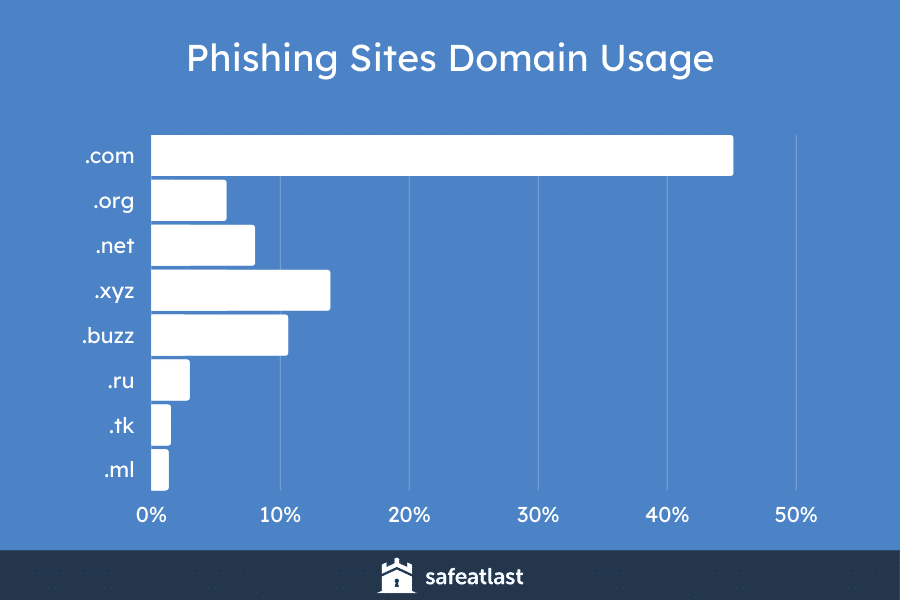
    During the third quarter of 2020, 40.09% of phishing websites were hosted on .com domains, making them even more difficult to distinguish from genuine sites. Statistics on phishing attacks reveal that hackers also used other seemingly legit domains, such as .org (1.79%) and .net (3%). However, many opted for phishy-looking domains like .xyz (5.84%) and .buzz (2.57%).

    Interestingly, the top 10 includes three top-level domains: .ru (Russian national domain) in 2.93% of cases, .tk (the domain of Tokelau, a territory of New Zealand) in 1.47% of cases, and .ml (Mali’s national domain) in 1.3% of cases.

    Phishing Sites Domain Usage for 2021

    8. Since 2011, the number of mobile phishing attacks has been growing by 85% each year. 

    (Lookout)

    According to mobile phishing statistics, the number of attacks has been growing since 2011 at a steady annual rate of 85%. In the first quarter of 2020 alone, mobile phishing attacks have gone up by 37%. Mobile devices are mostly targeted for all the personal and corporate data they carry. Research shows that mobile users are three times more likely to fall for phishing scams.

    9. There were more than 611,000 phishing sites in the first quarter of 2021.

    (Statista)

    The latest phishing statistics show that a total of 611,877 unique phishing sites were discovered in the first quarter of 2021. Encouragingly, this number marks a 5% decrease compared to the last quarter of 2020. Unfortunately, it’s also about four times more than what we saw in early 2020. That tells us that this downward trend will not last long and that the numbers will rise again.

    Interesting Phishing Stats

    10. Spam messages accounted for 28.5% of global email traffic in 2019.

    (Statista)

    Minor interruptions aside, the share of email spam in total email traffic has been steadily declining since 2008. That year, 92.6% of all email messages exchanged worldwide were spam. In the 11 years since then, the share of spam emails has gone down by more than two-thirds, according to internet spam statistics. The number from 2019 also represents a significant decline from 2018, when email spam volume was 45.3%.

    11. More than 50% of ransomware is distributed through phishing emails.

    (Statista), (Proofpoint)

    Phishing emails are still the preferred way for criminals to conduct ransomware attacks. Cybercriminals can buy, rent or lease ransomware instead of creating their own. That gives them more time to invest in new phishing techniques and baits. Ransomware statistics show six major organizations with as many as 350,000 emails sent daily in June 2020. 

    12. Gmail blocks over 100 million phishing emails daily.

    (Google Security Blog)

    Google phishing statistics reveal that Gmail’s built-in filters block more than 100 million phishing emails daily. In 68% of the cases, blocked emails are part of a previously unknown phishing scam. Google notes that the attacks are usually targeted at a few dozen organizations with corporate accounts on Gmail. This again shows that hackers have reduced the volume of attacks to focus on those most likely to fall for their scam.

    13. Phishing scam statistics show that about two-thirds of internet users can’t identify phishing websites and emails.

    (Avast)

    Avast’s survey showed that 61% of participants couldn’t distinguish between a genuine and fake Amazon login page. It could be that users are relying too much on their antivirus programs and don’t pay attention. 

    In just one month, the company has blocked almost 3 million phishing attempts targeting more than 590,000 US users. 

    14. Google and Facebook lost $100 million as a result of phishing attacks.

    (Fortune)

    Even tech giants like Facebook and Google aren’t immune to these attacks. Cybercrime statistics show that these two companies lost over $100 million in one of the biggest phishing attacks to date. A hacker pretended to be a computer parts supplier and was regularly sending invoices. The companies were clearing them without suspecting anything.

    What makes this case interesting is that the criminal was caught. Unfortunately, that happens very rarely in cybercrime. The criminal was arrested in Lithuania and extradited to the US. He is now serving a sentence in US federal prison.

    15. “Urgent” is the most common word in phishing emails targeted at businesses.

    (PhishingBox)

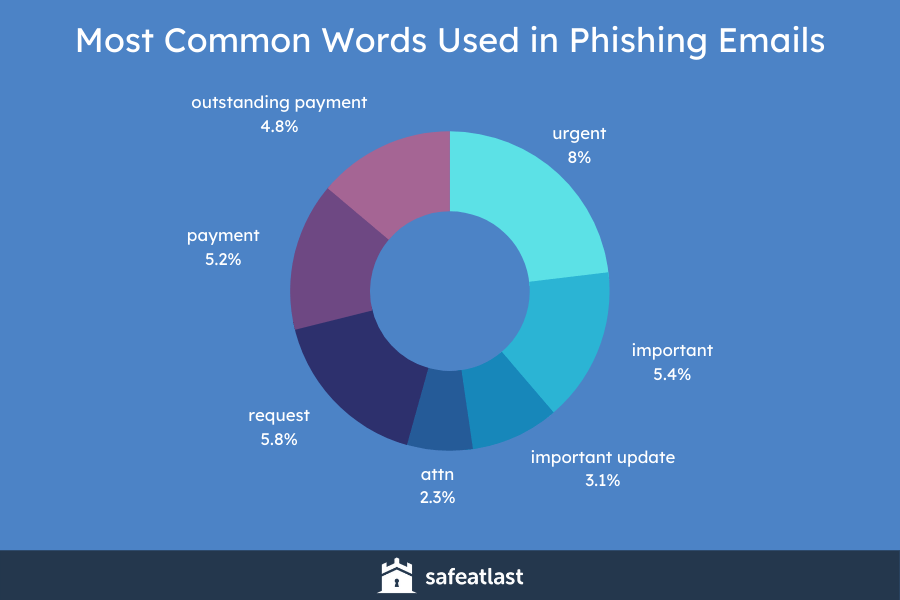
    This word appears in 8% of all phishing emails sent to organizations in an attempt to scam them. According to phishing attacks statistics, variations of this word are also used, including “important” (5.4%), “important update” (3.1%), and “attn” (short for attention; 2.3%). Other keywords commonly found in phishing emails targeted at organizations included “request” (5.8%), as well as “payment” and “outstanding payment” (5.2% and 4.8%, respectively).

    Statistics also reveal that hackers targeted 5,803 organizations with emails containing these words in 2018. Each of these organizations received 4.5 such emails on average.

    Phishing Statistics - Phishing Email

    Data Phishing vs. Spear Phishing Stats

    16. In 2020, there were 1,001 data breaches in the US.

    (Statista)

    According to data breach statistics, more than 1,001 data breaches occurred due to data phishing attacks, compromising 155.8 million records. Most of these attacks targeted businesses intending to steal confidential information and client data. This marked a 19.8% decrease from 1,473 breaches in 2019 when hackers stole more than 164 million records.

    17. According to internet fraud statistics, 65% of hackers use spear phishing.

    (PhishingBox)

    While data phishing targets multiple recipients as part of an extensive campaign, spear phishing is aimed at a single organization or individual. It generally requires a lot more effort than mass low-quality phishing attacks. That’s mainly because the hackers need to find details that would make them look credible. But, in turn, these attacks bring more profit.

    18. 83% of spear phishing attacks are brand impersonations.

    (Channel Futures), (Statista)

    Spear phishing statistics reveal that brand impersonation is by far the most popular way to carry out these attacks. It involves hackers posing as a trustworthy brand or company in an attempt to gain access to valuable information from their targets. In 2019, Microsoft was the most impersonated brand. Financial institutions like banks were also often impersonated.

    Google and Amazon were the two most impersonated brands in 2020 (13% each). Social media platforms Facebook and WhatsApp are in second place (9%), followed by Microsoft (7%). Online fraud statistics show that other commonly impersonated brands include Apple, Netflix, PayPal, and Huawei (2% each).

    19. 96% of hackers use spear phishing to gather intelligence.

    (PhishingBox)

    Apart from intelligence gathering, hacker groups cite disruption (10%) and financial gain (6%) as their main motivators for launching a spear phishing attack. The number of known spear phishing groups has had a steady rise over the last few years. In 2016, there were 116 known groups. Phishing email statistics show that the following year, this number rose by 18.1% to 137. There were 155 active groups in 2018, marking a 13.1% increase year-over-year.

    20. The losses from business email compromise schemes skyrocketed to $1.8 billion in 2020.

    (FBI)

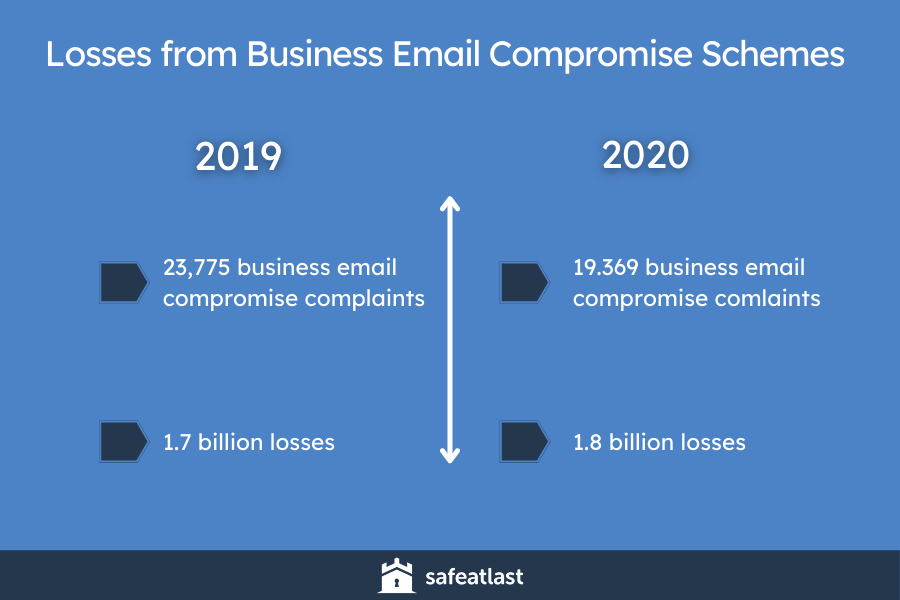
    In its annual report, the FBI states that it received 19,369 business email compromise complaints. The losses reported were $1.8 billion. However, if we compare that to 2019 data (23,775 complaints and $1.7 billion in losses), we can see that the number of complaints dropped, but the losses increased. These business email compromise statistics indicate that hackers are shifting their focus from mass phishing attacks to more precise and sophisticated attacks that bring in a larger bounty.

    Phishing Statistics - Schemes

    Conclusion

    Phishing attacks have become much more sophisticated. If we combine that with the fact that most can’t tell the difference between fake and genuine websites and emails, it’s easy to see why no one should take these statistics on hacking and phishing for granted.

    Whether you’re an executive at a big company or just a regular internet user, you must be careful online. Don’t click on any suspicious links sent from an unknown email address.

    If you receive an unusual email from someone claiming to be your coworker, always check with them first before opening any attachments.

    When visiting websites, double-check the address bar before entering your personal information to ensure it’s not hackers trying to scam you.

    People Also Ask

    How big of a problem is phishing?

    According to a Kaspersky Lab report, there were more than 103 million attempted phishing attacks worldwide in the third quarter of 2020. In the second quarter of the year, hackers also set up more than 140,000 phishing websites.
    While both these numbers are lower than in recent years, today’s phishing emails and sites are much more difficult to tell apart from their genuine counterparts.
    Hackers nowadays use SSL certificates, HTTPS address prefixes, .com domains, and compromised Google and Microsoft email accounts, all this to ensure the potential victim falls for their scheme.

    How many phishing attacks occurred in 2020?

    According to the FBI’s statistics, there were 241,342 phishing attacks in 2020, which generated losses higher than $54 million. Its statistics also show that the number is on the rise. For instance, there were more than 114,000 phishing attacks in 2019 and more than 26,000 in 2018.
    What’s worrying is that the quality is also improving. Hackers are switching from mass low-quality campaigns to targeted, sophisticated attacks.

    What will phishing cost in 2021?

    In its study, the Ponemon Institute concluded that the average annual cost of a phishing attack in 2021 is around $14.8 million for a company with 9,600 employees. The amount has almost quadrupled since 2015 when it was around $3.8 million.
    In addition, the attacks are becoming more sophisticated and target higher-ranking executives, which, in turn, brings better profits.

    How many phishing attacks are attempted everyday?

    Valimail, a cybersecurity company, estimates that there are about 3 billion spoofed emails sent every day. This is 1% of all emails sent each day globally. Spoofing allows phishing and spam emails to appear as if they are coming from legitimate sources.
    Furthermore, Google’s data shows that Gmail blocks more than 100 million phishing emails every day. Considering that it has 1.5 billion users, we can conclude that roughly 7% of users are targeted by cybercriminals.

    How many businesses are targeted by spear phishing attacks each day?

    Spear phishing is on the rise, both in quantity and in quality. According to one study, 75% of organizations experienced phishing attempts, and 35% experienced spear phishing in 2020.
    96% of phishing attacks arrive by email, and Symantec research says that one in 4,200 emails is, in fact, a phishing email.
    The most common subject lines were: Urgent, Request, Important, Payment, and Attention.

    How many victims of phishing are there?

    According to the FBI, there were 241,342 victims of phishing attacks in 2020, more than a 100% increase compared to 2019. The statistics look even grimmer when compared to 2018 when there were just 26,000 victims.
    These are official statistics based on the reported phishing attacks. The real numbers are likely higher because victims sometimes become aware of the attack months after it happened.
    We can assume that the numbers we see in phishing statistics will continue to rise since cybercrime is a lucrative business.

  • 20+ Essential Housing Statistics

    20+ Essential Housing Statistics

    If you are considering renting a new place or investing in a property — we can help. The housing statistics we compiled have all the information on the market you need before making up your mind.

    Besides all the uncertainty the pandemic brought into our lives, it also gave us some new perspectives on life. As people began spending more time in their houses, working, or simply socially distancing, many of them found the motivation to start looking for their dream home.

    So, if you are one of them, this article will provide you with valuable insight into the housing market.

    Advantageous Housing Trends (Editor’s Picks)

    • The homeownership rate in 2020 was over 65%
    • There is a 9% increase in new listings compared to the previous year
    • In 2021, houses sell 32 days faster than before
    • The average search for a new home takes around eight weeks
    • Real estate agents are responsible for 88% of the house sales
    • Current housing market trends show that the average monthly rent is $1124
    • Millennials/ Gen Y make up 38% of all homebuyers in the US
    • Only 6% of graduate students live on-campus

    Basic Housing Market Data & Trends

    This section will provide you with info that you’re probably curious about — what percentage of people own a home, if house prices are rising or declining, and how many new listings there are, compared to previous years. 

    You’ll also find much-needed housing data about the process of selling or buying — such as the average time a house spends on the market or how long a house search lasts.

    1. The homeownership rate in 2020 was 65.8%.

    (Statista)

    Data for 2020 shows an increase in the homeownership rate by 0.7%. The highest rate ever recorded was in 2004 — right before the recession —over 69%.

    2. Home prices rose higher than rents in 83% of the US counties by the end of 2020.

    (Kiplinger)

    In most states, the rate of home prices increased more than the wages. Nonetheless, housing market stats reveal that in 63% of the counties, people still believe it’s a better investment to buy a house than to rent.

    3. New listings in 2021 are up by 9%.

    (Norada)

    Besides more buyers, the increased number of sellers is another housing trend of 2021. With spring being among the most popular times to put a house on the market, the number might get even higher.

    4. Houses are spending 32 days less on the market in 2021.

    (Norada)

    According to experts, people want to make the most out of the low mortgage rates before the market bounces back, so the sales happen faster and more often.

    5. The typical house search takes around eight weeks.

    (NAR)

    According to the NAR national housing statistics, buyers consider approximately nine places before they find the one that’s perfect for them. Generally, five out of those nine houses are looked at only online. 

    6. 15% of home sellers in the US relocate to be closer to their families.

    (NAR)

    The most common reason for selling a house is to be closer to family and friends. Real estate trends show that 12% of the sales are due to a change in the family situation. In addition, 14% of the people want a new house because of the small size of their current one. The safety of the neighborhood is also a common concern. 

    7. 1.3 million housing units currently belong to public housing.

    (Office for Policy Development and Research)

    Around 48% of the public housing are either small studios or one-bedroom apartments, and nearly 25% — two-bedroom homes, while 28% — have three or more bedrooms.

    Home Sales Data by Zip Code

    Have you ever wondered how different the housing prices are in various parts of the country? We have gathered some interesting stats on the most expensive and cheapest states to buy a house in. 

    Let’s take a look at the most surprising affordability indexes in the country.

    8. West Virginia is the cheapest place to buy a house, with a median price of $113,000.

    (Roofstock)

    Besides West Virginia, the cheapest houses in the US are in Mississippi, Oklahoma, and Arkansas — with a median value of around $140,000 and less.

    9. New York City has the worst affordability index in the US.

    (Kiplinger)

    The affordability index is calculated by comparing the average annual income in a city with the median home prices. Real estate statistics by city reveal that the most affordable place is Augusta, Georgia.

    10. One of the most expensive houses in the US costs $135,000,000.

    (Christie’s)

    The house is located in Woodside, CA, and is part of a 74-acre property, perfectly preserved since it was built in 1911. The property has 32 bedrooms, a tennis court, pools, and hiking trails, among the long list of amenities.

    Housing Trends About Real Estate Agents

    Undoubtedly, real estate agents are a vital part of any housing transaction. So, this section will reveal the popularity of real estate agents and websites, and the unexpected means of communication the agents use to reach clients. 

    11. 88% of the people buy a house through a real estate agent.

    (NAR)

    Housing market statistics 2021 show that the majority of home buyers use the help of a real estate agent. Surprisingly, around 73% of the buyers hired the first agent they contacted, and 91% say they would work with the same agent again. 

    12. 90% of real estate agents communicate with their clients via texts.

    (NAR)

    Real estate statistics reveal that many agents have adapted to the new communication ways. Emails are even more popular than texts — 94% of agents use this way of reaching out to the clients — and 34% use instant messaging. 

    13. The real estate website Zillow has 36 million visitors every month.

    (Statista)

    According to real estate stats, websites are the most accessible information source for house buyers. Besides Zillow, another popular site is Trulia, with around 23 million unique monthly visitors. The third most popular option is Yahoo! Homes, with an average of 20 million people browsing through the offers.

    Housing Statistics on Rents

    Renting is also an enormous part of the housing market. These stats will show you more about the average monthly prices and the demographics of renters in the US.

    14. The average monthly rent in the US is $1124.

    (Statista)

    Housing price trends exhibit a constant increase in rent costs since the beginning of 2021. The price varies depending on the state, and research shows that the rent prices are much higher than the minimum wage.

    15. The average rent for a studio is around $900.

    (Statista)

    Housing market trends by zip code show that rents vary depending on the state and the city. Approximately renters spend around $960 for a one-bedroom apartment, $1200 for a three-bedroom, and $1500 for a four-bedroom apartment.

    16. 49% of renters in the US are under 30 years old.

    (Statista)

    It is not surprising that the majority of renters are under 30 years old. According to the latest housing market statistics on rents, only 9% of people over 65 years old are currently renting a place.

    Millennial Housing Trends

    Millennials make up a significant part of the homeowners. Let’s take a look into their housing choices and preferences.

    17. Millennials make up around 60% of all first-time buyers.

    (Dotloop)

    The latest research shows that millennials take on an active role when searching for a house — choosing properties to visit and tracking real estate price trends. They also prove to be pickier with their choice of real estate agents and do thorough online research before committing.

    18. Millennial/Gen Y buyers make up 38% of all homebuyers in the US.

    (Investopedia)

    NAR reports that technology plays a significant role in their home buying process — almost every millennial goes online to find information about the housing market before they begin looking for a house.

    19. 47% of Millennials prefer to live in the suburbs.

    (Investopedia)

    Housing market trends of millenials’ purchases show that nearly half the people in their 20s and 30s choose to live out of town. Research has also indicated that most of the buyers that age prefer to have a bigger house. In fact, around 45% of homeowners in their 30s pay over $300,000 for their new property.

    Student Housing Trends

    This February, 10% fewer students enrolled in college and were looking for university housing. Nonetheless, it seems the student housing problem is not nearly resolved.

    20. Around eight million students need near-campus housing every year.

    (Guide2Research)

    Housing statistics confirm that student housing is constantly in demand, and that presents a great investment opportunity. Currently, the data shows that student housing in the West and South regions of the country will be in high demand this year.

    According to the latest California real estate numbers, this comes as no surprise.

    21. 90% of students place Wi-Fi first among practical amenities.

    (Guide2Research)

    As most of them don’t have a significant income, students generally look for the cheapest houses in the US. However, the must-have functional amenities are the laundry machine for 78% of the students and a designated study area — for 45%.

    22. Only 6% of graduate students live on-campus, show housing statistics.

    (Guide2Research)

    It is safe to say that graduates are the target group for any investor looking to build near campus due to students’ transportation and access to campus resources issues. However, there is much for entrepreneurs to consider like safety regulations and affordable prices.

    Housing Trends – The Bottom Line

    Our statistics presented you with insight into today’s housing market in terms of buyer demographics, rent prices, and student housing and, hopefully, helped you get a better overview of the favorable house-buying situation.

    Are you ready to make such a change in your lives? If you do, 2021 will be a perfect time for that. Don’t forget to take a look at the housing statistics by zip code to make sure buying a house is a good investment for your area. 

    People Also Ask

    How many houses were sold in 2020?

    Approximately 5.6 million homes were sold in 2020 in the US. Experts predict a significant rise in 2021, with almost 6.5 million existing houses already being sold. In recent years, 2010 was the year with the lowest number of houses sold — 4.2 million, while in 2005, US buyers purchased over 7 million homes.

    Are housing prices declining?

    On the contrary, in March of 2021, the median house prices hit an all-time high — $370.000 — over 15% more than last year. However, experts expect that the prices will soon stop rising.

    Is 2022 a good year to buy a house?

    The COVID-19 pandemic caused high levels of unemployment, and the economy is too unpredictable for risky investments. However, mortgage rates are close to the record lows, which is something buyers should utilize, as well as the new working flexibility from home gives many people more location options.

    Is the housing market going to crash in 2022?

    Google reports an increase of 2450% in searches on whether the housing market will crash in 2022. Home sales data shows that the situation is very different from the 2008 crisis and is more likely to stabilize instead of crash.

    What percentage of homes are over $1 million?

    Around 3.6% of the total number of homes in the US is worth more than $1 million — adding up to over 3 million houses. It comes as no surprise that a large number of these homes are in cities in California, as it is the biggest state.

    Will apartment rent go down in 2022?

    Housing statistics indicate that rent prices are more likely to remain stagnant than to decrease. Experts expect that renters in the key markets, such as Atlanta, Phoenix, and Denver, might even have to spend a little extra on their rents.

  • 30+ Alarming Cyber Attack Statistics & Numbers

    30+ Alarming Cyber Attack Statistics & Numbers

    One of the scariest cyber attack statistics is that almost half of a million pieces of malware are registered every day. The chances are that one of them has your name on it.

    So, what can we do to improve our safety?

    Knowing your enemy is a good starting point and these important statistics will help you do that.

    You will see how many attacks are caused by exploiting weak spots in your system and how many rely on tricking you with more old-fashioned tactics.

    Vital Cyber Attack Stats (Editor’s Choice)

    • There are around 6 billion internet users
    • On average, there are 26 smart devices per human being on Earth
    • 20% of users have done nothing to protect themselves from cybercrime
    • In the past 12 months, almost 330 million fell victim to cybercrime across 10 countries
    • For every cybercriminal that gets caught, 10,000 or more go free
    • 85% of all cyber-espionage attacks are state-affiliated
    • On average, there were two data breaches per day in healthcare in 2021
    • Small businesses represent 58% of all data breaches

    General Cyber Attack Statistics

    1. Hackers attack our devices every 39 seconds.

    (James Clark School of Engineering)

    A recent study by the A. James Clark School of Engineering at the University of Maryland informed us of this alarming data. This is one of the first attempts at quantifying the nearly constant rate of online attacks.

    2. On average, each computer is attacked 2,244 times a day.

    (James Clark School of Engineering)

    This amounts to more than 819,000 annually. Luckily, even with a large number of cyber attacks per year, most of them are unsuccessful. Michel Cukier, Clark School assistant professor of mechanical engineering and his two assistants came up with this figure. They learned that most attacks involved relatively unsophisticated “dictionary scripts,” or a brute force attempt at logging in with common usernames and passwords.

    3. There are around 6 billion internet users.

    (Cybersecurity Ventures)

    This is about 75% of the total world population. With an increasing number of vulnerable individuals, the number of attacks is likely to increase as well. What’s more, by 2030, the number of internet users is estimated to grow to over 7.5 billion. This will, no doubt, have a great impact on cyber crime statistics worldwide.

    4. In 2020, there were roughly 200 billion connected devices.

    (The Washington Times)

    That’s an average of 26 smart devices per human being on Earth. The more interconnected we are, the more vulnerable we become to attacks, perhaps in areas we haven’t even thought of yet. 

    5. At 36%, the United States ranked first in hosting botnet control servers.

    (McAfee)

    Botnet network is a group of devices owned by regular people utterly unaware that the hackers installed stealthy malware on their devices. They then control a specific part of the device and use it as they wish while keeping it under the owner’s radar. The cyber attack statistics by country show that more than a third of global botnet servers are in the US, which is significantly higher than Germany with 14%, and Russia and The Netherlands with 5% each.

    6. Only 18% of the cybersecurity laws brought forward in the US were passed, the 2019 report shows.

    (National Conference of State Legislatures)

    Despite severe losses due to cyber attacks, only 52 cybersecurity laws were enacted in 2018 out of 265 introduced. This lack of cybersecurity awareness will cause more trouble in the future, and it certainly helps keep the cybercrime business alive.

    7. According to the Russian government cyber attack statistics, the authorities stopped around 25 million cyber attacks during 2018’s FIFA World Cup.

    (Infosecurity)

    The Russian government apparently saw this coming, and it strengthened the country’s cybersecurity services before the World Cup. This confirms that being over-prepared sometimes works when countering potential threats.

    8. A data leak in the Oklahoma government exposed seven years’ worth of FBI investigations.

    (Forbes)

    These recent attacks are an excellent example of why every company and organization should invest more in protecting archived data. According to US government cyber attack statistics, the oldest stolen data in this breach originated from 1986, and the most recent had been modified in 2016.

    (Europol)

    Money muling refers to the transfer of illegally obtained funds between accounts on behalf of others. Most often, the stolen money often comes from phishing, where an attacker sends emails while masquerading as a legitimate business. The second most common source is e-commerce fraud, where a cybercriminal uses stolen online bank or credit card information.

    10. For every cybercriminal that gets caught, 10,000 or more go free.

    (CSO)

    One of the most disturbing facts about cyber attacks is that criminals rarely get caught. If they live in countries with weak or non-existent cybercrime laws like Algeria, cybercriminals can enjoy a passive income and know that they won’t be punished.

    Even if a criminal is somehow prosecuted in a court of law, for every person that’s caught, 100 get off scot-free or with a warning. The efforts to battle cybercrime must be global. As long as there is a safe haven for cybercriminals anywhere in the world, they will continue to operate.

    Cyber Attacks Statistics 2021

    11. 20% of users have done nothing to protect themselves from cybercrime.

    (Norton)

    Whether they’re not aware or they simply can’t be bothered, some percentage of internet users still do not take any steps to protect themselves from cybercrime. At the same time, about half of the internet users believe that it is very likely that a hacker attack on their computer (56%) or a smartphone (49%) is just a matter of time.

    In general, there is a feeling that people don’t take the facts about the rise in cyber attacks in past years too seriously. For instance, 31% of Americans admit that they’ve become addicted to being online and 63% of them use personal information for passwords.

    12. Over 12 months, almost 330 million fell victim to cybercrime across 10 countries. 

    (Norton)

    If you think you’re not at risk, Norton’s 2021 cyber attack research will make you think twice. In the United States alone, nearly 108 million adults were victims of cybercrime. However, the highest rate is 120 million individuals in India.

    13. 533 million Facebook users’ account information and personal data have been leaked in April 2021.

    (Business Insider)

    The stolen data was posted on one hacking forum, and corporate cyber attack statistics show that it included full names, emails, addresses, and other sensitive information of 533 million Facebook users. However, the company officials claim that the data is not new and that the data was scraped before 2019 when the new patch solved security issues that enabled hackers to get the info. 

    14. McAfee counted 668 threats/minute on average in 2021.

    (McAfee)

    McAfee’s statistics show that there is a 3% increase in attacks on its clients in the first quarter of 2021. The company’s cyber attack statistics in the US by industry show that the most significant increases are reported in technology (54%), education (46%), and finance/insurance sectors (41%).

    Some sectors were much safer, as they recorded a drop in cyber attacks. For instance, wholesale and retail had a 76% drop, while public administration recorded a 39% decline.

    15. Over 2.3 million new malware threats for Android were discovered during Q1 of 2021.

    (McAfee)

    As scary as that number seems, it’s dwarfed by the overall number of threats detected —over 100 million. Our devices are susceptible to so many threats. Some of them are computer viruses, Trojans, worms, logic bombs, spyware, crypto-mining malware. The scary part is that cyber attacks trends analysis show that there are millions more in development.

    16. 65% of cybersecurity professionals say that their company experienced spear phishing in 2021.

    (Cybersecurity Insiders)

    This kind of phishing method is a sort of high-effort cybercrime compared to malware or ransomware. The attacker needs to research their victim to fool them with a fake email that looks like the real deal.

    51% of cybersecurity pros say that, according to their statistics, attacks have increased in the last 12 months. The researchers’ statistics of big business and cyber attack correlation show that 39% of large companies now experience spear-phishing attempts on a weekly basis.

    17. Microsoft’s Azure reported a 25% increase in DDoS attacks in 2021.

    (Microsoft)

    The average daily number of attacks was 1392, which is a significant increase compared to 2020 results. These attacks are typically short, with 74% being under 30 minutes and 87% being one hour or less. The company’s statistics show that only 2% lasted more than 10 hours.

    These attacks are increasingly used as smokescreens for ransomware attacks, data theft, IP theft, and an overall desire to deplete a company’s resources.

    Business Cyber Security Facts 2020

    18. Small businesses represent around 58% of all data breaches.

    (Verizon), (CNBC)

    According to the latest data, small businesses are the number one mark for hackers. What’s disturbing is that their owners are surprisingly very confident about their ability to handle cyber attacks (59%), even though only 28% of them have plans of action in case they happen.

    The average loss per attack is around $188,000. One of the reasons for such small business cyber attack statistics is that the majority of these companies have minimal visibility into their employees’ password practices. It also doesn’t help that some of them can’t afford to have dedicated IT personnel.

    However, there’s always a solution that allows small businesses to invest in a dedicated password manager to safeguard the personnel’s data.

    19. 73% of internet security professionals believe that the number of attacks through emails is increasing.

    (Computer Weekly)

    Additionally, 80% of organizations have faced some form of this type of attack in the past year. The increase in attacks that target human beings as weak links instead of the devices they use is due to the strategy’s undeniable success.

    Cyber attack statistics by year show that just a small portion of malware is run via a hacker attack that exploits a technical flaw in a system. Social engineering is more resistant to anti-virus and anti-malware software. It is not dependent neither on a specific operating system or any other particular type of device.

    20. 85% of all cyber-espionage attacks are state-affiliated.

    (Verizon)

    The second place goes to nation-state cyber-espionage (8%). Other attacks come from organized crime (4%) and former employees (2%).

    Surprisingly, in this age of fierce competition in every sector, where you would expect companies to go above and beyond to find out their competitors’ secrets, market rivals are responsible for only 1% of espionage cyber attacks. That’s two times less than angry former employees.

    Cyber Attack Cost Statistics

    21. The annual revenue for stolen trade secrets and IP theft is $500 billion.

    (Bromium)

    This comes from two sources, namely, economic espionage revenue ($200 billion), and the cost of pirated music and films for the US ($300 billion). As we can see from the data breach that hit Sony, Netflix, and HBO, an attack can cost a company, not only their confidential data and future viewership but also their jobs and reputations.

    22. Energy utilities will spend $3.2 billion by 2026 for protecting their systems from cyber attacks.

    (Smart Energy),( Forbes)

    The first successful critical infrastructure cyber attack recorded in the statistics happened in Ukraine in 2015. This suspected state-sponsored attack on the electric grid left 230,000 people in the dark for hours on end. This only fueled fear in other countries.

    Digitalization and the internet of things have certainly increased the connectivity of the developed world’s infrastructure.

    23. Cybercrime could cost companies up to $5.2 trillion over the next three years.

    (Accenture)

    The companies’ hesitancy to put up defenses against cybercrime could cost them dearly. The economic cost is probably one of the most obtrusive results of having an insecure network with insecure smart devices.

    The financial network cyber attack statistics show that the companies are facing a $5.2 trillion projected loss due to cybercrime. This is 2.8% of revenue loss over the next three years. Industries relying heavily on technology face the most risk at over $753 billion.

    24. Only 38% of global organizations are adequately prepared to handle a sophisticated cyber attack.

    (Fraud Watch International), (Microsoft)

    Although 54% of organizations worldwide have experienced one or more significant cyber attacks in the past year, there is still a lower percentage of prepared organizations. A Frost & Sullivan study commissioned by Microsoft revealed in their cybercrime statistics that Asia Pacific companies can lose as much as $1.745 trillion to cybercrime.

    25. According to the cyber attack statistics, the annual revenue for hire-a-hacker services reached $1.6 billion.

    (Bromium)

    Additionally, the yearly revenue for DDoS attack/botnet for hire is $13 million, and malware-for-hire is around $11 million. Over the years, cybercrime has become a complex, regulated online criminal industry. One can now purchase several zombified computers and malware tools within seconds.

    You don’t even have to be actively engaged in cybercrime to make money on it now. Thanks to the IoT growth, criminal activities committed from one’s own bedroom can easily go unpunished, especially if the criminal is located in a country with little to no cybercrime-related laws.

    26. 82% believe that new cyber attacks will bring an increased risk of money and data theft.

    (World Economic Forum)

    Another 80% also expect an increase in operation disruptions, cyber attack stats show. Results like these can hardly be called surprising if you consider the ways connected devices are becoming more and more integrated into our everyday lives.

    As many as two-thirds of respondents believe the number of fake news and identity theft cases will increase in the coming years. These views show distrust among the public of their personal safety, not to mention their government’s honesty.

    Find out how to deter identity theft.

    27. The total number of coin miner malware files grew by 117% in Q1 of 2021.

    (McAfee)

    The coin mining malware is considered the only cyber attack that can damage your hardware as well as your software. This attack can tax CPUs, shorten a device’s lifespan, run down your batteries, and even cause physical damage.

    28. On average, there were two data breaches per day in healthcare in 2021.

    (HIPAA)

    In its 2021 journal, HIPAA reported that hackers attacked the healthcare system 706 times in the period from mid-2020 to mid-2021. One of the most worrying cyber attacks facts is that they have resulted in 44,369,781 individuals having their personal information exposed or compromised.

    29. The world is turning into an enormous cyberwarfare battlefield, with more than 500 documented geopolitical cyber attacks since 2009.

    (Global Times), (PrivacyAffairs)

    Out of 500 documented large-scale attacks, 79 originated from Russia, 79 from China, and 31 from Iran. The reports state that the US is responsible for just 12 national-level attacks. Still, the Chinese cyber attack statistics tell a different story. A security company has discovered more than 2700 advanced attacks against China in the past few years.

    30. More than 90% of the global airline industry was affected in a single 2021 data breach.

    (Guardian)

    The data breach statistics show that airline companies are one of the most endangered. One of the largest airline company data breaches in 2021 was when a sophisticated attack was conducted against SITA. This IT systems operator serves around 90% of the global aviation industry.

    According to the sources, hundreds of thousands of airline passengers around the world had their data exposed.

    However, the company claims that the data is limited to just names, membership, and tier status. When it comes to the company’s financial sector, the cyber attack statistics show that the hackers couldn’t get information such as credit card numbers, emails, passwords.

    31. On average, there are more than 450,000 new malicious programs registered every day.

    (AV-TEST)

    The AV-TEST Institute from Germany, one of the authorities on cybercrime, has registered around 1.26 billion malicious and potentially unwanted programs by September of 2021.

    Furthermore, the experts from the institute have also detected approximately 123 million new malicious programs in the first eight months of 2021.

    With such a high number of threats, it’s paramount that we all improve our safety. But, just knowing how many cyber attacks per day were there in 2020 and 2021 isn’t enough. We must improve our safety by taking the necessary precautions and getting specialized software and support.

    32. MacOS malware boomed in Q3 of 2020 by 420%, but it came down to normal levels in 2021.

    (McAfee) (Help Net Security)

    The 2021 data show a 70% drop in EvilQuest infections, the main contributor to the increase we saw in 2020. The malware statistics show that it was first spotted in June that year, and has infected many computers, encrypting data and requesting a ransom.

    Conclusion

    Cybercrime is on the rise and is becoming more targeted and sophisticated. This means that we should be more careful too.

    It’s a good idea to update your OS regularly, train your employees on the potential dangers of social engineering, and avoid downloading unfamiliar apps from unknown sources if you want to lower the risk of a cyber attack.

    People Also Ask

    What was the first cyber attack?

    The first-ever cybercrime happened In 1979 when a 16-year-old Kevin Mitnick hacked into Ark. it was the computer at the Digital Equipment Corporation. In 1986, German hacker Marcus Hess hacked ARPANET. Thought that he gained access to 400 military computers, some of them in the Pentagon. He intended to sell the data to the KGB.
    As a result, 1987 was the birth year of commercial antiviruses, when NOD Antivirus and McAfee were created. The first DDoS was recorded in 1988, and the first ransomware attack happened in 1989. The culprits were Robert Morris and Joseph Popp, respectively.

    How many cyber attacks happen per day?

    Research conducted by the A. James Clark School of Engineering at the University of Maryland showed that our computers are attacked 2244 times a day, once every 39 seconds. Luckily, the vast majority of them are unsuccessful.
    Most attacks involve relatively simple “dictionary scripts” or a brute force attempt at logging in with popular usernames and passwords. The trends, however, show that the attacks are becoming more sophisticated.

    How many cyber attacks happened in 2020?

    It’s impossible to count the overall number of cyberattacks in 2020 because every digital device is under attack every 39 seconds.
    However, the number of data breaches is one of the ways we can measure current safety conditions. There were 3,932 breaches in 2020, and the total number of records compromised exceeded 37 billion. As data breaches usually take months to be discovered, there is no doubt that the number will be even higher.

    How many cyber attacks occur each year?

    Sophos Security estimates that more than 30,000 company websites are hacked every day, which comes to roughly 11 million per year.
    If we consider that private users are not included in these statistics and that hackers need just one day to place 300,000 pieces of malware into circulation, we can assume that the total number of cyberattacks per year is much greater.

    What is the most dangerous cyber attack?

    The most dangerous (and most common at the same time) are phishing and malware attacks. They are followed by DDoS and brute force attacks.
    Keeping safe from these attacks is very important, as 60% of small companies go out of business within six months of a successful cyber-attack.
    The basic precautions are keeping your passwords hard to guess, changing them often, being careful with your correspondence, and having good antivirus software that covers different kinds of attacks.

    Where do cyber attacks come from?

    The most significant sources of cyberattacks are China and Russia – almost 35% of global attacks originate from these two countries. North Korea and Iran share 16% of global attacks, and the USA is in fifth place, with 3%. There were 108 documented global cyber attacks.
    Of course, we should keep in mind that, due to secrecy, the general public doesn’t hear about all of the attacks. Therefore, we can assume that the numbers are higher.

    Which country has the most cyber attacks?

    With 80% of internet users that have experienced cybercrime at least once, India takes first place on the list. It is followed by the United States with 61% and France with 60% of internet users. Japan and Germany are at the bottom of the list, with 42% and 47% respectively. To put things in perspective, the global average is 56%.
    The latest cyber attack statistics also show that the most common types of cybercrime internet users experienced are malicious software or unauthorized access to social media accounts and emails.