Author: Darko Jacimovic

  • Smart Home Guide – All You Need to Know About Your Home in 2024

    Smart Home Guide – All You Need to Know About Your Home in 2024

    A smart home is a house that contains devices that are able to communicate with each other and automate your daily activities. Our comprehensive smart home guide will show you precisely what you should be focusing on when setting up your house with smart devices and features.

    These smart devices may range from appliances and lights to televisions and security cameras. Technically, if you own at least one device that is connected to your network and can be controlled through it, you are a smart-home owner.

    Today you can control smart tech in your home from anywhere in the world simply by using your mobile device.

    These smart home devices serve to simplify your daily life, save you time on miscellaneous tasks, and even save you money in some cases. Not only do they make your daily tasks a breeze, but they also make your home a safer place.

    There are cameras, locks, and motion sensors you can install to secure your home. All of these things can also increase the overall value of your property. More and more buyers are looking to purchase homes with pre-installed smart devices.

    What Are the Benefits of Smart Homes?

    There are quite a few benefits to home automation, which we can categorize in the following groups:

    Money

    Devices like thermostats, light bulbs, and sprinklers can save energy and, therefore, money. Some home security devices can monitor energy usage, like water and electricity, which gives you a better overview of where you might be wasting energy.

    Security

    You could say that most devices fall under this category. Many people want to make their home a safer place, which is why they might opt for something like motion-triggered smart lights in order to trick burglars into thinking someone is home while they’re really on vacation.

    The best smart home security cameras are also a great way to see what’s going on in someone’s home from any location.

    Convenience and Comfort

    A lot of devices work together. You can, for example, program your door lock to switch on the lights when you unlock the door to enter the house.

    It’s also convenient when someone is at the door. You can check who it is with your doorbell cam and let them in using a mobile app. You can also record shows with smart televisions, play music on command, dim your lights, and so on.

    Control

    This is a useful one. People choose smart homes automation in order to have complete control over their homes at any time and from any location.

    Is a Smart Home Worth It?

    In most cases, it is. In order to properly assess whether it’s worth it for you, you need to think of how much you will be saving on expenses and time.

    Here are some examples of why we think it’s worth it:

    Save Money

    You can save on utility bills and water expenses by using smart devices like smart thermostats, lights, and sprinklers. In the long run, these devices practically pay for themselves.

    Increase Safety

    You can monitor in-house activities remotely and receive notifications on your mobile device. You can get notifications when a pet cat escapes or when your children come home from school. Burglars also tend to avoid well-secured homes.

    Stay Comfortable

    You can turn your home into a palace of comfort after a long and stressful day at work. Smart home systems allow you to manage your TV, answer and open the door, dim the lights, send emails, answer calls, and more, all from the comfort of your couch. 

    In addition, smart home hubs can help you with reminders, create grocery lists, and so on. And you can be sure when you leave the house that all appliances are switched off, so there’s no need for any double-checking or finger-crossing that everything will be the way you left it when you get back.

    Best Smart Home Devices – Which Ones Are the Most Commonly Controlled in a Smart Home?

    The four main categories of most-used devices are lighting, entertainment, climate, and safety.

    Smart Lights

    Smart light bulbs are the easiest to install and use. They have features like timers, motion-sensing abilities, and schedules. For example, you can set the lights to turn on when you come home from work and have them automatically switch off after midnight.

    The lights with motion sensor abilities can switch on when they detect someone coming into a room and switch off when they exit. Using a smart light switch, you can also set the lights to function based on the activation of another device. Like, for example, when you open the garage door, your house lights will switch on.

    Here’s a selection of the top-selling & best-rated smart lights on Amazon.

    Smart WiFi Light Bulb, LED RGBCW Color Changing, Works with Alexa and Google Home Assistant, No Hub Required, A19 E26 Multicolor LUMIMAN 2 Pack
    Govee Smart LED Strip Lights, 16.4ft WiFi LED Lights Work with Alexa and Google Assistant, RGB Color Changing, 16 Million Colors with App Control and Music Sync for Home, Kitchen, TV, Party
    Philips Hue White and Color Ambiance A19 LED Smart Bulb, Bluetooth & Zigbee compatible (Hue Hub Optional), Works with Alexa & Google Assistant – A Certified for Humans Device

    Smart Thermostat

    These are also pretty common. They are relatively simple to install, though slightly more complex than light bulbs. They are also able to adapt to your climate preference and schedule, which is why you can look forward to a flawless home climate.

    Here’s a selection of the top-selling & best-rated smart thermostats on Amazon.

    Emerson Sensi Wi-Fi Smart Thermostat for Smart Home, DIY, Works With Alexa, Energy Star Certified, ST55
    Google Nest Learning Thermostat - Programmable Smart Thermostat for Home - 3rd Generation Nest Thermostat - Works with Alexa - Stainless Steel
    Honeywell Home RTH9585WF1004 Wi-Fi Smart Color Thermostat, 7 Day Programmable, Touch Screen, Energy Star, Alexa Ready

    Security

    Home security systems are a rising trend in the industry as more and more people are choosing to protect their homes and families, not just from burglaries and break-ins but also from damage caused by floods, fires, and the like.

    Standard smart home products would be smart locks, security cameras, motion sensors, and flood and smoke detectors.

    Here’s a selection of the top-selling & best-rated home security systems on Amazon.

    SimpliSafe 8 Piece Wireless Home Security System - Optional 24/7 Professional Monitoring - No Contract - Compatible with Alexa and Google Assistant , White
    Ring Alarm 5-piece kit (2nd Gen) – home security system with optional 24/7 professional monitoring – Works with Alexa
    Ring Spotlight Cam Battery HD Security Camera with Built Two-Way Talk and a Siren Alarm, White, Works with Alexa

    Entertainment

    Some people only use smart tech for entertainment, like smart TVs, speakers, and projectors. These devices can be pretty expensive and even require some installation costs in case you want built-in devices or ceiling speakers.

    However, entertainment is by far the most vital aspect when setting up your smart home.

    Here’s a selection of the top-selling & best-rated home entertainment units on Amazon.

    TCL 32-inch 3-Series 720p Roku Smart TV - 32S335, 2021 Model
    Echo Dot (3rd Gen, 2018 release) - Smart speaker with Alexa - Charcoal
    Echo Show 8 (1st Gen, 2019 release) -- HD smart display with Alexa – Unlimited Cloud Photo Storage – Digital Photo Display - Charcoal

    Home Automation Guide – What Are the Basic Elements of a Home Automation System?

    The most basic system will consist of just three elements: smart hubs, smart devices, and an app that connects them all.

    However, some systems can even function with only two out of the three elements. Let’s check them out:

    Smart Hubs

    Smart hubs are the command points for all your other devices. Basically, a smart home hub connects all your devices and helps them interact with each other.

    However, it’s important to note that there are some hubs that are only compatible with devices produced by the same company.

    There are others, like the Amazon Echo, that work with a plethora of third-party devices.

    Mobile Applications

    By simply downloading the app and connecting it to your hub, you can control your smart homes gadgets remotely.

    Devices

    Here are some examples of the types of devices:

    Access and Control

    These would be cameras, locks, and motion sensors.

    Appliances

    Practically anything can be smart. Refrigerators, dishwashers, machines, and ovens, for example. There are even smart slow cookers and coffee makers.

    Climate

    These are systems that optimize your energy usage, and one of the top smart homes devices here would be the smart thermostat.

    Resources

    These are essentially the devices that monitor energy usage and help you use them rationally. Examples would be smart sprinklers to reduce water waste or smart switches to reduce energy usage.

    Entertainment

    This would be smart TVs, speakers, and even projectors.

    Health

    These are becoming more and more common by the day. An example of a healthcare device would be a smart humidifier.

    Lights

    Here you have options from light bulbs to dimmers to switches and strips.

    Let’s not leave out your router, modem, and internet. They often play a vital part in your smart ecosystem. High-speed internet can make sure your WiFi-reliant devices are running smoothly.

    Brilliant Smart Home Control (2-Switch Panel) — Alexa Built-In & Compatible with Ring, Sonos, Hue, Google Nest, Wemo, SmartThings, Apple HomeKit — In-Wall Touchscreen Control for Lights, Music, & More

    Brilliant Smart Home Control (2-Switch Panel) — Alexa Built-In & Compatible with Ring, Sonos, Hue, Google Nest, Wemo, SmartThings, Apple HomeKit — In-Wall Touchscreen Control for Lights, Music, & More

    Price: $349.00

    Smart Home Setup – Do I Have to Make My Whole House Smart?

    Not at all. You need to decide whether you want full automation or stand-alone smart gadgets. Usually, if you’re a new user, it’s better to start small and ease into it.

    It’s easy to add on to existing tech rather than take down already installed devices, as their installation may have required some serious home remodeling. Sometimes you may just want to automate one or two tasks instead of the whole house.

    Simple Setup

    For people who want to automate a few tasks or just one, it’s better to go for the thermostats, smart lights, smart locks, or maybe even a smart doorbell. These are the best options to start out with.

    If you are all about convenience, then maybe smart switches are the way to go, along with some connected appliances. These appliances can tell you when you are out of juice or turn off the lights in the yard when you forget to switch them off before leaving the house.

    Hardcore Setup

    There are people who opt for entire home automation systems. This means all smart home components that can be automated usually are. When it comes to security, comfort, and high-tech appliances, with a hardcore smart-house setup, you can have it all.

    For access to security, appliances, and comfort, you can have it all. The best part is, even if you want to “smart” your entire home, you don’t have to do it all at once. You can set a budget, start slow, and gradually build onto your existing system.

    Whether you automate only some parts of your home or the entire place, you will notice the time you save on specific miscellaneous tasks, and depending on the smart device, you might even notice a pleasant decrease in monthly energy expenses.

    How Can I Save Energy with the Best Smart Home Technology?

    Using smart devices helps protect your family and makes your home a safer place. But, it’s also important to note that smart-home technology can also save some serious money on miscellaneous expenses, all while helping the environment.

    More specifically, automation helps you save energy by helping you optimize your resource usage.

    Basically, automation helps you limit and control how you use your resources. That’s the good thing about our smart home guide — we try to showcase the positives, like having an overview of usage, so you can see exactly how much you use and when.

    There are many elements you can optimize with smart home devices:

    Climate

    This can be controlled by an intelligent thermostat. They are able to monitor how much energy you use in the house in order to warm or cool your home in the most efficient way.

    Lighting

    Smart lights are fantastic and some of the best smart home products that help you save on energy. There are options for setting timers to make sure all lights are switched off at specific times or when you are out of the house.

    You can also opt for the ones that are triggered by motion sensors. This option means that the lights turn on when they sense someone entering or leaving a room.

    Water

    This is where smart sprinklers come in handy. You can set timers to have your sprinklers turn on and off whenever you choose. This will reduce the amount of water you waste while keeping your grass and plants healthy.

    Smart Home Guide 2021 – Is a Smart Home Affordable?

    Home control systems are affordable if you opt for a simple setup. However, more complex setups with lots of tech involved can cost you a pretty penny.

    Essentially, the price depends on what you want. Do you want everything to be controlled by smart devices or just the basics? It all comes down to your preferences when choosing the best smart home hub.

    We recommend you give yourself a small starting budget and go from there. It’s easy to add on to existing tech, so don’t worry, by starting small.

    You can maybe start with smart light bulbs, thermostats, or doorbells, and then gradually move up to full control of your home if you wish.

    Can I Upgrade an Existing or Older Home with Smart Home Technology?

    No matter the age of your home, you can always install a smart system. The majority of devices have a wireless connection, so the necessities will give you good coverage and connectivity.

    There are also devices that create a mesh network, like Z-Wave and Zigbee technology. A mesh network is probably a better option for older homes that might have odd corners or thick walls, which can dampen WiFi signals.

    If you want even more home control, upgrades can always be made—there is no limit to the number of devices you can have and use.

    Best Smart Home System Installation – How Long Does It Take?

    This entirely depends on what and how many devices you are installing. It usually won’t take more than a few hours to install a device unless you are opting for a more complicated smart home system.

    For example, smart light bulbs only take a few minutes to install. Take the old ones out, screw in the new ones, connect them to the smart app, confirm the settings, and voila! You are ready to go.

    Best smart home devices like smart speakers, on the other hand, can take longer to install depending on the type and quantity. Built-in speakers and ceiling speakers take more time because they involve extra work around the house.

    Thermostats tend to also take more time to install since they require some wiring. For more complex installations, it would be best to hire a professional.

    Placement is a key factor to properly installing your smart homes technology. Take the time to look for prime spots to install your purchase, like motion sensors, speakers, and so on.

    Of course, we recommend you do the scouting before you purchase your smart tech. This way you’ll save valuable time and energy.

    We also recommend professional installation, as it goes faster, and they can provide expert advice on prime locations.

    Smart homes - increasing value of smart homes

    Best Buy Smart Home – Does a Smart System Increase Home Value?

    Yes, they do. More and more home buyers are taking the “smart” factor into account when purchasing a home. Of course, you should ask your real estate agent for an estimated selling price that includes the smart devices to make sure you are making the most of your investment.

    However, 81% of buyers claim they would rather purchase a smart home instead of looking for ways on how to make a smart home.

    There’s a high demand for automation, and it just keeps rising. The main reason is voice control.

    Studies show that 72% of people in the United States who own smart devices want voice control capabilities.

    Research suggests that there are three leading reasons people opt for voice control: hands-free capabilities, remote control, and practicality.

    People of all age groups are choosing to use smart house setup to enjoy the best home automation perks, which will improve their quality of life and save time and money.

    To be more precise, Millennials (58%), Gen X-ers (50%), and Baby Boomers (26%) are all adopting smart devices with voice control.

    As people are increasingly choosing to buy homes with pre-installed systems, it’s safe to say that automating your home can increase your home’s overall value.

    Smart Home Solutions – Can Smart Systems Be Used for Businesses?

    Yes. However, businesses require a more sophisticated automation system. Usually, businesses focus on security, climate control, and energy-saving — though they sometimes also invest in smart tech to help them discover floods or leaks beforehand, saving on damage costs.

    In the long run, smart-home systems can improve their bottom line. A lot of businesses invest in AI technology, and therefore in smart tech as well.

    It’s also common for businesses to invest in motion-sensor-triggered devices when creating a smart home, both to save on energy and for security purposes.

    Remember, the demand for smart technology and automation in businesses is increasing more and more, so hurry up and get your smart tech before prices rise to fit this demand. Don’t be fooled by the “home” in home automation — these companies want to turn a profit, and they will grab the right opportunity when it comes.

    Smart Home Basics – Is My Information Secure if I Use Smart Devices?

    Some automated devices use excellent bank-grade encryption. On the other hand, some devices can’t even change a default passcode. Essentially, your security depends on the devices you use and how.

    Due to these potential risks, people turn away from automation, concerned that someone will hack their home, compromise a lock, or spy on them. This has been a top concern and will surely continue to be one in the future.

    Here are some tips to help you choose a secure system:

    Research Before You Buy

    Read about the product, and look at reviews about searching for the best smart home security system. Manufacturers using the latest security practices are the best choice. Find out about these practices and learn their encryption standards.

    Data-Collection Practices

    Some smart devices collect more data than they should, so be sure to check that the devices solely collect the data they need in order to function in the home environment. It’s also a plus if you can find out about data storage, processing, and usage.

    Third-Party Apps

    A lot of devices for best smart homes function solely through their companion apps, but there are some that allow third-party app developers to create their own apps, which can sometimes have troublesome loopholes. We recommend you stick to the ones that don’t require involving a third party.

    Network

    Guard it with double and triple password protection, guest-access networks, firewalls, and even parental control. In some cases, owners can also set up a separate network for their smart devices—a lot of newer modems and routers have this option. Securing your network is extremely important.

    Smart Home Guide Happy Thoughts

    Smart devices and home-automation companies know about the potential security issues and are always working on them to better improve their security. Their main goal is to keep your home safe.

    They work with white-hat hackers in order to find and develop the best measures to protect their clients and provide them with the best smart systems.

    People Also Ask

    To successfully set up and create your own smart home, you have to first build a foundation with the most important devices according to your style and preferences.

    Compatibility is key, so here’s a list of items you need to prioritize before you start building your smart home:

    1. Lights
    2. Thermostats
    3. Locks
    4. Doorbells
    5. Cameras
    6. Security Systems
    7. TVs and Remotes
    8. Others (Kitchen Appliances, Outlets, Sprinkler Systems, etc.)

    Once you get down the basic devices, it’s time to look for a smart hub to rule them all. And of course, hire professional help to easily, efficiently, and methodically install all devices.

    The answer to this question is not an easy one. At the top of our list of the best systems are Amazon Echo, Google Nest Mini, and Google Nest Hub.

    However, browsing, selecting, and buying the best system is not a straightforward process.

    For these reasons, we’ve created a plethora of reviews about home security equipment that would each suit many people’s needs.

    Check out our reviews and find details about each product, its pros and cons, pricing plans, and important features.

    There are numerous awesome features of a smart home, but a few stand out massively. A simple wireless router is not enough to maintain a proper network of WiFi activity.

    You’ll need full-on, high-quality networking equipment that would integrate all devices into one automated system.

    With that in mind, here are the three vital components that every smart home needs:

    1. Automated treatment of windows and control of lighting
    2. Remote access
    3. Top-notch security

    Fully remote control of your internal and ambient outdoor lighting, alongside impeccable home security in place, are the fundamental components of every smart home. These are the crucial features you’ll find in every smart home guide.

  • Best Self-Defense Stun Gun & TASER Devices in 2024

    Best Self-Defense Stun Gun & TASER Devices in 2024

    The pandemic had us confined to our homes, and we couldn’t wait to go out, which made street muggers and other criminals very happy. Having the best stun gun on you is a great way to turn the odds. But how to choose the right one? After all, they come in different sizes, designs, and power levels. Do not be afraid, we are here to help you find the best solution for you.


    Stay with us, and we will help you find the product you can use in real-life situations. No gimmicks, no sales pitches — only the information you need to make the best decision.

    Best Stun Gun on the Market – Top 13 Devices For Self-Defense

    Each of these eleven items are effective and affordable. Continue reading to check in-depth specifics and features to find the most convenient option for you.

    1. TASER Pulse Plus
    2. Vipertek VTS-989
    3. TASER Strikelight
    4. Police Force Tactical Flashlight Baton
    5. Tactical SABRE With LED Flashlight
    6. TASER X2
    7. TASER X26p Professional Series
    8. Streetwise Sting Ring Knuckle Stun Gun
    9. Streetwise FRiPHONE
    10. Gladiator Ultra Powerful Mini
    11. Stun Master Lipstick
    12. Mace Compact

    Our Pick of the 3 Best Stun Guns

    1. TASER X26p

    Features
    • Professional-grade product quality
    • Trusted by police forces around the world
    • Causes extreme muscle contractions when used
    Price: From $1499.99

    2. Police Force Tactical 13.5″ LED Stun Gun Baton 12M

    Features
    • 12M Voltage
    • Rechargeable Li-ion batteries
    • 3 activation levels
    Price: From $89.99

    3. TASER Pulse+

    Features
    • Mobile app dispatches police as soon as the weapon is used
    • An exceptionally strong shock
    • Can subdue a target from 15 feet away
    Price: From $399.99

    TASER & Stun Gun Reviews – The Top 10 Choice

    TASER Pulse+

    Taser Pulse+

    Price from $399.99

    Pros

    • Mobile app dispatches police as soon as the weapon is used
    • An exceptionally strong shock
    • Can subdue a target from 15 feet away

    Cons

    • A steep price: $449.99

    We hold the TASER Pulse Plus model in very high regard. It’s the most appropriate TASER for self-defense, and it has a price tag to match.

    Imagine finding yourself in a dark alley with no one to hear you cry out for help. A burglar approaches and demands that you hand over your belongings. Those are the moments you’ll be glad you’ve invested in a self-defense option.

    But having a Taser stun gun close at hand doesn’t mean you’re out of the woods just yet—you could miss, or the weapon could misfire.

    Features

    With this stun gun, missing your target is not as detrimental—the Noonlight mobile app stays connected to the weapon at all times and contacts the authorities as soon as it fires.

    When the pulse taser darts hit the mark, you are free to run away and leave it behind. If you provide evidence (an official police report) that the weapon was used in self-defense, Axon’s Safe Escape product replacement guarantee allows you to take a new weapon free of charge.

    There’s another fail-safe if you miss; this taser pistol turns into a melee-range weapon after you fire. That said, the Pulse+ laser aiming system makes it difficult to miss an assailant in even the most stressful situations.

    A direct hit will send 50,000 volts of electricity at 7 watts through the target’s body. Undoubtedly, TASER Pulse packs quite a punch. It will render attackers unable to move and cause them to convulse uncontrollably for 30 seconds.

    That’s ample time to escape and wait for the police that have already been notified via the mobile app. The low-battery indicator will notify you when your weapon’s battery is almost empty. It uses CR123 batteries that can be found in most retail stores.

    It’s also a great TASER for women as its ergonomic and streamlined design makes it easy to conceal and carry, especially in small purses. An additional benefit is that it immediately sends out a distress signal, something you might forget to do in stressful situations. And even if you do remember, dialing while running is not something you could easily do.

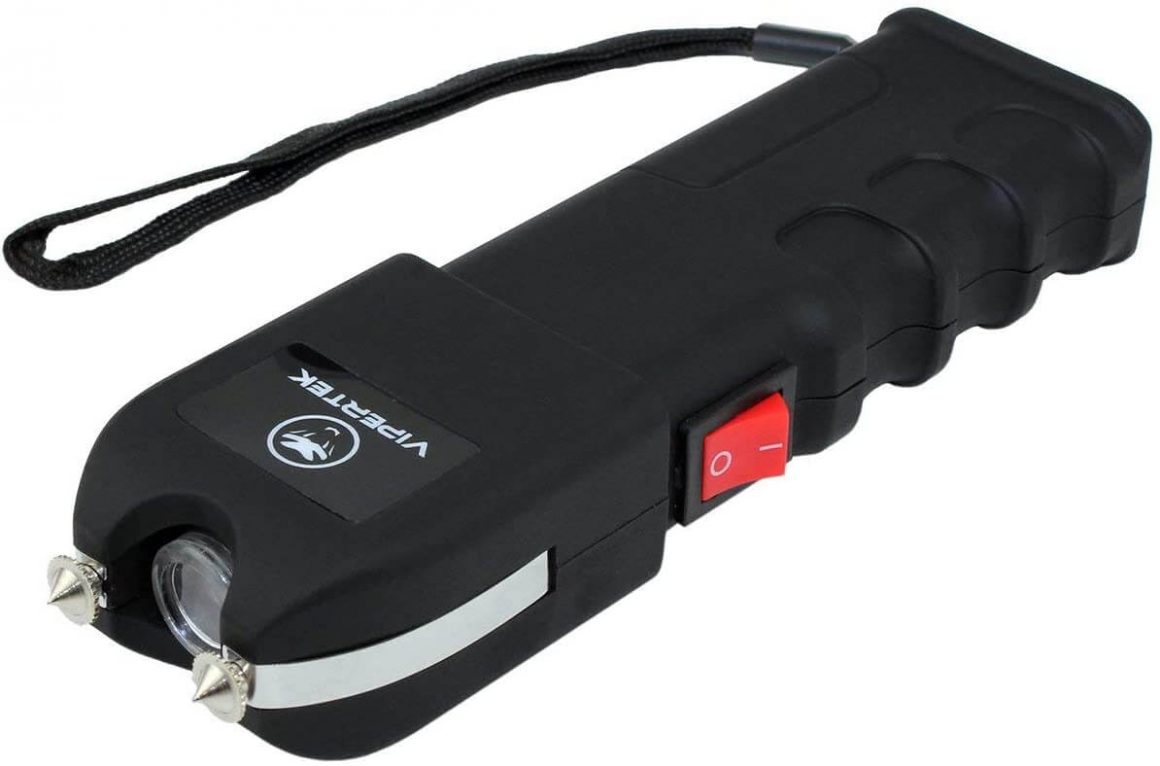
    Vipertek VTS-989

    Vipertek VTS-989

    Price from $19.99

    Pros

    • The best option for mini stun guns
    • The metal shock plates on the sides shock an assailant if they try to grab the weapon from your hand
    • Rechargeable battery

    Cons

    • The safety mechanisms sometimes hinder the effectiveness of the device

    The best thing about this Vipertek stun gun is the light design, which means you can carry it in your purse or pocket, enabling you to feel safe when walking the streets.

    Its small size guarantees that nobody will suspect you are ready to deliver a devastating hit to anyone who tries to threaten you or compromise your safety.

    The metal shock plates at the top of the device deliver a debilitating shock to any attacker who tries to grab it from your hand. Right beside them are two ultra-sharp spike electrodes that can penetrate even the thickest clothes.

    Once you grasp this portable taser, there’s no dropping it—the deep contours on the sides ensure that this piece of security equipment fits snugly in the palm of your hand.

    Features

    You need to engage two switches to fire this stun gun effectively. The safety switch on one side has three positions: off, flashlight, and stun. When the switch is in the middle position, you will see a Vipertek stun gun flashlight on the top shining, warning your attacker or blinding them enough to get a cleaner shot.

    When you put the switch in the final position, the safety is off, and the stun gun is ready to be used. This may sound complicated; however, the Vipertek VTS-989 is actually one of the easiest mini stun guns to use.

    A red on/off switch on the other side creates an incredibly strong current. The terrifying noise alone is enough to deter most attackers. If they do engage and you have no choice but to defend yourself, the Vipertek VTS-989 produces a shock of 53 million volts. A current with that amount of voltage passes through any barrier.

    The Vipertek taser flashlight is one of the best stun guns on the market. It has a rechargeable battery and a low price. This is one of the cheapest stunners around to get when you feel you need an extra layer of close-range protection. With an ergonomic lightweight design and incredible shocking power, it’s the perfect safety tool to have, especially for women.

    TASER Strikelight

    Price from $134.99

    Pros

    • A trusted manufacturer with a great reputation
    • A powerful flashlight
    • 500 stun cycles
    • A rechargeable battery
    • A heavy-duty casing

    Cons

    • Pricey

    This device is a Swiss army knife of the stun gun world. Namely, it is a powerful flashlight and a taser for self-protection, all wrapped in a heavy-duty protective casing. This makes it ideal for outdoor activities like hiking and camping.

    It comes from one of the most famous names in the business, and the built quality is excellent. However, Is it the best fit for you? Let’s take a look at the features.

    Features

    This disguised taser is small enough to fit in a glove box, backpack, or your hand while strolling but large enough to be used as a baton.

    The flashlight is not just for show. It emits a powerful beam of 80 Lumens, which is more than sufficient to shed light on those dark corners in public garages or a dark path on your hiking trail.

    When it comes to protection, this taser flashlight can be used both as a deterrent and an immediate self-protection device. So, by hitting a dedicated button, the device emits a warning arc and a shrilling noise. If that doesn’t chase away an attacker, the shock will. And you have 500 stun cycles at your disposal, so you don’t have to go economical on the aggressor.

    The only drawback to this taser—the price. It is more expensive than its counterparts with similar characteristics, but we can partly justify that. Namely, the materials are high-quality and durable, and the producer is this industry segment founder and has an excellent reputation.

    Police Force Tactical 13.5″ LED Stun Gun Baton 12M

    Price from $89.99

    Pros

    • 12M Voltage
    • Rechargeable Li-ion batteries
    • 3 activation levels

    Cons

    • Heavy (weighs 1.89lbs)

    A police-issued stun gun will never fail the user as it delivers a powerful 12 million volts of electricity.

    The best thing about this baton stun gun is its ease of use. This means that with a simple setting to “stun” you can quickly turn it on and just hit the button to tase the target.

    Features

    It has five light modes and two rechargeable Li-ion batteries, making it reliable at any point in the day. And, the only drawback is its weight. With 1.89lbs, it might not be suitable for seniors who go for long walks daily.

    On the other hand, pulling out a stun gun baton that also looks powerful may just intimidate an attacker enough to think twice about coming at you.

    Furthermore, this baton is made entirely of military-grade aluminum alloy and equipped with a tactical striking edge for a faster and easier way to break the glass.

    Maximum Strength Tactical SABRE Stun Gun With LED Flashlight

    Price from $23.99

    Pros

    • An ergonomic design
    • The stun gun emits 95 decibels of noise
    • Made from durable materials

    Cons

    • The flashlight could be stronger

    Combining stun guns with flashlights has become more and more popular over the past couple of years.

    The utility of the flashlight perfectly fits the defensive features of a stun gun, especially since most attacks happen in the dead of night. Shining a flashlight at the attacker’s eyes can temporarily blind them and discourage them from continuing the assault.

    Thanks to its ergonomic design, Sabre’s best stun gun stands out from the competition—the aluminum casing is lightweight and sits comfortably in the palm of your hand.

    It can also fit comfortably into a holster on your hip. Furthermore, the build quality is excellent, with no loose parts compromising the integrity of the piece.

    Features

    With 2.517 micro coulombs of charge, it won’t take the first place on the stun gun voltage chart, but it has more than sufficient power. It causes intolerable pain to the person getting shocked. The flashlight gives off a light of 130 lumens, while the stun gun generates a 95 dB noise.

    For an affordable price, you’ll get a weapon that will help you avoid most fights and give you an extreme edge in the ones you do get into.

    Taser X2: Police-Grade Taser

    Taser X26P Yellow

    Price from $1,399.99

    Pros

    • Loaded with a second shot in case you miss the first one
    • Made by the most prominent company in the industry
    • Replacement warranty, if the weapon is used in a proven self-defense situation

    Cons

    • Extremely expensive, as you’d expect from such a product

    An attacker is approaching you. The warning arc doesn’t scare him off. So you panic and miss the first shot. This would usually mean game over for any other taser gun that shoots, but not for the TASER X2. This extra-reliable security device has a backup shot ready to be deployed.

    The police officers who have tested this TASER device claim that the warning arc is enough to scare some sense into almost all assailants. Also, a taser that looks like a gun probably looks scarier than the one that looks like lipstick.

    If they do not comply, the shock will cause debilitating pain and involuntary muscle spasms to give you enough time to escape. The electric shock duration is limited to five seconds—any more would risk serious injury, defeating the purpose of a less-than-lethal weapon.

    Features

    Material and design quality make it one of the best tasers on the market. A laser-guided aiming system makes it easy to be accurate.

    To top it all off, even if you miss both your shots, this TASER gun becomes a close-range stun gun.

    However, the price will not make you smile. It is much more expensive than the competition. But the high price is to be expected, considering that this is a professional device and much more than your run-of-the-mill taser flashlight.

    The company included things like a spare cartridge and holster in the package to make things a bit easier on a buyer. Furthermore, the letter is especially useful because this is a large weapon. The holster also enables a user to quickly draw the taser, which is crucial in risky situations.

    Taser X26p Professional Series

    Price from $1,499.99

    Pros

    • Professional-grade product quality
    • Trusted by police forces around the world
    • Causes extreme muscle contractions when used

    Cons

    • Steep price
    • Both probes need to land for effectiveness

    TASER is a registered trademark of the Axon company. Until 2017, the company was even called TASER. As a top-of-the-line product, the X26P Professional Series is considered one of the best tasers on the market.

    The electrical current this less-than-lethal electroshock weapon delivers is ideal. Its amperage and voltage are strong enough to neutralize the target without risking cardiac arrest. It causes neuro-muscular incapacitation (NMI) that temporarily tampers with the person’s sensory and motor neurons.

    Moreover, it causes severe muscle spasms and bodily control loss for five seconds. The company’s best taser gun leaves the suspect stunned and subdued for a period long enough for the police to arrive.

    Speaking of the police, the X26P is the preferred less-than-lethal weapon of law-enforcement agencies across the globe.

    Features

    The professional holster, long battery life, ergonomic design, and quality of materials come together to make it the industry standard for a long-range TASER device. Its safety range is 15 feet—a safe enough distance in any situation.

    The laser installed on the X26P will significantly improve your accuracy, which is another characteristic that makes it a great self-defense taser. If by any chance, the TASER gun probes fail to fire and hand-to-hand combat occurs, the X26P can be used as a melee stun gun.

    The price tag is in line with the high-grade professional protection the X26P provides. No surprises there.

    Best Options for a Taser Gun Under $100

    Streetwise Sting Ring Knuckle Stun Gun

    Price from $18.99

    Pros

    • Fits perfectly in the palm of your hand
    • A Squeeze-N-Stun technology for the ease of activation
    • A low price

    Cons

    • A low battery life
    • Illegal in California

    This is one of the strongest stun gun devices on the market. Shaped like a single-finger knuckle-duster, Sting Ring packs a punch. An 18 million-volt punch, to be exact. The high voltage guarantees that the current will reach the flesh through thick clothing.

    It may be lightweight (it weighs only 0.32 lbs), but it is very powerful. By remaining easily concealed in the palm of your hand, this device is a very suitable stun gun for women that gives you an extra boost of confidence in situations where you can become susceptible to attack.

    Features

    The revolutionary “Squeeze-N-Stun” technology enables you to throw a jab and electrocute an attacker at the same time. Of course, there’s an on/off safety switch to prevent accidental discharge. This is probably the best stun gun for runners because they can keep it in their hands while running—they don’t need a pocket or a purse.

    You can charge the batteries with the cable that comes with the product. However, you’ll have to charge them for eight hours straight before the first use.

    You’ll also receive a lifetime warranty if you choose to buy this stun gun. However, bear in mind that electric batons and stun rings are illegal in the state of California.

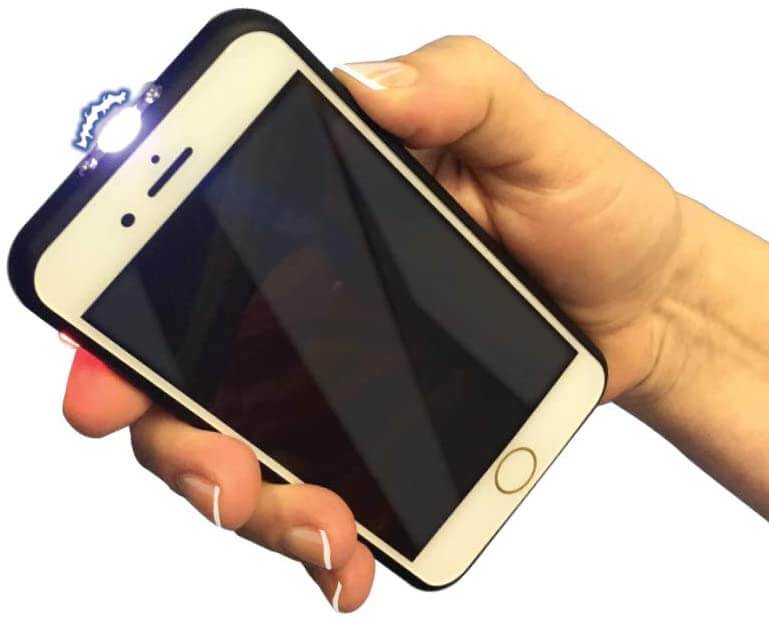
    Streetwise FRiPHONE

    Streetwise Smart Cell Phone Stun Gun

    Price from $18.99

    Pros

    • Maintain the element of surprise with a cleverly concealed weapon
    • Voltage in the millions passes through thick clothing
    • Flashlight included

    Cons

    • Poor casing quality

    Sometimes, the element of surprise is your biggest asset when facing down attackers. What looks like a smartphone to the unknowing perpetrator is a phone stun gun. The electric pressure of 14 million volts is more than enough to penetrate thick clothing and bring even the biggest of brutes to their knees. The product also has a built-in alarm that releases an ear-piercing sound to discourage thugs from attacking you.

    Even though this product’s build quality is not the greatest, and it’s more of a novelty item than a serious stun gun, we chose to include it in our list because of its creativity and unique design. This cellular phone stun gun even has a flashlight.

    Features

    Its main feature, as with most hidden tasers, is its clever disguise. So, imagine a burglar telling you to empty your purse. You start pulling out various items—lipstick, tissues, a box of mints, and similar. Just by chance, you keep a mobile phone in your hand while you’re rummaging for your wallet.

    The crook’s attention is so fixated on the upcoming reward that they let their guard down. That’s your moment to strike. You give the thug a taste of your FRiPHONE, then make a break for it.

    Although it is one of the cheaper devices and not the most powerful stun gun out there, you can rest assured it won’t fail you when you need it most.

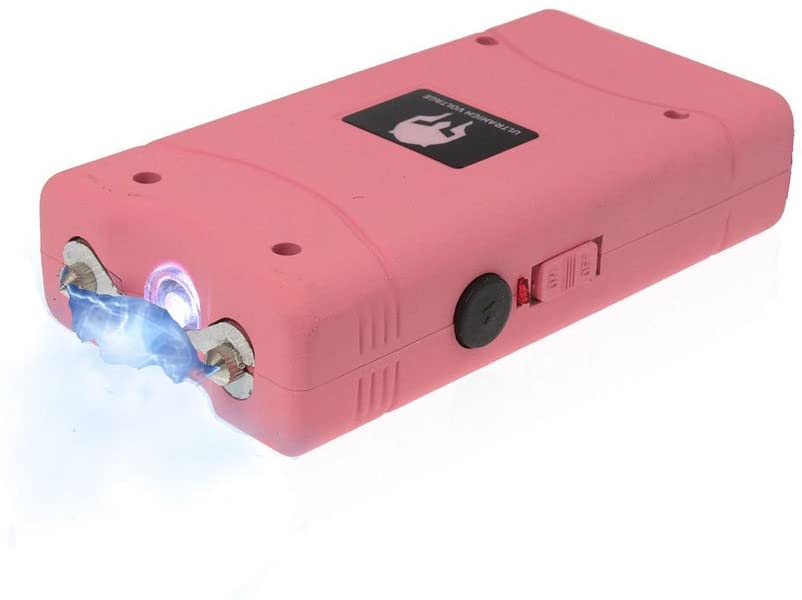
    Gladiator USA Ultra Powerful Mini Stun Gun Police Rechargeable With Flashlight

    Gladiator Ultra

    Price from $12.99

    Pros

    • Small in size, easily concealed
    • Rubber casing reduces slippage
    • Long battery life

    Cons

    • The activation button can jam after it has been used

    The stylish design of this item makes it one of the most popular personal tasers. For a ridiculously low price, you’ll be able to defend yourself against all attackers. The rubber casing ensures the weapon will stay in your hand, and the hit is strong enough to bring an assailant to their knees, no matter how large they are.

    With it, you get a blinding stun gun flashlight that ensures a clean shot. The batteries need to be charged only once every five months with the accompanying USB charger.

    Features

    The most important detail is its small size that makes it easy to hide, even in the palm of your hand.

    Although small tasers like this one are often regarded as women’s self-defense weapons, men can also carry them to boost their safety. Even the sound alone will scare off most potential attackers. It might even scare you.

    Besides being one of the best, this is also one of the cheapest small stun guns you can buy for yourself or your loved one to stay protected. You can combine this handheld weapon with the best pepper spray for a complete sense of security when walking the streets. Money spent on personal safety is never wasted.

    Stun Master Lipstick Stun Gun

    FoxFend Spark

    Price from $16.75

    Pros

    • Perfectly disguised as lipstick
    • High-amperage shock
    • This is the best stun tool for women

    Cons

    • The design makes it difficult to handle sometimes
    • Small activation buttons

    We have to says that stun guns for women are an incredibly useful tool in today’s world. For example, you never really know what’s in store with the total strangers you encounter in online dating. Some guys might get too pushy and cross the boundaries of decency.

    In that situation, you must have a way to defend yourself; a stun gun is the perfect non-lethal self-defense option.

    A good stun gun has to be inconspicuous and easily concealed but pack enough of a punch to allow enough time to escape. This tiny but powerful stun gun has both of those qualities.

    Features

    Cleverly disguised in a five-inch plastic case, this lipstick stun gun delivers a 4.2 milliampere shock with a force of 3 million volts. Not even the strongest and most-determined attacker will be able to withstand the muscle-spasming pain that the shock produces, especially when taken by surprise.

    This little devil solves the stun gun vs. taser dilemma women usually have. Namely, they are often torn between power and size. And it is understandable because (in general), the bigger the weapon is, the stronger the punch it provides. But women need something in between.

    Hand tasers should be small enough to carry around and easy enough to use. After all, their sole purpose is to make you feel safe.

    If you end up in a situation where using these weapons is necessary, the shock-and-run tactic is your best bet.

    Mace Compact Pocket Stun Gun

    Safety Tech BashLite Stun Flashlight 15M Black

    Price from $19.99

    Pros

    • 7.6 microcoulombs hit
    • Flashlight-stun gun combo
    • Quality build
    • Clip makes it easy to hang on the hip

    Cons

    • It’s look will not deter the attackers

    This interesting device isn’t produced by any of the famous stun gun companies but by one of their main competitors in the self-defense market. From the famous Mace company that produces the best pepper sprays on the market comes a fresh take on another popular self-defense weapon—the flashlight stun gun.

    The classic distract-and-attack tactic should be deployed when using this weapon. Distract an aggressor with the flashlight that also has a strobe mode for maximum effect.

    Then, either discharge the weapon in the air, creating an intimidating visual effect or fire at the attacker. The best spots to shock someone with a pocket taser are the shoulder, hip, below the rib cage, or on the buttocks.

    Features

    It’s worth noting that the numbers Mace lists on its site seem overinflated. The company claims its product delivers a shock of up to 7.6 micro coulombs, which may seem a bit much for what’s a small keychain stun gun.

    But even if we lower it by 20% or 30%, it is still enough to incapacitate an assailant for 3–5 seconds. This will give you ample time to escape.

    Some users have complained about the shock gun’s build quality. However, our experts tested it and found that this device is sturdy and well-made.

    It comes at a low price, and it’s a worthy choice for self-defense.

    Taser vs. Stun Gun: How to Make the Right Choice

    When deciding to buy a stun gun, the choice is not easy as you need to take into account the size, weight, and effectiveness of the tool.

    While pepper sprays are easier to use, determined attackers might be able to avoid a spray, and in case of wind blowback, you could end up being hurt and not an attacker.

    On the other hand, muscle spasms that a taser pulse induces cannot be ignored. If you hit one of the sweet spots, such as under the arm or just above the hip, the shock will bring your assailant to their knees no matter how big they are.

    The warning arc also emits a thunderous noise and an ominous light, most likely dissuading the attacker and defusing the situation before things get out of hand.

    Although the terms “stun gun” and “TASER” are often used interchangeably, they do not mean the same thing, and it’s important to understand the difference between a stun gun and a taser:

    • Developed and sold by the company called Axon (formerly TASER International), a TASER device is a projectile electroshock weapon that has a 15-foot range. Two probes connected to the casing by thin insulated wires deliver the voltage.

    To deliver the highest voltage, both TASER probes need to touch an attacker to close the circuit and activate the weapon. This will successfully incapacitate the attacker by making his muscles involuntary contract. However, the shock will not hurt them, and the shock will wear off in about 5 minutes. A handheld TASER will usually have only a single shot, so you will need to make it count.

    • A stun gun is a close-range weapon. The electrodes are firmly attached to the case, meaning you can only use it for hand-to-hand combat. The high taser gun voltage makes the arc of electricity between the electrodes very loud and bright, which is often enough to diffuse a tense situation quickly. Furthermore, stun guns are much easier to conceal than larger electroshock weapons.

    What You Should Know Before You Go Out and Buy a Taser

    We all want to feel safe, whether it is in our home or outside. And while we can equip our homes with security door locks and alarms, we are pretty much on our own when we go out. So, it is only natural for people to search for ways to increase their safety.

    But before deciding to purchase a stun gun, you’ll need to take into account local and state laws about carrying such items.

    Given that some devices have lithium batteries attached, transport of such devices needs to adhere to law regulations to avoid accidental discharge.

    Furthermore, stun guns aren’t legal in all states. Before starting your research on where to buy a stun gun, you should check your local regulations. So you need to be careful about where you live or travel before deciding to purchase. Check out this article to see which states allow stun gun carrying, and how each state regulates the possession of these devices.

    Best Stun Gun: Requirements & Regulations

    United States’ laws and regulations regarding the carrying of stun guns and taser devices are inconsistent across different states, to say the least. So even though your device is completely legal in one part of the country, it doesn’t mean you can have it on you when visiting another state.

    The situation is changing today as self-defense taser devices get heavy upgrades, prompting many to consider them as dangerous as handguns.

    With that in mind, some states regulate stun guns in the same way as any other weapon, needing specific permits to carry and use.

    The Criminal Defense Lawyer site issued a detailed analysis of the requirements, permits, laws, and penalties regarding stun guns and taser devices.

    Taser and Stun Gun Voltage: Truth & Myths

    Stun gun manufacturers seem to compete when it comes to putting the biggest number of volts in their product specifications. An uninformed consumer assumes that the bigger the number, the stronger the shock and that the best devices need to be in a million-volt category.

    Unfortunately, physics begs to differ when it comes to electroshock weapons. You don’t need to buy a Taser gun with the highest voltage. Remember that the TASER X26P has a voltage of 50,000 and is still used by police forces around the world.

    The potential difference in a current, measured in volts, is just a part of the equation for determining a weapon’s power. It is the “force” or “pressure” with which the source pushes electric current.

    The other part of the equation determining the punch a shooting stun gun delivers is the amount of electricity—measured in amperes or coulombs.

    The water hose metaphor explains it best: volts represent the water pressure, and amps are the water quantity. Ramping up the volts is equivalent to putting your thumb on the mouth of a hose—it does not increase the amount of water being sprayed.

    Increasing the amps is equivalent to turning the faucet up. With this in mind, the highest amperage stun gun is considerably more powerful than the one with the highest voltage.

    Stun Gun Power

    Volts play an important part in the stun gun formula—they determine how effective it will be in penetrating thick clothing and surmounting the human body’s natural resistance. Voltage also helps “jump the gap” and creates the intimidating bright lightning arc between electrodes.

    One thing to remember about tasers for self defense – the volts do not deliver the true punch. The pain depends on amperes—the amount of electricity (measured in coulombs) that goes through a given point in a second. You don’t need the strongest taser to bring attackers to their knees. For instance, a 4–5 milliampere current hits the sweet spot—strong enough to cause pain but not strong enough to do any severe damage or interfere with a pacemaker.

    So, while manufacturers selling cheap electroshock weapons boast about the millions of volts their products deliver, the police-grade TASER M26 delivers its 3.6 milliamperes at 50,000 volts.

    When you tase an attacker with that much power, not even the best tactical first aid kit will help them recover quickly.

    People Also Ask

    What is the best TASER gun to buy?

    Best Tasers to buy are TASER X2 and TASER X26P. They are police-grade models that provide excellent stopping power, reliability, and precision. They are less-lethal weapons of choice for police departments across the country and the world.

    Which is better: stun gun or TASER?

    A stun gun is better for people who are not afraid of physical contact because you have to touch an attacker with it to shock him. TASER devices are better for people who can shoot at distances of up to 15 feet precisely, even when under stress. Many TASERS are also equipped with a secondary mechanism and can be used as contact shockers if you miss the shot.

    What is the best TASER for a woman?

    The best TASER for women would be TASER Pulse Plus. It is small, lightweight, and easy to conceal. It has a range of 15 feet, and even if you miss the shot, you can use it as a contact shocker. More importantly, it alerts the police once activated. If you can provide proof (official police report) that you used it in self-defense, the company will send you a new device.

    What stun gun has the highest voltage?

    Marketing divisions of stun gun manufacturers often go overboard with their voltage claims. In reality, the voltage depends on many different factors like distance, clothes, weather conditions, and similar. The truth is that you don’t need gazillion volts. For instance, police-grade tasers go from 25,000 to 50,000 volts.

    What brand of stun gun do police use?

    Most police departments in the country use Axon Enterprise products from the TASER line of products. They are TASER X2, TASER X26P, and TASER 7. The Axon Enterprise was previously called Taser International, and it had marketed the first stun gun—TASER. TASERS are considered the best on the market and highly appreciated by professionals all over the world.

    Which stun gun is the most effective?

    All stun guns are effective if you use them properly and hit or touch an attacker. It’s best to keep the weapon in contact with the attacker for longer than 3 seconds. This is because the effects of a stun gun vary depending on the time it comes in contact with the target.

    If it’s half a second, the target will only be startled and likely jump back. Lastly, going over 3 seconds would incapacitate the target for 5–60 minutes, which is more than enough time to run away and call the police.

    How much does a TASER cost?

    Prices vary depending on the capacity, brand, and features of the stun gun you’re looking to buy. However, it ranges from a little under $10 to over $1,000.

    One of the cheapest ones you can buy is the Vipertek VTS-880. For the price of $9.98, you can get a pocket stun gun with a flashlight and rechargeable batteries.

    On the more expensive side, a TASER X2 package that includes the device, a spare cartridge, and a holster will cost you more than $1,000.

    Where can I buy a TASER?

    Nowadays, you can buy a stun gun or TASER for your safety practically anywhere. You can buy it from physical stores, such as Walmart, or choose from a wider selection of online stores like Amazon. You can even buy it online directly from some companies and have it shipped straight to your door.

    The only two states where stun guns are illegal are Hawaii and Rhode Island. Moreover, to purchase stun guns, states like Illinois, Maryland, Massachusetts, and Minnesota require a background check. So, before setting off to buy the best stun gun, check if your local regulations allow it.

  • Kids Online Safety – Internet Safety for Kids

    Kids Online Safety – Internet Safety for Kids

    Internet safety for kids is a topic that’s not addressed properly. Many people don’t realize the dangers of internet activity and the need to bolster kids online safety is ever greater.

    The stranger danger scare easily applies to a random creepy person your kid might run into on the street. Most kids know better than to go near them.

    But what happens when their friend—whom they’ve been opening up to for months, building a solid, trusting emotional relationship—wants to meet in real life?

    How does a parent deal with classmates who’ve created a group on social media dedicated solely to humiliating, embarrassing, and spreading rumors about their child?

    In the following text and infographic, you’ll learn all the most recent information on internet safety for kids, and the real scale of potential threats.

    Latest Kids Online Safety Statistics [Editor’s Choice]

    • 70% of kids encounter sexual or violent content online while doing homework research
    • 17% of tweens (age 8-12) received an online message with photos or words that made them feel uncomfortable, only 7% of parents were aware of this
    • 65% of 8-14 year-olds have been involved in a cyberbullying incident
    • 36% of girls and 31% of boys have been bullied online
    • 16% of high school students have considered suicide because of cyberbullying
    • 75% of children would share personal information online in exchange for goods and services

    We collected information from reputable sources: comparative studies with over 100,000 participants, 2018’s Parental Control reports, government websites, Child Protective Services, and cybersecurity companies.

    In addition, we examined all aspects of children’s online behavior, such as smartphone ownership rates, time spent online, time spent on social networks, and positive, as well as negative, online experiences.

    We took notice of the demographics: data on kids’, tweens’, and teens’ age, gender, and country, including the US, China, Brazil, and Italy.

    You’ll see detailed descriptions of kids’ exposure to the most common online threats like cyberbullying, scams, adult content, and online predators.

    We also listed just how aware both kids and parents are of issues like online safety for kids, cyberbullying, and children’s overall online presence.

    Do kids turn to their parents when they need help with online harassment?

    Do parents talk to their kids about how to stay safe online?

    Do they use parental control software?

    To what degree?

    We’ll conclude with some tips on staying safe on the internet, for both parents and their offspring.

    We also included the tools and resources that can help you monitor and optimize your kids’ online behavior.

    Our goal is to help them make the most of the internet, without falling victim to its many pitfalls.

    Sexting, Sextortion, and Trust: How Can We Keep Children Safe from Online Predators?

    1. 1 out of 7 children have sent messages with sexual content, while 1 in 4 admits they’ve received these kinds of messages.

    A 2018 study came to these worrying conclusions. In 39 studies (with 110 ,380 participants), kids aged 11 to 17 were surveyed. A sext can include language, photos, or videos featuring sexual content.

    These kids’ unwitting decisions can ruin lives, and damage their self-esteem, even future career prospects. This is why they need to understand how to be safe on the internet.

    Sometimes kids send pictures consentingly, but after a breakup or a disagreement, a friend or a boyfriend can post them online.

    The aggressor’s motivation could be revenge, pettiness, jealousy, or even a minor disagreement. Once the explicit pics are on the web, users can download them, take screenshots, and forward them.

    2. 20% of teenagers have sent or posted nude or semi-nude photos or videos of themselves.

    According to Guard Child, 26% of teenagers don’t believe that the person to whom they sent the pics will forward them to someone else.

    This trust is so complete that 15% of teens have sent or posted this objectionable content to someone they only knew online.

    A number of online friends can turn out to be adults, adults posing as kids, classmates, or ex-partners who end up harboring a grudge.

    3. 11% of young teen girls aged 13–16 have sent or posted nude or semi-nude photos or videos of themselves.

    Kids as young as 13 are particularly vulnerable when it comes to outside influence.

    This includes strangers who’ve built a relationship with them over time, as well as their peers and classmates. Kids seek approval, and this need sometimes outweighs common sense.

    One of the main conversations you need to have with your kid, therefore, will start with the obvious question, “Why is internet safety important?” Explain the far-reaching consequences of their actions, and help them understand how to protect themselves.

    4. The prevalence of forwarding a sext to others without consent is 12%, while only 8.4% of kids admitted someone forwarded a sext to them.

    So much for trust, right?

    It turns out that peers and even adults posing as peers can ask for explicit pictures of teenagers and then forward them to others without their consent.

    If you care about how to keep your kids safe online and on their phones, you must consider this stat.

    What’s worse, many kids don’t realize that this is illegal. According to the Department of Justice and Crime Prevention, “if a child aids, abets, induces, incites, instigates, instructs, commands, counsels, or procures another child to take and send such a photo of the latter to the first child or another person, he or she will be guilty of an offense.”

    A conviction may lead to a hefty fine, but that’s not the worst part. In particularly nasty cases, a conviction might lead to imprisonment or even registration with the National Register for Sex Offenders.

    Sometimes, cyber safety for kids includes making sure your kid is neither the victim nor the aggressor.

    5. Suicide is the second most common cause of death in adolescents aged 15–19.

    Kids are in more danger of killing themselves than of dying of any sort of disease.

    The “deal with it” or “get over it” attitude can only take you so far. In fact, cyberbullying and harassment have conclusively been linked to depression.

    Regardless of your attitude, the numbers show that internet safety for kids should be on every parent’s mind.

    According to a 2018 paper by Young Minds, young people who use social media are most vulnerable to a low sense of well-being, as well as symptoms of anxiety and depression.

    In 2012, 15-year-old Audrie Pott commit suicide after she had been sexually assaulted at a party eight days prior.

    The boys who assaulted her posted nude pictures of her online, and accompanied them with bullying and cyberbullying.

    Her death was one of the tragedies that started an avalanche, making people around the US face the real danger of cyberbullying and address how to keep kids safe online.

    In 2016, a documentary titled Audrie and Daisy, premiered at the Sundance Film Festival, detailing the experiences of Audrie Pott and Daisy Coleman, a girl with similar experiences who lived.

    6. Only 25% of the children who’ve received a sexual solicitation told a parent.

    According to the Crimes Against Children Research Center, even though kids may place too much trust in peers and even strangers online, the same does not apply to parents. The fear of an overreaction, being blamed, or even something like having internet access taken away can stop kids from asking for help.

    7. 20% of teens have met up with an online friend in person.

    It’s important that your child knows the importance of cybersecurity and how to stay safe on the internet.

    However, what happens when online dangers become a problem offline?

    Agreeing to meet a stranger can be a whole new level of dangerous.

    A 2015 Pew Research Center report exploring friendship in the digital age conducted a survey involving kids aged 13 to 17. 57% of teens have met a new friend online.

    Considering this, it’s no wonder that at least some of them feel comfortable extending that friendship to their offline lives. Making sure you know who your kids are interacting with is certainly among our internet safety tips for raising teens.

    8. 1 in 4 stalking victims also reported some form of cyberstalking, often taking place via email (83%) or instant messaging (35%).

    People might check social media profiles of their crushes or employees, jokingly referring to this as cyberstalking. But this couldn’t be further from the real danger. Today, the United States has cyberstalking and cyberharassment legislature.

    Did you know that the pictures you share online can be traced to your location, even if you don’t tag it on Facebook?

    Smartphone location services place a stamp that can be used by computer-savvy web users to find out where a kid is located. To prevent cyberstalking, consider using a VPN, a type of software that encrypts data traffic, making it difficult for others to access your data.

    If you, your friends, your child, or your friend’s child are experiencing any of the types of bullying or cyberbullying we’ve discussed, you can get support by calling a suicide hotline number or the national suicide hotline (1-800-273-8255) or by using their chat option, available 24/7 across the US. Trained, experienced individuals will offer compassion, advice, and useful resources.

    Internet Safety For Kids – Depression, Cyberbullying, & Social Media Safety

    9. 90% of teens who participate in social media have ignored the bullying they’ve witnessed.

    Out of said 90%, a third have been victims of cyberbullying themselves. The grin-and-bear-it attitude surrounding this phenomenon has led to many damaging consequences for kids and parents, even though cyberbullying can seem silly to a casual observer.

    So what can be done when friends aren’t willing to help?

    Keep in mind that young people aged 16–24 spend an average of 34.3 hours a week on the internet.

    For teens, cyberbullying is a real problem. Their online presence is at least equally important as how they appear in real life.

    It should come as no surprise, then, that kids who’ve experienced cyberbullying can develop serious conditions, including anxiety and depression.

    Friendships are destroyed, and in some cases, leaked photos and videos can even cause long-term damage to a kid’s reputation as an adult.

    10. 95% of schools already impose some kind of restriction on mobile phones during the school day.

    Every school implements its own internet safety practices. Some merely install parental control onto the school’s Wi-Fi, while others forbid mobile phone use during school hours altogether.

    Schools want to ensure that kids are safe from risks like cyberbullying, online grooming, and harmful content.

    Grooming stands for “when someone builds an emotional connection with a child to gain their trust for the purposes of sexual abuse, sexual exploitation, or trafficking.”

    Internet safety for elementary students and middle and high schoolers is important because along with making students safer, it also leaves them more focused on class.

    11. According to a 2018 survey, 58% of parents check which websites their teens visit, and look through their kids’ call records and messages.

    While most parents resort to checking kids’ online behavior manually, 52% also use software as the best way to handle internet safety for kids, which restricts which websites the child can visit.

    Age plays a big part here: 72% of parents of 13- to 14-year-olds look through their child’s cell phone, compared to 48% of parents of teens aged 15 to 17.

    12. Only 25% of teens socialize with friends in person on a daily basis outside of school.

    This stat highlights the significance of online communication more than any other. In their free time, kids choose to communicate online, which is why online representation is so important to them.

    Learning how to keep kids safe online becomes vital when you see that this is their primary channel for seeking connection, affection, approval, and validation.

    13. 16% of boy gamers (13–17) play in person with friends on a daily or near-daily basis, and an additional 35% do so weekly.

    With gamer kids, the stats are even worse. Their self-esteem and happiness levels tend to be based on gaming skills.

    Internet games for kids and adults alike can become a problem for particularly vulnerable teens.

    That’s why ganking (a big group of players teaming up on one lone player) is sometimes categorized as a type of online bullying.

    14. 88% of teens online believe people share too much information about themselves on social media.

    Pics or it didn’t happen, right? According to a 2018 article by Net Nanny, 10 of the most dangerous teen chat sites—like Kik, Snapchat, Ask.fm, Whisper, and Blendr—can easily bypass parental controls. On Kik, kids can exchange messages parents can’t see, and it’s also very difficult to confirm the participants’ identities.

    Snapchat allows users to determine when messages they send will self-destruct, leaving an illusion of anonymity. Screenshots take care of that, of course, proving once more that everything posted online stays online forever.

    Among these teenage chatting sites, Ask.fm is so scary that the former UK Prime Minister, David Cameron, urged parents to ban the app.

    There are no age restrictions, and groups are formed based on GPS location, a serious liability since potential predators can easily learn a kid’s location.

    15. 18% of kids aged 1–7 have social media profiles.

    This is another big reason to consider instituting some online safety rules. After all, the age limit for creating an account on Facebook and Instagram is 13.

    SnapChat users aged under 13 are redirected to Snapkidz. The minimum age for the mobile phone messaging app WhatsApp is 16 years old.

    There are a few ways that you can manage what your kids are doing online. First and foremost, a family password manager is a good idea.

    You can make an account for your child on any platform they regularly visit and then enable restricted mode on all the devices they use.

    All passwords will be known to you, and you’ll be able to keep them and yourself safe from potential breaches.

    16. Around three-quarters of 12–15-year-olds are aware of online reporting functions, and 1 in 8 who go online have used one to report something that bothered them.

    Bystander apathy seems to extend to the internet. For those unfamiliar, it’s a social and psychological phenomenon where people are less likely to help a victim when other individuals are present.

    17. 17% of children aged 12–15 admitted to accidentally spending money online—almost double the percentage from 2017 (9%).

    A 2018 OF.com report came up with these surprising results. Parents who don’t want to lose money obviously need to provide a sort of kids’ guide to the internet.

    It’s a fast way to ensure that if a child blows through their money on trivialities, at least it’s on purpose. Provided that these kids weren’t lying about the accidental nature of their actions, it’s surprising that they seem to know less about the way online purchases work.

    18. 45% of kids aged 3–4 use Youtube, 80% use it to watch cartoons, and 40% watch funny videos and pranks.

    On the other hand, 70% of kids aged 5–7 use Youtube, and 4% have social media profiles. Here’s a good reason to set something up like Google safe search for kids (but more on that in the next stat).

    If you leave your child alone with a mobile device and just let the videos go on shuffle, they can easily be exposed to many violent, frightening, and otherwise damaging videos and images.

    Downloading a free adblock program would be a good way to solve this.

    You should also provide reliable android virus protection or get virus protection for any iPhone device that your kid might use. After all, kids are more likely to unknowingly click on malware or phishing emails than you are.

    19. About 8 in 10 parents of 3–15-year-olds online knew about at least 1 of the 6 content filtering tools they were surveyed about. And more than half of parents of 3–4-year-olds (56%) and 5–15-year-olds (59%) used at least one of them.

    A website content filter is designed to reduce recreational internet use and restrict access to content that would be deemed objectionable by a parent, school, or enterprise.

    A web filter blocks pages from websites that are likely to include objectionable advertising, malware, viruses, and pornographic content. While it’s good that so many parents know about these programs, their use could be even more widespread.

    The best free internet filter you can use is Qustodio Free. It may be aimed at Windows, but it’s also available for Mac, Android, iOS, Kindle, and (weirdly) Nook.

    Windows Live Family Safety and Open DNS FamilyShield are more family-oriented and will block domains on your whole home network.

    If you want to generate only cherry-picked, safe results, Kiddle is probably the best kids’ search engine for you.

    20. 19% of parents had no idea whether or not their kids had SnapChat accounts.

    In addition, 22% of parents were aware that their children had a Twitter account.

    Cyberbullying can become an issue on any social media website. Because of this, not knowing if your kid has a SnapChat account—or any social media account—can be a problem.

    21. 59.68% of parental control notifications were triggered by children visiting online communication sites.

    All the more reason why social media safety for teens is an issue you ought to take seriously. It seems like no stat was actually needed to let you know your kid spends all of their time on Instagram and SnapChat.

    22. 22.4% of parental control notifications were triggered by children’s software, video, or audio consumption.

    Images or videos featuring alcohol, tobacco, or narcotics triggered 6.32% of the parental control notifications. And kids’ computer games triggered 4.99% of parental control notifications.

    10 Tips About Internet Safety for Kids

    1. Don’t lie about your age.
    2. Avoid private forums and chat rooms that require an email address, home address, or phone number.
    3. Don’t ever give out your own or your family’s personal information.
    4. Create strong passwords and update them regularly.
    5. Don’t accept strangers’ friend requests, don’t add strangers, don’t chat with strangers, and never make emotional connections with them.
    6. Set the privacy settings on your media accounts, make sure your profile details are only visible to friends.
    7. Never share personal photographs or videos, and never engage in sexting. Everything that happens on the internet stays on the internet forever.
    8. Disable location services.
    9. Only purchase items from reputable websites.
    10. Most of all, block anybody who makes you feel uncomfortable. Report them to your parents, teachers, or even the authorities.

    Get the best parental control app for your phone: these options include Qustodio, NetNanny, Symantec Norton Family Premier, Kaspersky Safe Kids, Circle with Disney, Clean Router, and Mobicop.

    There are also computer monitoring and parental control software options. These include K9 Web Protection, Qustodio, Family Time, Windows Live Family Safety, Norton Online Family, NetNanny, and Kidlogger.

    If you’re looking for Google parental controls, Family Link allows parents to set screen time limits, lock devices when it’s time for a break, approve or block apps downloaded from the Play Store, and locate their kids through their devices. Technically, it’s available to anyone with an existing Google account.

    And finally, there is also an Android parental control option: When you turn on parental controls, you can restrict what content can be downloaded or purchased from Google Play based on maturity level.

    For family members who manage their own accounts, parental controls only apply to the Android device you add them onto.

    For family members whose accounts are managed with Family Link, you can set up parental controls on your child’s Google Account.

    So how do you explain internet safety to a child?

    Conversations between kids and parents need to include some ground rules: Don’t give away private information about either yourself or your family.

    Do not send, download, or forward explicit photos, texts, or videos of either yourself or other kids. Report a bully to the page administrator, a parent, or an authority at your school.

    And most of all, be open in your parent-child communication. In the long run, it’s better for you and your kids when they can trust you, not fear you, so that you can work together if something ever does go wrong online.

    As we can see, internet safety for kids needs to be as major an issue for parents as what happens in their kids’ offline lives.

    Put simply, the stats and tips we’ve provided here are designed to educate you and your kids, while helping you all communicate better about being safe online.

    How to Keep Kids Safe Online - Guide -2021-(2) (1)
    1. PC Magazine
    2. The Sun
    3. NSPCC
    4. YoungMinds
    5. Netflix
    6. The Department of Justice and Crime Prevention
    7. Rainbow Rehab
    8. Guard Child
    9. JamaNetwork
    10. National Institute for Mental Health
    11. SentryPC
    12. Pew Research Center
    13. Bureau of Justice Statistics
    14. The Guardian
    15. USA Kaspersky
    16. OFcom
    17. NetNanny
    18. Statista
    19. Wonder Share
    20. The Verge
    21. Google Play Help
  • The Truth About Child Abduction Statistics in 2024

    The Truth About Child Abduction Statistics in 2024

    Far from the days of seeing kids show up on the milk carton of your morning cereal, missing children in the United States and worldwide is a deeply concerning issue. Child abduction statistics show that the prevalence of this type of crime is more often than you think, but the perpetrators are who you’d least expect. 

    It’s easy to get swept away in the myths about who and why children go missing. Less sinister than the news would have you believe, most children go missing because a non-custodial parent has picked them up. While stranger danger is real, it’s not as real as we’ve been made to believe. Check out these latest statistics to find out the truth about kids going missing. 

    8 Child Abduction Statistics (Editor’s Choice)

    • Every year, approximately eight million children are reported missing worldwide
    • In the US, 2300 children are reported missing per day 
    • Strangers abduct less than 1% of missing children
    • Parents are accountable for over 90% of abductions
    • In the US, nearly 400 000 youth were abducted in 2020
    • Every two minutes, a child is reported missing in Europe
    • In 2019, Turkey had an abduction rate of 14.86 cases per 100,000 people
    • In Europe, one-third of missing children were found by the police in 2020

    General Missing Children Statistics 

    There are three different types of child abduction: stranger abduction, abduction for the purpose of raising a child, and parental abduction. Millions of children go missing every year, and due to lack of reporting, that instance is likely much more. In recent years, however, the combination of awareness and technology has ensured that almost all children are returned home safely.

    1. Around 8 million children are reported missing each year worldwide. 

    (ICMEC)

    According to the latest worldwide missing children statistics, the US accounts for 800,000 missing child cases each year. While many high-profile cases come from the United States, the speculation that child abduction is an American problem is evidently false, with millions more being reported across the globe. 

    2. 2300 children are reported missing daily in the US. 

    (Child Find of America)

    Missing child reports cover many different situations, including abductions. While some are instances of parental or stranger abduction, other instances include running away, being kicked out, misunderstandings, or getting lost. 

    3. In 2020, almost 400 000 youth were abducted in the US. 

    (Statista)

    Based on the latest child abduction statistics for 2020, there were 178 747 teen male kidnapping cases, while the number of girls was much higher, at 209 375 cases. It seems that kidnapping and age do have an inverse relationship. The higher the age of the person, the lower the likelihood of being abducted. For example, less than 160,000 adults were abducted in 2020. 

    4. Teenagers are the most common age group for abduction.

    (MoCHIP)

    According to analyses of missing children cases, teenagers are the most likely to be victimized. While the press may be inclined to cover cases of smaller children under the age of 12, statistics show that teens between 12 and 18 account for 80% of all parental and stranger abductions in the US. 

    5. More than 99% of missing children return home alive. 

    (Reuters)

    While a missing child is always a scene for concern, the vast amount of child abduction cases in recent years have returned home alive. Many point to technological advancement as a leading reason for this positive indication, as well as greater awareness that quick responses make a difference for the lives of abductees.

    Stranger abductions are the only outlier in this hopeful outlook. Studies show that of this small group of children every year, 40% of them are killed by the person who took them.

    Child Abduction Statistics: Non-Family Kidnapping 

    Non-family kidnapping is perhaps the most commonly associated type of abduction in this phenomenon. Fear of human trafficking, child abuse, and other crimes is very real in these scenarios, and while they account for a small proportion of all missing child cases, the impact is devastating. 

    6. Less than 1% of missing children get abducted by strangers. 

    (Missing Kids, Reuters)

    When it comes to all cases of children reported missing, less than 1% are taken by someone they don’t know. The vast 91% of missing cases are runaways, as child kidnapping statistics show, while family abductions make up 5% of missing children. Based on reports from the FBI over the last ten years, fewer than 350 children were abducted annually by strangers, despite the high profile news coverage of many cases. 

    7. 57% of children abducted by strangers make it back home.

    (Reuters)

    While stranger abductions are more difficult to prevent and intercept, the majority are still returned home alive. Child abduction rates show that since stranger abduction is most often a premeditated act, it involves using techniques to lure the child to come willingly with the perpetrator, only to be victimized later. The nature of this crime makes it much more difficult to catch, especially after more than a few days have passed.

    8. One in six runaways are likely victims of child sex trafficking. 

    (Missing Kids)

    Of the 26 500 missing children in 2020, 1 in 6 were likely involved in sex trafficking. Sex trafficking is a pertinent issue in regards to child abduction cases, and the majority of the time, the trafficker is someone close to the child, such as a guardian, parent, neighbor, or friend of the family. One scary statistics says that 20% of abusers have attacked between 10 and 40 minors. Background checking services have become available in recent decades, giving parents extra security about the adults they let into their children’s lives. 

    9. The first three hours after the abduction is the most crucial for finding a child. 

    (q13fox)

    A fast response to missing child cases is the key to bringing kids home safely. According to children kidnapping statistics, in 74% of abduction-murder cases, the children were harmed or murdered within the first three hours of being abducted. 

    10. 71% of non-family abductions happen on the way to or from school.

    (Reuters, News24)

    Statistics show that 71% of non-family abductions happen outdoors. Notably, the most likely time of day for abductions is the afternoon or early in the morning, when children are walking to and from school.

    11. Almost all children abducted by strangers are taken by men.

    (Kids Health)

    Child abduction statistics show that most kidnappers unknown to the victim are male, and two-thirds of victims in this category are young girls. 

    12. Abducted children often come from low-income households.

    (Journalist Secure)

    Children from low-income houses are more likely to be abducted and are more likely to have divorced or separated parents. The difference is quite substantial, with 9 in 1000 children experiencing an abduction in two-parent households and 84 in 1000 in single-parent households. 

    Statistics on Child Abductions by Family

    Parental abduction is the main type of kidnapping in the US. Many reports question the labeling of this particular crime as it insinuates something ill-intentioned, while the majority of the time, the child is safe, but a parent has broken a custodial agreement. This mislabeling inflates statistics and creates a perception that stranger danger is around every corner.

    13. More than 90% of abductions are committed by a parent.

    (Journalist Secure, Reuters)

    Parental abduction is the most common type of kidnapping, and statistics on child abduction indicate that 60% of the time, the person is the mother or another female relative. 

    Even though the abduction by a parent doesn’t have to be a negative experience for the kid, there may be long-term traumatizing effects. That’s especially the case when children experience grief, stress, or conflicts in loyalty because of the abduction. 

    14. Three in every thousand children are abducted by a family member each year.

    (Journalist Secure) (Science Direct)

    Almost 5% of children in the US have experienced a parental abduction in their lifetime. 90% of the abductions were conducted by a parent, with 10% reported as another family member. Using a GPS tracker for your kids is becoming a more popular trend, so parents can feel secure knowing where their child is. 

    Child Abduction Statistics by Country

    Child abduction is sometimes seen as an American problem. With many high-profile cases that reach global scales, this stereotype is far from the truth. While the US has a fair number of abductions every year, the rest of the world isn’t doing much better. Reporting is an issue with this topic, as many lower-income countries simply don’t keep track of missing children or follow up on reports.

    15. In 2019, Turkey was the country with the highest child abduction rate — 14.86 cases per 100,000 people.

    (SidmartinBio)

    Canada was a close second, with a rate of 13.82 abductions per 100,000 residents, followed by Kuwait, with 11.52 abductions per 100,000 people. Switzerland wasn’t far behind, with 8.61 abductions per 100,000 people.

    Abducted child statistics are difficult to estimate, however, as many countries don’t report this activity at all.

    16. Around 20 000 children go missing every year in Australia. 

    (Global Missing Kids)

    Australia also deals with a significant missing child problem. With similar barriers to the United States and Canada, this issue is even more severe for indigenous kids. Studies show that 20% of abductions are indigenous teens, and 70% of cases are children living in out-of-home care. 

    17. In India, around 100 000 children go missing every year. 

    (Global Missing Kids)

    With a population of 1.3 billion, India reports 100,000 missing children every year. It’s speculated that the number of missing children in India is unknowable since most cases are never reported. With a population of 84 million, Germany reports the same number of abductions, granted with a much higher rate. The issue of reporting plagues this problem, making it difficult to draw any concrete conclusions. 

    18. 20 000 children are abducted each year in China.

    (Deutsche Welle) (QZ)

    It’s reported that 70,000 people go missing every year in China, 20,000 of which are children. China is a unique case for reporting as parental abduction is not considered a criminal offense, nor is it part of the missing child count. The latest stats on child abduction indicate thousands of children in China are abducted for the purpose of being sold.

    19. A child gets reported missing every two minutes in Europe.

    (Missing Children)

    Europe faces unique challenges to reporting and finding missing children. More than half of reported abduction cases are children who have run away, while 22.7% of abductions were by a parent. The number of missing children per year is also affected by child migration, human trafficking, and non-reporting in several countries. 

    20. 33% of missing children in Europe were found by the police in 2020. 

    (Missing Children)

    Out of the 19 countries that contributed to the data collection, police found 33% of all missing children in 2020 in Europe. Notably, 38% of children came back on their own, and 20% were brought back by a third party. 

    21. Alaska has the highest number of missing people in the US. 

    (KREM)

    When it comes to child abduction statistics in 2020 by state, Alaska takes the lead. The state not only has the highest number of missing people but also the highest crime rate in the country, almost double the national average crime rate.

    Conclusion

    Child abduction and missing children is a serious global issue. With many countries facing the same barriers to reporting, tracking, and ultimately finding lost kids, the lack of information has dire consequences. While the most common form of child abduction is by a non-custodial parent, there are other cases that are much more sinister that include human trafficking, child abuse, and long-term abduction. 

    With technological advancement and awareness-raising, the number of missing children that are found and returned home safely in the US is almost all of them. Through quick response and GPS tracking, many situations are resolved with no harm to the child. By being equipped with the right tools like stun guns and pepper sprays to respond to things that don’t seem right, everyone can help play a role in keeping children safe and at home, where they’re supposed to be. 

    People Also Ask

    How many children are abducted each year?

    A large number of children get kidnapped every year. In 2020 alone, almost 400 000 youth were abducted in the US. The majority of cases were girls, accounting for 209, 375, compared to 178, 747 boys. Less than 160,000 adults were kidnapped, showing a relationship between age and likelihood of being abducted. Importantly, statistics indicate that more than 99% of abducted children make it back home alive.

    Where do most child abductions occur?

    Up to 71% of non-family abductions happen outdoors. The perpetrators usually intercept the child on their way to or from school, in parks, or in the streets. Abductions are most likely to happen in the afternoon or early in the morning. Indigenous and low-income children are most affected by this crime and over-represent in cases where child abuse occurs.

    What state has the highest rate of child abduction?

    Alaska is the state with the highest number of missing people, including both adults and children. The state of Arizona takes second place, followed by Oregon, Washington, and Vermont. Taking into consideration population size, California has the highest missing persons rate in the United States. The highest rate of child abduction, by state, is currently unknown.

    Who is most likely to abduct a child?

    The most common type of child abduction is parental abduction. Parents that are violating custodial agreements are the most likely to commit kidnapping, and in more than 60% of the cases, the parent is either the mother or another female relative.
    90% of all missing children get taken by their parents or another family member. For example, 78% of abductors are non-custodial parents in the United States.

    How many kids get kidnapped a day?

    Globally, around 8 million kids are kidnapped every year. The true numbers are difficult to know, as many countries and cases are never even reported. In the US, 2300 children get taken every single day. During 2020, there were more than 400 000 recorded cases.

    What country has the highest child abduction rate?

    Due to reporting variances, it’s difficult to say which country has the highest abduction rate of children. In 2019, Turkey had the highest child abduction rate — 14.86 cases per 100,000 people.
    Canada took the second place, with a rate of 13.82 abductions per 100,000 residents, followed by Kuwait, with 11.52 abductions per 100,000 people. Switzerland wasn’t far behind, with 8.61 abductions per 100,000 people.

    What is the most common age for kidnapping?

    Children under the age of 12 may receive the most press due to their vulnerable status in society, but the majority of children who are abducted are teenagers between the age of 12 and 18. Runaways who are believed to be coerced into sex trafficking are considered part of this category, as well as stranger abductions that end in abuse and/or murder.

    How many missing children are found?

    For the majority of abductions, 99% of children are returned home safely to their guardians without any harm. In Europe, 35% of missing children are recovered by the police. For stranger abductions, the statistics are less promising, with only 57% of children returning home in these cases. Child abduction statistics show that perpetrators of stranger abduction kill their victims in 40% of cases. Reporting, fast response, and technological tools are all contributing factors to quickly returning a child home.

  • Google Home Statistics That Predict the Landscape of Smart Speakers

    Google Home Statistics That Predict the Landscape of Smart Speakers

    When Google entered the smart speaker market with its Google Home and Google Assistant, few people believed it could make it in the market already dominated by Amazon Alexa. Recent Google Home Statistics proved them wrong. 

    Google is not only hanging on but also increasing its market share. In a growing market, the battle between these fierce competitors is not only about profits but also prestige.

    As consumers, we can only be glad— in an effort to beat the competition, the companies have improved their services to levels unimaginable a couple of years ago.

    Top 8 Fascinating Google Home Statistics (Editor’s Pick)

    • Google holds more than 20% of the global smart speaker market
    • Google Home can work with more than 50,000 smart home devices from more than 10,000 brands
    • There are more than one million actions available for Google Assistant
    • Almost 40% of people use smart speakers for playing music
    • More than 1 billion devices have Google Assistant installed
    • 22% of Americans aged 30 to 44 own a Google Home device
    • Google Home is the only smart speaker to understand 100% of the questions
    • 50 Million Google Home devices were sold worldwide in 2021

    Interesting Facts About Google Home Virtual Assistant

    1. 22% of Americans aged 30 to 44 own a Google Home device.

    (Statista)

    Within the network of appliances, the smart speaker acts as the hub and interface for human control. That’s why it’s one of the most crucial pieces of gear a smart home can have. No wonder, then, that more than one in five adults own a Google Home. 

    But don’t expect to regularly see a Google Home purchase among the 60 and up demographic. It’s fair to predict that devices like these may take a little while to catch on in some age groups.

    2. In a comparative test, Google Home was the only smart speaker to understand 100% of the queries directed at it. 

    (Loup Ventures)

    Google’s AI algorithm that governs speech recognition is clearly unparalleled. Having the only perfect score in “hearing” commands is a clear indication that the Google personal assistant device trumps its competition. 

    Not only that, but there is a sharp difference in “understanding” queries. Google Assistant correctly answered 87.9% of the questions it was asked, while the second highest percentage was achieved by Amazon Alexa at an ostensibly lower 74.6%.

    3. Google holds more than 20% of the global smart speaker market

    (Statista)

    This piece of data shows that Google smart speakers are holding well against the still dominant Amazon Alexa (26.4%). However, this is lower than the results Google Home Assistant had in 2019 – 24.9% of the market. This is due to the rapid expansion of brands like Baidu, Xiaomi, Alibaba, and Apple. They are taking a significant portion of the market and, by the looks of it, have no intention of slowing down.

    4. Google Home can work with more than 50,000 smart home devices from more than 10,000 brands. 

    (Google)

    In order for devices to connect to Google Home Assistant, the apps must be compatible. At the beginning of 2018, Google boasted that their device could pair up with over 1,500 devices. The fact that this number rose to 50,000 in 2022 is a certain testament to how rapidly Google Assistant is growing and developing. 

    5. Almost 40% of people use smart speakers for playing music

    (Statista)

    Hardly surprising since they are speakers before all. But it seems that people are not taking advantage of the smart speakers’ possibilities, as they are used for checking the weather (34%), answering questions (30%), or as glorified alarms and timers (45%). Only about 25% of smart speaker owners use them daily to control other smart devices in their homes.

    How many Google Homes have been sold?

    50 Million Google Home devices were sold worldwide in 2021, and the number is estimated to reach 140 billion by 2025. As we can see, Google is slowly but surely staking its claim on the smart speaker market. 

    It should be noted that there are several households with multiple smart speaker devices. To keep your smart speakers interconnected and to make sure they’re communicating efficiently, you can always make Groups in Google Home. This will help “group” the devices you specifically want working together, increasing effectiveness and making your life easier.

    6. Google Home speakers can understand two languages at once. 

    (Google)

    Google Home became the only smart speaker system that could understand two languages simultaneously. This feature uses LangID technology developed by Google. It’s especially useful for multilingual households, which aren’t exactly rare in the US.

    Google Home statistics continue to show that soon it will be the new king of smart speakers.Yet another benefit that Google’s impressive algorithms provide, this is a big advantage that its competition just cannot achieve.

    7. Google Home generates $3.4 billion in revenue 

    (Voicebot), (Statista)

    This contributed roughly $850 million to Google’s overall gross profit in 2018. After all, the product is pretty easy to find. You can buy Google Home at Target, Walmart, Kroger, and all major retailers.Of course, being readily available is the main factor in product success, but it does help.

    Still, the revenues made from hardware are just a minor part of the company’s total revenue of $256.74 billion in 2021. Most of it comes from advertising.

    8. Google claims there are more than one million actions available for Google Home personal assistant, dwarfing the estimated 30,000 skills available for Amazon Alexa. 

    (Google)

    A single voice command that can be issued to a Google Assistant is called an “action.” These new actions are added by the third-party companies that manufacture the different appliances the system connects to. 

    Google also factors in the searches you can make using their device. If you look at it that way, there is an almost endless number of actions Google Home can complete.

    9. Google Home statistics show that more than two-thirds of requests to the Google Assistant are verbalized in a natural tone—one people would use when talking to a person.

    (Google)

    When we search for something on our phone or laptop browser, we tend to use certain keywords and form sentences and phrases differently from what we do in a normal conversation. 

    However, when speaking with Google Assistant, people address it as if they were speaking with a person. Take a look at this smart home guide and see how you can take advantage of your speaker.

    10. More than 1 billion devices have Google Assistant installed 

    (Google)

    According to Google, its Assistant is featured on more than one billion devices. That is amazing if we consider that there are almost eight billion people on this planet. Experts predict that the number of IoT devices will surpass 75 billion by 2025.

    People Also Ask

    Does Google Home record what it “hears”?

    Google Home only records your voice after you say its triggering keyword. By default, that keyword is “OK Google,” but you can change it to whatever you like. Just make sure it’s not something that you often say when you aren’t speaking to your device. While Google Home may not always be recording, it is constantly listening.

    How efficient is Google Home data usage?

    That all depends on what you use your device for. Some features, like smart thermostats, use very little data.
    However, you need to be wary of features like Cast. Cast sends data packets in 20-second intervals. If left in a standby state for too long, it can send all the packets at once when awakened, which can really damage your data plan. Be sure to disable the Cast feature or reboot your device before you wake it.

    Is Google home always listening?

    Yes, Google Home is always listening, but—and this is an important caveat—it isn’t always recording. Google Home records only when you utter the keyword “OK Google.” When the device “hears” the keyword, it begins recording. It sends the recording up to the cloud and receives instructions back.
    Nevertheless, you should be careful of what personal information Google Assistant gathers from the third party devices connected to your smart home system. You can always delete recordings from the cloud, but Google Home statistics show that hardly anyone has the time and patience to micromanage the information Google and other big companies store about them.

    What percentage of Google searches are voice?

    In 2020, 50% of all searches were voice searches, and the percentage is expected to rise. The number of voice searches compared to regular, typed searches is rapidly moving in favor of the former, according to most voice search statistics.

  • 22 Intriguing Distracted Driving Statistics to Increase Awareness

    22 Intriguing Distracted Driving Statistics to Increase Awareness

    Even though there have been fewer cars in the streets last year, it seems like distracted driving statistics haven’t improved notably compared to the previous years.

    Nonetheless, we should all be aware of the consequences of distracted driving. Instead of ignoring this problem, we should focus on minimizing distractions on the road, now more than ever, with the crowded hospitals worldwide. This way, we will show appreciation to the tireless medical staff across the globe.

    Keep reading to stay informed about the latest stats concerning distracted driving.

    The Top 8 Distracted Driving Statistics (Editor’s Choice)

    • Every year, around 3,000 people are victims of crashes involving a distracted driver
    • In 2019, 6% of drivers in fatal crashes were distracted during the crash
    • Over 565 nonoccupants died in distracted driver crashes in 2019
    • Using cell phones while driving is responsible for 14% of deadly crashes
    • Every day, 11 teenagers are killed because of texting and driving
    • 25% of car accidents in the United States happen due to texting and driving 
    • 60% of respondents claim that they rely on GPS while driving
    • Texting while driving is six times more likely to lead to an accident than drunk driving 

    General Distracted Driving Statistics

    The first step towards reducing and hopefully eliminating distracted driving is getting into the matter, familiarizing with stats, and apprehending such behavior’s consequences. 

    1. There are three main categories of distracted driving. 

    (CDC) 

    In general, everything that takes your attention off the road and driving is a possible distraction, whether physical or mental (verbal, visual, etc.). Still, here are the three main types of distracted driving: 

    • Visual distraction – anything that makes you take your eyes off the road.
    • Manual distraction – a stimulus that makes you take your hands off the steering wheel.
    • Cognitive distraction – taking your mind off driving (it can be caused by a stimulus from the driver’s environment, or the driver can wander off in their thoughts).

    2. Around 3,000 people die every year in crashes involving a distracted driver.

    (CDC, NHTSA)

    In general, about 3,000 people die every year in crashes that involve a distracted driver. For example, NHTSA distracted driving stats revealed that in 2019, 3,142 people passed away. 

    Moreover, about eight Americans lose their lives in crashes involving a distracted driver every day.

    3. 5% of fatal crashes occur because the driver was distracted at the time of the crash. 

    (Crashstats.NHTSA)

    Besides, 8% of fatalities occurred because the distracted driver was a teenager aged 15 to 19. This age group is the riskiest one when it comes to deaths as a result of distracted driving. Stay with us to find out more about teen distracted driving statistics. 

    4. In 2019, 6% of drivers involved in fatal crashes were distracted at the time of the crash.

    (NHTSA)

    In addition, around 9% of drivers aged 15–20 who were related to fatal crashes were distracted. As a matter of fact, that’s the age group with the largest proportion of distracted drivers during fatal crashes. 

    5. In 2019, 566 nonoccupants lost their lives in distracted driver crashes. 

    (NHTSA)

    They were pedestrians, people riding their bikes or something else. This issue should be emphasized in public more often, considering that most research focuses on traffic participants as primary victims of distracted driving while neglecting victims outside the vehicles.

    Cell Phone Use While Driving Statistics

    Cell phone use while driving is the primary source of distracted driving. This way, technology is, in a way, taking the lives of people who (mis)use it. 

    6. There are three ways of using electronic devices while driving.

    (Crashstats.NHTSA)

    As stated by the National Occupant Protection Use Survey (NOPUS), three types of devices are used while driving. 

    • Drivers ‘holding phones to their ears’—stats on distracted driving indicate that this practice is more common among women than men. Also, young drivers aged from 15 to 24 years are more likely to hold their phones to their ears than the other age categories. 
    • Drivers ‘speaking with visible headsets on’.
    • Drivers ‘visibly manipulating handheld devices’. This type of misuse is also the most common among people aged between 15 and 24. 

    7. Using a phone while driving is the leading cause of distracted driving. 

    (LGinjuryfirm)

    Distracted driving facts reveal that two leading causes of distraction are talking and texting while driving. As estimated, 26% of all accidents involve cell phones. Using GPS takes second place when it comes to causes of distracted driving. The third is adjusting music and car controls. Other causes include applying makeup, wandering off, handling children or pets in the vehicle, talking to passengers, etc.

    8. 14% of fatal crashes involved using cell phones while driving.

    (TheZebra)

    In addition, 9% of all fatal crashes involve texting and driving as people’s addiction to their smartphones continues to increase. Later on, we will talk specifically about texting and driving facts.

    9. 7% of all drivers admit to using their phones at any time while driving.

    (TheZebra, iii)

    This type of behavior leads, of course, to a large number of accidents and fatalities. For example, there were 387 fatal crashes due to cell phone distraction in 2019. They led to 422 deaths. 

    In addition, of course, the financial damage is enormous—15% of the overall damage caused by crashes is connected to mobile devices. To illustrate, drivers who drive and use their mobile devices cause societal damage of 129$ billion annually.

    Teenage Distracted Driving Statistics

    Unfortunately, teenagers are the most endangered when it comes to distracted driving. Surveys show that people of this age tend to show riskier behavior in traffic than the other age groups. So firstly, let’s make straightforward what the syntagm ‘teen driver’ implies—it is a person with a valid state license, aged 15 to 18 years. 

    10. 11 teens are killed every day due to texting and driving. 

    (VictoriaAdvocate, TheZebra)

    In the US only, 11 teenagers die every day as a result of driving and texting. This indicates that over 3,000 teens are killed annually due to texting and driving. It is actually the leading cause of teen deaths in the US. This type of behavior takes more teen’s lives than mass school shootings, as texting while driving statistics demonstrate. On average, less than one person (both children and adults) dies from mass shootings every day. 

    11. 39% of high school students text or email while driving.

    (CDC)

    A study conducted in 2019 showed that 39% of US high school students texted or emailed while driving at least once in the last 30 days. Still, this habit is more common among older students. Also, it is more frequent among white than black or Hispanic students. 

    12. Students who text and drive are more likely to report other risky behaviors.

    (CDC)

    Statistics on distracted driving show that students who email or text while driving are more likely to report other types of risk behavior in transport. This includes not wearing a seat belt, driving under the influence of alcohol, riding with a person who previously consumed alcohol, etc. In addition, texting and emailing while driving is more frequent among the ‘good graders’—students who mainly gain As or Bs instead of lower grades. 

    13. Teens are more likely to show risky behaviors when accompanied by another teenager. 

    (NHTSA)

    NHTSA distracted driving statistics indicate that most teens are distracted by the passenger in the vehicle, especially if they are close to their age. The same study proved that teen drivers are 2,5 times more likely to report risky behavior while driving if accompanied by another teenager. The risk goes up proportionally to the number of passengers. For example, a teen driver is three times more likely to engage in risky traffic behavior if accompanied by multiple passengers. 

    Texting and Driving Statistics 

    When texting, you are visually, manually, and cognitively diverted from driving. Therefore, all three main types of distractions are involved. This makes texting and driving the main cause of distracted driving.

    15. When texting, the driver takes their eyes off the road for five seconds.

    (NHTSA)

    This doesn’t sound alarming, right? Let’s illustrate. When driving at 55 mph, taking your eyes off the road for only five seconds is the equivalent of driving a whole football field with closed eyes. Texting and driving statistics (that are pretty dismal) make more sense now?

    16. One in every four car accidents in the US happens due to texting and driving. 

    (Edgarsnyder, TheZebra)

    Nearly 390,000 traffic injuries happen every year because of texting while driving. It is way more dangerous than any other activity that includes a cell phone. Nonetheless, you are 400% more likely to cause an accident when driving and texting. 

    16. Apple users are more likely to be distracted while driving.

    (TheZebra, Injuryfacts.NSC)

    A study conducted at the beginning of 2021 showed a drop in distracted driving cases compared to distracted driving statistics 2020. Still, it is only the beginning of the year, which we all expected due to the lower number of vehicles on the road.

    There is a 13.7% increase in cell phone usage while driving among Apple users. Strange enough, there has been a 2.7% decrease among Android users compared to the last year. This study proves how complicated and confusing statistics can sometimes be.

    In conclusion, texting and driving death stats revealed a drop in recorded cases, even though the number of drivers using mobile devices has increased in the last few years. 

    17. 94% of drivers support banning texting and driving.

    (Edgarsnyder)

    Even though many drivers admit that they use their cell phones while driving, most of them support the idea of prohibiting texting while driving. At the same time, up to 74% of drivers support banning the usage of all hand-held mobile devices, as facts about distracted driving indicate.

    18. 60% of respondents admit that they use GPS while driving. 

    (TheZebra)

    Even though it might not seem that way, using GPS while driving can be as dangerous as texting. It is still a distraction from the driver’s attention. Unfortunately, only 7% of respondents who use GPS while driving state that they believe it is more dangerous than texting. 

    Distracted Driving vs. Drunk Driving Statistics

    The majority of people believe that drunk driving is the most destructive behavior in traffic. Still, research results are completely opposite to the standard view.

    19. Texting while driving is six times more likely to cause an accident than drunk driving. 

    (TheZebra)

    As opposed to the general opinion, statistics have shown that texting while driving is way more dangerous than driving under the impact of alcohol. (As we have already underlined, multiple types, texting, and driving, is the leading factor for distracted driving deaths.

    20. Using a phone while driving creates the same amount of distraction as 0.08% of alcohol.

    (TheZebra)

    Using a phone and driving distracts the driver and delays their reaction in case of danger in the same measure as having the legal federal amount of alcohol in the blood, which is 0.08%. We should ask ourselves how the level of distraction is the same, yet texting and driving deaths are much more common than fatalities caused by excessive alcohol consumption. 

    21. 48% of respondents believe that driving under the influence of alcohol is more dangerous than texting and driving.

    (TheZebra)

    The same number of respondents (48%) claim that they consider driving while intoxicated to be just as dangerous as driving and texting. This proves that the awareness of texting while driving dangers is on the rise. 

    22. Men are more likely to drink and drive.

    (TheZebra)

    Statistics about distracted driving indicate that women are more likely to text and drive, while men are about four times more likely to drink and drive. 

    How to Prevent Distracted Driving

    In the end, all we can do is try to improve ourselves to lower the number of distracted driving accidents. Thus, we’ve created a short manual on preventing distracted driving, using Centers for Disease and Control Protection advice on the subject.

    As a Driver

    (TheZebra)

    Put an end to multitasking while driving. Nothing is worth risking your life and the lives of your passengers. So, forget about that quick text that ‘will only take a second,’ adjusting your mirror, having a bite… Even though eating while driving statistics for 2021 were bright since the decrease of 4.2% compared to 2020, it was still one of the most frequent distractions. 

    As a Passenger

    (NHTSA)

    If you notice that the driver is getting distracted, speak up to them. Of course, try not to create any distractions yourself. Keep in mind that drivers’ attention (especially if they are young) can be diverted by loud music or sudden sounds. Most states have a law that limits the number of passengers if the driver is a teenager. Of course, no such laws refer to adult drivers; thus, safety is partly a passenger’s responsibility. 

    As a Parent 

    Communication is the key in educating your children—talk to them about all the dangers of distracted driving. Be familiar with the state’s laws and guidelines for young drivers. Try to bring them closer to your driving teenager and keep them informed about distracted driving accident statistics.

    Conclusion

    Distracted driving is a major cause of car accidents in the US. Thus, we must stay informed about the issue. Our primary goal in 2022 should be to educate our children, given that teenagers are the age group that is most involved in distracted driving fatalities. This is the only way to lower the number of crash cases involving a distracted driver. 

    People Also Ask

    How Many People Die from Distracted Driving?

    On average, around 3,000 people die every year in crashes that involve a distracted driver. These stats have been relatively invariable in the last years. Namely, in 2019, 3,142 people lost their lives due to distracted driving in the United States.
    Moreover, eight people die each day due to distracted driving.

    What Percentage of Accidents Are Caused by Distracted Drivers?

    Overall, 5% of all fatal accidents occur because of distracted drivers. Besides, up to 8% of fatalities come as a result of a distracted teen driver. Young adults are participants in 25% of the accidents that involve a distracted driver, while teenagers are even more likely to get distracted. As much as 14% of fatal crashes include using cell phones while driving. Not only that, but 9% of casualties happen because of driving and texting.

    Has Distracted Driving Increased?

    No, the number of cases that include distracted driving seems to be somewhat unchanged over the last years. Still, there are some indicators (and hope) that the numbers will start to drop. For example, the number of recorded cases of eating while driving has been on a decline. In addition, there is an increase in the figures for drivers who use cell phones. Still, the number of deaths caused by texting and driving has been decreasing.

    What Is the Number One Cause of Distracted Driving?

    The leading cause of distracted driving is using a phone. The number one cause of death involving a distracted driver is driving and texting. Surprisingly for many, GPS takes second place. The third common reason for distracted driving is adjusting car controls and music, followed by other causes, such as eating, applying makeup, handling children and pets, talking with passengers, wandering off, etc.

    What Age Group Is Most Distracted While Driving?

    Even though the statistics indicate that young adults (aged 20 to 29) participate in 25% of distracted driving cases, teenagers (aged 15 to 19) are known to get distracted more often. They are responsible for up to 8% of annual death cases caused by distracted driving. Unfortunately, up to 39% of high school students admit to texting or emailing while driving.

    How Many Deaths a Year Are Caused by Texting and Driving?

    Almost 390,000 traffic injuries happen every year as a result of texting while driving. To put numbers in perspective, one in every four car crashes occurs because the driver was texting at the time of the accident. Multiple studies have shown that a person is 400% more likely to cause an accident when driving and texting. Unfortunately, up to 7% of drivers admit to using their phones while driving.

    How Many Teens Die a Day from Texting and Driving?

    Every day, 11 teenagers die in the US as a result of driving and texting. It is the leading cause of teen deaths in the US. Over 3,000 teenagers lose their lives every year because of texting and driving. This type of behavior in traffic kills more teens than mass school shootings. For example, nearly one person (including children and adults) dies daily as a victim of mass shootings, compared to the above-stated 11 perished teens. It seems like distracted driving statistics are rather severe and defeating when it comes to our children’s lives.