Category: Blog

  • 23 Up-to-Date Renters Insurance Statistics

    23 Up-to-Date Renters Insurance Statistics

    As a renter, you should be familiar with the renters insurance statistics, especially nowadays, in light of the ongoing pandemic and the economic consequences it caused.

    Unfortunately, the consciousness regarding this issue isn’t at a high level. People are still struggling to coordinate between their everyday life and new circumstances that took place. Still, we should keep in mind that securing ourselves as renters might be more important these days than ever before.

    Thus, stay with us and get familiar with all the relevant statistics on this topic.

    Renters Insurance Statistics (Editor’s Choice)

    • 41.5% of renters spent a minimum of 30% of their income on rent in 2019.
    • Theft is the most common claim regarding renters insurance.
    • 25% of examinees feel like the information on renter’s policies isn’t concise enough.
    • The number of high-income renters has been on the rise since 2016.
    • In 2019, New York was the metropolitan area with the highest percentage of renting households.
    • Louisiana is the most expensive state for homeowners insurance.
    • Renters’ insurance in Michigan costs $155 a year.
    • Renters’ insurance in Utah costs $135 per year.

    Renters Insurance Facts

    Even though trends regarding renters insurance are prone to change, some facts seem consistent over the years. For example, every household usually spends a large part of their income on rent, and it doesn’t seem like this will change any time soon.

    1. 41.5% of renters spent a minimum of 30% of their income on rent in 2019.

    (iii.org)

    Judging by US Census’ renters insurance stats, almost half of renters spent at least 30% of their household income on rent and utilities. Also, Florida is the state with the highest percentage among all states—52.4%.

    2. Theft is the most common claim regarding renters insurance.

    (Mavon Insurance)

    This fact tells a lot about the society we live in. Furthermore, the process of filing a renters’ insurance claim isn’t complicated. In conclusion, if you are a renter, it is best to keep your possessions protected.

    By the way, storm damage and flooding are the next two most common claims.

    3. 27% of renters insurance customers have difficulties understanding what their policy covers.

    (Qualtrics)

    Renters insurance statistics point out that most examinees stated the insurance plan was confusing and difficult to understand. Also, many of them could hardly understand what the policy covered and comprehend the deductible.

    This should be a signal for the renters’ insurance providers to try and make contracts clearer and easier to understand for an average customer. It is of essential importance that users know what their policy covers, and what their rights and obligations are.

    4. 33% of consumers stated that more detailed information would make shopping easier.

    (Qualtrics)

    Renters insurance facts show that a third of consumers say that renters insurance often doesn’t explain all the required information. Thus, they feel like the purchase would be easier if the policy provided more detailed information. In addition, the same number of examinees stated the comparisons between plans should be more explicit.

    5. 25% of examinees think the information on renter’s policies isn’t concise enough.

    (Qualtrics)

    A fourth of questioned customers explained that the information provided by the company should be more concise. Almost the same percentage of respondents (24% to be precise) feel like renter insurance rates aren’t crystal clear and the pricing information needs to be more transparent.

    6. 84% of customers plan to keep their current renters’ insurance coverage.

    (Qualtrics)

    The majority of respondents are satisfied with their current rent insurance coverage. Thus, they are willing to keep the same policy. On the other hand, 11% plan to increase their coverage, while only 5% want to decrease it.

    Homeowners vs. Renters Statistics

    In the last few years, the number of rented units (as opposed to homeowners) has been through some changes. These days, the number of people who own their apartments is dropping.

    7. In 2021, the homeownership rate dropped by 2% in the US.

    (iii.org)

    In Q2 and Q3 2021, the homeownership rate stood at 65.4 percent, down from 67.4 percent in Q3 2020. Moreover, New York state renters insurance statistics from 2020 show that NY had 53.6% of owner-occupied households. West Virginia was first with 78.2%, while Delaware was second with 77.9%, and Maine was third with 77.1%.

    8. The renter share of occupied housing units decreased to 35.4% in 2019.

    (iii.org)

    Even though the renter share had increased from 2010 to 2016, it began declining since then, renters insurance statistics and facts confirm. To illustrate, the rate was 36.4% in 2016, and it fell to 35.4% in 2019.

    It is interesting to note that 49% of rental housing in 2019 belonged to people younger than 30.

    9. Renting is now more common among family households and people between 35 and 64.

    (iii.org)

    In the 2000s (and the years before that), renters insurance industry statistics imply that families and people from 35 to 64 were usually owners of their homes. However, since 2016, the trend has changed, and families and the stated age groups more often become renters.

    10. The number of high-income renters has been on the rise since 2016.

    (iii.org)

    We’ll take a step back here since the last available data is from 2018. Still, between 2016 and 2018, the number of high-income renters increased. That is a radical change compared to previous years.

    In comparison, 93% of renters’ growth was made by low-income households in the 2000s, renters insurance information facts show.

    11. In 2019, New York was the metropolitan area with the highest percentage of renting households (27%).

    (iii.org)

    It is expected that the Big Apple has the highest percentage of renting households, as it is a city where most of its population wasn’t born there. Rental statistics show that Los Angeles follows New York with 24%. San Diego and Miami share third place, with 21% of renting households. Also, San Jose is fourth with 20%, based on 2019 research.

    Renters Insurance Cost

    We have already mentioned the low number of renter insurance users, even though the insurance itself can be affordable. Moreover, we’ve tried to find some of the cheapest renters insurance policies for you and show you how much time you need to get an insurance policy.

    12. The average renters insurance price is $326 annually.

    (Travelers)

    This means that the average cost of renter insurance in the US is $27 monthly. That is the insurance policy price with a recommended coverage level of $40,000. Of course, the cost differs based on the coverage level and your state. Thus, it is best to consult an agent and see which option will suit your needs.

    13. On average, it takes less than half an hour to get renters’ insurance.

    (Clearsurance)

    This is one of the encouraging statistics on renters insurance. In most companies, it can take anything from five minutes to half an hour to apply for this type of insurance. Still, the approval time depends on the company.

    When signing a policy, you decide when it will begin. You can sign the day you bought the policy or some day in the future (it can usually start in a few months tops, usually three).

    Renters Insurance Trends

    In times of progressing and transforming digitalization, the trends in the insurance industry have changed as well. Here are some of the hottest trends in the last few years.

    14. 51% of consumers consult an insurance agent before purchasing renters insurance.

    (Qualtrics)

    More than half of surveyed people said they would consult an insurance agent before buying a renters policy, renters insurance facts prove. Keep in mind that it is always best to consult an agent and get familiar with all the options you have in front of you since this might save you from a potential financial loss.

    15. 73% of customers who have used an agent earlier would do it again.

    (Qualtrics)

    Lately, it looks like people are more willing to take advice from an expert and ensure the best yet economically affordable policy to meet their requests. On the other hand, 12% of consumers who didn’t use an agent earlier would do it the next time they purchase a renters’ policy.

    16. Renters’ insurance market share is estimated to be worth $4.0 billion in 2022.

    (Ibis World)

    Although the growth in the last few years (2017 to 2022) has been much higher—1.9%, the market size is expected to decline to -1.7 in 2022. This is a little step back for the industry. Still, it is somewhat expected, with the pandemic and the effect it had on the economy in general.

    Renters Insurance Stats by State

    Not only do the prices of renters’ insurance differ from one company to another, but they also vary from one state to another.

    17. Louisiana is the most expensive state for homeowners insurance.

    (iii.org)

    The average expenditure in Louisiana is $2,037. Oklahoma is very close, with $2,000, while Florida is slightly cheaper, with average spending of $1,988. Texas is fourth with $1,982, followed by Rhode Island with $1,731.

    On the other hand, the cheapest renters insurance cost is in Oregon, with an average of only $727. Utah, Wisconsin, and Nevada follow with less than $800.

    18. In 2019, West Virginia had the highest percentage of owner-occupied housing units.

    (iii.org)

    Besides West Virginia, there are Delaware, Maine, and Alabama. On the other hand, the District of Columbia has the lowest share of the housing units occupied by owners. The next one is New York, followed by California, Hawaii, and Nevada.

    19. Renters insurance in Michigan costs $155 a year.

    (The Zebra)

    If you were wondering ‘How much is renters insurance in Michigan?’, here is the answer. This means its rates are lower by $29 compared to the national average.

    Still, to make sure you have bought the most economical renters’ insurance, you should compare the prices across the state. For example, companies like Frankenmuth Insurance offer low prices, up to $102 a year. The next most affordable company would be Hastings Mutual with $111 annually.

    20. Renters insurance in Utah costs $135 per year.

    (The Zebra)

    So, we’ve seen that Michigan is rather affordable when it comes to renters’ insurance prices. But how much is renters insurance in Utah? Utah offers renters’ insurance policies cheaper than the national average. The typical fee for annual insurance would be $135, which is $49 less than the national average.

    Allstate seems to have the cheapest offer of $105 for a year, followed by AAA, whose insurance costs $110. State Farm and MetLife come next, with average prices of around $121.

    21. Renters insurance in Oregon will cost you $114 annually.

    (Monkey Geek)

    You can purchase renters’ insurance in Oregon for less money than in other states. So, how much is renters insurance in Oregon? While the national average is $159, it is about $46 less in Oregon. So, Oregon renters insurance is cheaper by almost a third of the national fee—29%, to be exact. Of course, the price differs from one company to another, but MetLife is said to have the lowest prices, as low as $88 annually.

    22. Renters’ insurance in Arizona is $157 a year.

    (The Zebra)

    As opposed to the three states we’ve previously discussed, Arizona’s average renters’ insurance cost is higher than the national average. Still, exactly how much is renters insurance in AZ? To illustrate, renters’ insurance in Arizona is $27 higher than in other states.

    Furthermore, American Family offers one of the most economical renters’ insurance policies, costing $121 annually. In second place is ACA with $122, while State Farm, Farm Bureau and Travelers offer $126, $127, and $129, respectively.

    23. Renters insurance in California costs $195 a year.

    (Value Penguin)

    California real estate statistics show renters insurance in California cost is slightly higher than the national average. While the national average is around $160 a year or $13 per month, in California it is $16 per month. State Farm offers the lowest costs for policies, with an average of $13 monthly, which is $3 less than the state’s average. Besides State Farm, Liberty Mutual offers similar prices, while the policies of others are usually higher.

    Why Are Renters Insurance Statistics Important?

    Even though most renters aren’t aware they need renters’ insurance, it is a great benefit, especially for people living in places prone to natural disasters. Of course, people aren’t excited about purchasing renter’s insurance in the heat of the pandemic, but if you give it a thought, it can turn out to be more valuable than you believe.

    In conclusion, renters insurance can help you preserve your economic independence if anything goes wrong, from a natural disaster to burglary and theft.

    People Also Ask

    What percentage of renters have renters insurance?

    Unfortunately, only 57% of renters have renters insurance. That may come off as a surprise, considering the amount of money they can save in case of a disaster or any other issue covered by the insurance policy. Also, the average cost of this type of insurance can be pretty low and more than affordable. If you are one of the renters without renters insurance, maybe it is time to change your perspective and view on the issue.

    Who has the cheapest rental insurance?

    The pricing depends on the particular company and the state you live in. In this regard, Oregon has the lowest prices—around $706 a year. Furthermore, Utah, Idaho, and Nevada have similarly low rental insurance prices.

    On the other hand, Louisiana is the most expensive state regarding this type of insurance. There, annual insurance will cost you around $1,000 (the precise average price is $955). Florida is the second most expensive, with an average annual fee of $1,960. Texas and Oklahoma are next, with the prices of around $1,950.

    How much is State Farm renters insurance monthly?

    State Farm offers one of the lowest prices for renters insurance. For example, its policy of up to $30,000 in personal property coverage is more than affordable. You will pay $144 a year for it, or $12 every month. You have to agree that it is economical to insure the property you live in for the price of a couple of drinks in a cafe. The company’s insurance policy can combine with other types of insurance (for example, renters and auto) for an additional discount.

    How long does it take to get approved for renters insurance?

    In most companies, you can apply for your renters’ insurance in less than half an hour, while in some, you can do it even in five minutes. Still, the time for approval depends on the specific company. Another benefit is that, when signing a policy, you decide when it will begin. You can sign the day you purchased the policy or some day in the future (it can usually start in a few months tops, usually three).

    What is a good renters insurance rate?

    A reasonable renters insurance rate depends on the state you live in. Nonetheless, we have already mentioned State Farm as a company with very affordable insurance rates. Also, it has offices in all 50 states.By contrast, Louisiana has the highest prices—$2,000 a year. Florida, Texas, and Oklahoma are also very expensive, with an average of around $1,960. On the other hand, if you want to save some pennies, renters insurance statistics indicate you should live in Oregon, Utah, Idaho, or Nevada.

  • 19 Mind-Blowing Mortgage Fraud Statistics

    19 Mind-Blowing Mortgage Fraud Statistics

    According to the FBI, mortgage fraud is classified as a sub-category under Financial Institution Fraud as it involves criminal schemes targeting financial institutions.

    In 2021, 65.5% of American citizens owned their own homes, and with continued demands for real estate, it’s not surprising that more people want to take on the housing market.

    These mortgage fraud statistics give us a preview of how big these scams could be and how deceiving these illegal companies are. More scam operators seem to be running their ‘business’ as they see opportunities arise.

    It pays to know what to watch out for and stay vigilant whether you’re looking to buy a home, are a homeowner, or working in a financial institution.

    Noteworthy Mortgage Fraud Statistics (Editor’s Choice)

    • One of the highest mortgage frauds was $47 million
    • A convicted individual could be imprisoned for up to 30 years or pay a fine of up to $1 million
    • Around 500 mortgage fraud tips are received every quarter
    • 1 out of 123 mortgage applications is at risk of fraud
    • The Mortgage Application Fraud Risk Index is 11.4%
    • Idaho, Alabama, Mississippi, New York, and Delaware have the highest fraud risks
    • The number of loan applicants with less than one year of job tenure is increasing
    • A scam operator could involve up to 800 properties

    Mortgage Lender Frauds

    1. In Q2 2020, somewhere around 0.61% of all mortgage applications included fraud.

    (Core Logic)

    That translated to about 1 out of 164 applications containing fraud. Then again, it showed a decrease from the year before. In other words, in the same quarter of 2019, approximately 0.81% of all mortgage applications (or 1 in 123) included fraud.

    2. Mortgage fraud cases from 2021 involved a mortgage company loan officer confessing to long-running, large-scale mortgage fraud.

    (Justice)

    He confessed it in December. More specifically, Isaac DePaula was a long-time fugitive charged by criminal complaint 10 years ago and by indictment 6 years ago. Then he came back to the United States in March 2020 to face the charges in the indictment.

    Moreover, according to mortgage fraud data, DePaula and his conspirators engaged in this large-scale mortgage fraud through a company called Premier Mortgage Service from 2006 to 2010. The offense to which Isaac pleaded guilty has a maximum fine of $1 million and a maximum potential penalty of 30 years.

    3. In 2020, 12 defendants were charged for approving over 100 mortgages based on fraudulent files and false data.

    (Justice)

    So, similar to other real estate fraud cases, it entailed several individuals. The mortgage fraud allegedly lasted for over four years.

    Moreover, the Federal Housing Administration (FHA) insured a great part of these loans, ending in claims paid for mortgages that have undergone loan modification.

    4. A man conned elderly victims and charged monthly fees for illegal foreclosure and eviction delay services, gaining $10 million from the scheme.

    (Federal Housing Finance Agency)

    One of the mortgage fraud cases in 2019 involved a San Fernando Valley swindler who collected $7 million from unknowing homeowners. Furthermore, his total netted gains from the theft portions of the scheme was $10 million.

    Types of Mortgage Fraud

    5. There are two main areas of mortgage fraud.

    (FBI)

    These cover crimes of misstatement, misrepresentation, or concealing critical information that could affect a bank’s decision to approve a loan, accept a reduced payoff amount, or agree to certain repayment terms. Any lie that would affect the bank’s decision would be considered fraud. Mortgage statistics indicate that there are two types of mortgage fraud, and they are listed below:

    Fraud for Profit

    These mortgage lender frauds are usually from industry insiders with the particular knowledge and capabilities to take on certain transactions that will lead to fraud. Fraud for profit aims to get cash illegally during the mortgage lending process.

    Fraud for Property

    This type of fraud aims to take over home ownership where a borrower or applicant provides inaccurate information on income details or lures an appraiser into tweaking the property value.

    6. There are at least nine mortgage fraud schemes.

    (FBI)

    The types of mortgage frauds vary in nature, and the FBI has widened the scope of financial institution crimes to cover fraud affecting homeowners.

    7. The Corporate Finance Institute categorizes three types of mortgage fraud.

    (CFI)

    More specifically, they are the following:

    • Income fraud (An example of such fraud may include a borrower claiming self-employment income that isn’t real or providing a false job title. A variation of income fraud is identity theft.)
    • Appraisal fraud (This is one of the mortgage fraud trends when the property appraisal that a borrower is requesting a mortgage loan on is purposely overstated or understated. To commit this fraud, a potential borrower must collide with a dishonest appraiser.)
    • Occupancy fraud (An example of such fraud is when a potential borrower states they plan on occupying a property as their primary residence to obtain the most favorable loan terms when they don’t plan on living in the property. That’s because loans on primary residences have lower interest rates.)

    Mortgage Fraud Trends

    8. A lender is required to complete a minimum of 10% sample size of the Quality Control review.

    (Fannie Mae)

    The Federal National Mortgage Association, more commonly known as Fannie Mae, has released a Selling Guide that lenders use when conducting their business.

    It lists down comprehensive and essential details on the process of lending. One of the reviews it requires is a mortgage post-closing investigation or a quality control review performed every month. According to it, a lender must provide a 10% of mortgage loan or at least one loan sampling, whichever is higher.

    9. In 2020, Undisclosed Real Estate Debt Fraud Risk decreased by 24.5%.

    (Core Logic)

    Generally speaking, this happens when an applicant provides misinformation about outstanding debt or previous foreclosures. In 2020, this mortgage lender misrepresentation showed a decrease from the previous year when it was 37.9%.

    10. At least 500 fraud tips have been received every quarter since 2019.

    (Fannie Mae)

    Moreover, from Q3 2019 to Q2 2020, the majority of received fraud tips were from lender self-reports. On the other hand, most fraud tips received from Q3 2020 to Q2 2021 were from FNMA Internal.

    11. Income Fraud had the highest count in mortgage fraud stats on closed fraud tips.

    (Fannie Mae)

    Out of the fraud tips received through the Fannie Mae fraud reporting line, Income Fraud was the most common with more than 900 tips, followed by Employment Fraud with 800 and Liabilities with 500 tips.

    12. California had the highest percentage of closed fraud tips with findings from Q3 2019 to Q2 2021.

    (Fannie Mae)

    Mortgage fraud statistics share that the top 10 states having the highest number of closed fraud tips with findings from Q3 2019 to Q2 2020 were California, Florida, Texas, New York, Illinois, Michigan, Georgia, Nevada, North Carolina, and Arizona.

    From Q3 2020 to Q2 2021, California, Texas, Florida, New York, Colorado, Arizona, Georgia, New Jersey, and Washington were in the top 10, mortgage fraud facts show.

    13. There has been an increase in loan applicants with young job tenure.

    (Core Logic)

    False college transcripts and diplomas are typically added to the short tenure of young borrowers. Since 2018, mortgage loan applicants having less than one year tenure have an increasing trend falling around 4.5% for first-time home buyers.

    14. Fraud risk growth is the highest in Idaho, Alabama, Mississippi, New York, and Delaware.

    (Core Logic)

    Mortgage fraud statistics by the state show that several indicators are affecting year-over-year risk.

    Property fraud is a top fraud indicator in Idaho, Mississippi, and New York and has decreased by 9.9% nationally from Q2 2018 to Q2 2019. That occurs when information, such as a property appraisal, is intentionally misrepresented.

    Idaho and Alabama’s top fraud indicator is Transaction fraud, where transactions, such as agreements and down payments, are falsified or misrepresented.

    Another loan fraud crime risk is Occupancy fraud, where applicants lie about the purpose of a property (residence or investment), which could affect pricing and underwriting guidelines. In fact, Alabama and Delaware have occupancy fraud as one of their fraud indicators. Nationally, this decreased by 2.0%.

    Both Mississippi and New York have Income fraud as a risk indicator. This type of mortgage fraud happens as a misrepresentation of the amount, source, existence, or income continuance. It has decreased by 7.7% on the national level.

    Mortgage Fraud Red Flags

    15. Fannie Mae has listed 63 entities appearing to be fictitious.

    (Fannie Mae)

    These entities are listed as employment places in California, but the mortgage fraud program could not confirm their existence. Some of the red flags are: starting salary appears high, supported employer does not exist, and TPO / broker loans.

    16. Occupancy Fraud is one of the most common red flags.

    (Asurity)

    To recognize this type of red flag, lenders need to keep an eye on several things. Namely, they include buyers who offer evidence of living “rent-free” in their residence, appraisals involving expected rent payments, and very large down payments.

    Mortgage Fraud Facts

    17. In Q2 2019, there was 1 possible fraudulent application in every 123 mortgage applications.

    (Core Logic)

    That’s equivalent to 0.81% of mortgage applications with fraud indications. In addition, it had a minor decrease from 2018’s figures of approximately 0.92% or 1 in every 109 mortgage applications.

    18. The mortgage application fraud risk index went up by 37.2% in Q2 2021.

    (Core Logic)

    The CoreLogic 2021 Mortgage Fraud Report shares that risk followed a significant decline in 2020. More specifically, the drop was primarily driven by the pandemic’s surge in traditionally low-risk refinances.

    Furthermore, the fraud risk in the second quarter of 2021 is similar to that in mid-2019.

    19. New York, Florida, and New Jersey are the top three states regarding risk ranking.

    (Core Logic)

    In fact, New York has had a risk increase of 8% year-over-year. The risk in Florida has dipped by 4%, while it has dropped by 21% in New Jersey.

    Conclusion

    These mortgage fraud statistics cannot be taken lightly after unknowing victims could lose their hard-earned money. Homeowners must practice utmost vigilance given that homeownership rates in rural areas go as high as 81.1% and identity theft usually targets seniors. Preventing identity theft is important, but If you become a victim, here is how to file a report for identity theft.

    The whole process of buying a property or doing a refinance can be overwhelming. Factoring in the current pandemic crisis, it’s clear why everyone should be alert and remember to report mortgage fraud immediately.

    People Also Ask

    How to report mortgage fraud?

    There are several options to report mortgage fraud. You may report through these various channels:

    1. Report threats and crimes to the FBI.
    2. Report details of a scam, fraud, or bad business practice to a Federal Trade Commission Complaint Assistant.
    3. Contact the Fannie Mae Financial Crimes team if you suspect fraudulent activities.
    4. Locate your district’s US Attorney and report through their respective numbers.

    Who usually commits mortgage fraud?

    According to the FBI, those who do fraud for-profits usually are in connivance with industry insiders such as bank officers, real estate appraisers, loan originators, and other professionals. They are aware of the process and possible weakness of the system, which they exploit.

    Some buyers are not qualified; however, due to income, employment, or credit score requirements, they may feel tempted to tap scam operators offering to “fix” certain aspects of their documents.

    What are the two types of mortgage fraud?

    Mortgage fraud can be focused on profit or housing. Those involved in fraud for profit usually target the system or homeowners in financial difficulty to gain money. They either gain funds through the loan proceeds using fake identities or ask for upfront fees from the unknowing homeowner.

    Fraud to gain housing is usually committed by potential homebuyers who want to take out a mortgage but are not qualified. These applicants intend to pay the amortization but could involve themselves with scam operators who engage in providing fake documents. Some, though, may involve ‘straw buyers’ where identity theft could take place.

    Is mortgage fraud a federal crime?

    Yes, mortgage fraud is considered a severe offense and is punishable by US federal and state laws. It can result in up to 30 years in jail and up to $1 million in fines. In addition, an investigation into accusations of mortgage fraud may lead to additional charges for bankruptcy fraud, tax fraud, or other types of fraud, which can result in bigger criminal penalties upon conviction.

    How common is home title fraud?

    Home title fraud is a forged deed. This type of fraud happens when an individual can gather personal information about a homeowner, make it legally appear that a property sale/transfer was done, and apply for loans under the homeowner’s name. Identity fraud covers 20.33% of all reported scams, and the elderly are at more risk.

    What is the punishment for mortgage fraud?

    Depending on the case’s gravity, convictions could go from imprisonment to fines, restitution, and probation. Federal mortgage fraud could include prison time of up to 30 years and a fine of up to $1 million.

    State mortgage fraud could include prison time of a few years or more and a fine of a few thousand dollars for misdemeanor convictions or $100,000 or more for felony convictions.

    A restitution payment to compensate the affected party may also be in place on top of the penalties mentioned. Probation could also be an option or an additional penalty to the fines and jail time.

    What criminal acts may be included in mortgage fraud?

    The FBI defines it as any “misstatement, misrepresentation, or omission concerning a mortgage loan, which is then relied upon by a lender.”

    It happens when a potential homebuyer, seller, or lender can manipulate or remove important information that may affect the loan’s approval, pricing, or terms. Furthermore, conspiracy, money laundering, and racketeering provisions may provide an additional basis for federal criminal liability, mortgage fraud statistics show.

  • 20 Hate Crime Statistics That Will Make You Think

    20 Hate Crime Statistics That Will Make You Think

    Around 7.8 billion people live on planet Earth, so it’s quite logical that we can’t all share the same opinions or have the same outlook on life. Still, some resort to violence to make their point. Unfortunately, hate crimes occur every day worldwide because of someone’s affiliation or beliefs. 

    It seems that more and more people are victims of bias-motivated crimes. The Federal Bureau of Investigation has been tracking and monitoring hate crimes since the Hate Crime Statistics Act was passed in 1990. Therefore, the crimes committed because of someone’s race, religion, gender identity, ethnicity, disability, or sexual orientation are all included in the FBI’s hate crime statistics. 

    We should all be aware of the hate crimes that happen around us. The following are the latest hate crime stats that everyone should know. Let’s take a closer look. 

    Riveting Hate Crime Statistics (Editor’s Choice)

    • In 2020, there were over 8,050 single-biased crimes
    • In 2019, 11 transgender people were fatally injured or shot dead 
    • Over 230 offenses were categorized as hate crimes against society in 2020
    • There were 1,451 hate crime incidents based on gender or sexual orientation in 2020
    • Almost 2,930 sexual orientation hate crime offenses occurred in 2020/21 In England and Wales
    • In 2020, there were 104 anti-Islamic hate crime incidents 
    • Over 80% of the European Union LGTBQ people recall school bullying incidents 
    • In 2019, there were almost 230 victims of gender identity hate crimes

    FBI Hate Crime Statistics 2019 and 2020

    Since the 1990s, the Federal Bureau of Investigations has been tracking the number of hate crime incidents. The hate crime rate peaked in 2001, with 9,730 incidents. The majority of the following hate crimes were driven by religious or ethnic bias, as the FBI stats on hate crimes show. Let’s go into more detail below. 

    1. At 61.8%, race and ethnicity are at the top of the list of bias motivation categories for victims of single-bias incidents in 2020. 

    (The US Department of Justice) 

    FBI crime statistics show that race, ethnicity, and ancestry were the biggest motives for hate crimes in 2020. Sexual orientation was in second place with 20.0%, followed by religion as motivation with 13.3%. According to disability hate crime statistics, there were 130 registered incidents motivated by disability in 2019. 

    2. In 2020, 232 offenses were listed as hate crimes against society. 

    (FBI)

    FBI statistics on hate crimes reveal that there were 232 offenses listed as crimes against society in 2020. These crimes include activities such as gambling, sex work, and drug crimes. They usually don’t result in casualties. 

    3. In 2020, 28.9% of hate crimes happened in or around victims’ houses. 

    (FBI)

    Homes and neighborhoods are not as safe as we think. According to FBI crime stats, 28.9% of hate crime incidents happened in residences or near them. 19.9% of incidents occurred on roads, sidewalks, or in alleys. 4.2% took place in schools/colleges, while 6.5% happened in garages or parking lots. 

    4. Nearly half of hate crimes were driven by anti-Black or African-American bias. 

    (BBC News)

    Of 4,930 victims of racial or ethnic hate crimes, 48.5% were black, while only 15.7% were anti-white bias victims. Furthermore, as racial hate crime statistics show, 14.1% were victims of anti-Hispanic while 4.4% were victims of anti-Asian bias. 

    5. Hate crime murders reached their peak in 2019. 

    (CBS News) 

    FBI hate crime data show that hate crime murders reached an all-time high in 2019. The federal hate crime statistics report reveals that 51 people were victims of hate-motivated manslaughter, which was 27 more victims than the year before. 

    6. In 2020, there were 7,750 hate crime offenses categorized as crimes against persons.

    (FBI)

    More specifically, hate crime statistics by the FBI confirm that over 53% of them were for intimidation, almost 28% were for simple assault, and nearly 18% were for aggravated assault. Moreover, 22 murders and 21 rapes were also reported as hate crimes

    7. In 2019, there were 48 more hate-driven aggravated assaults than the previous year. 

    (VOA News) 

    According to the FBI hate crime statistics, the Bureau reported 866 in 2019, an increase from the 818 hate assaults the year before. Both years, race and ethnicity were the biggest motives for those assaults. 

    8. The FBI registered 8,052 single-biased crimes in 2020. 

    (The US Department of Justice) 

    The latest stats on single-biased crimes show they are increasing. For instance, in 2020, the number of such crimes was higher by 949 more cases. In particular, in 2019, there were 7,103 single-biased crimes, only to increase to 8,052 single-bias incidents in 2020. 

    LGBTQ Hate Crime Statistics

    Violence in response to someone’s gender identity or sexual orientation is known as a homophobic hate incident. The US hate crime rates show that LGBTQ hate crimes are more common than other hate crimes. Most incidents are recorded as anti-gay. Below are a few terrifying hate crime stats based on gender identity or sexual orientation. 

    9. In 2020, there were 1,451 hate crime incidents based on gender or sexual orientation. 

    (Statista)

    According to statistics on hate crime, more than 1,400 hate crime incidents recorded in 2020 resulted from anti-LGBTQ violence. The most frequent were the anti-gay hate crimes, with over 670 incidents in 2020.

    10. Hate crime incidents targeting LGBTQ people in Germany are growing. 

    (Reuters)

    It’s a pity, but the hate crime percentage is generally increasing. Attacks documented in Germany on those classified as LGBT+ are on the rise. Based on the hate crime data, this number increased by 36% in 2020. 

    11. Eleven transgender people were fatally injured or shot dead in 2019. 

    (USA Today)

    Since 2013, when the FBI first started recording them, attacks driven by discrimination against transgender and non-binary people have generally increased. As the Human Rights Campaign pointed out, 11 trans people were shot or murdered in 2019. According to transgender hate crimes statistics, the number of incidents based on gender identity increased annually. 

    12. A survey notes that in four out of seven given scenarios, those aged 18–34 feel pretty uncomfortable around LGBTQ people.

    (Time)

    In detail, those four scenarios included:

    • learning a doctor is LGBTQ
    • knowing my child had an LGBT history lesson at school
    • learning a family member is LGBT
    • having a child in a class with an LGBT teacher

    13. There were 1,395 incidents based on sexual orientation in 2019. 

    (FBI)

    Gay hate crime stats show that 1,395 offenses based on sexual orientation were recorded in 2019. Of those crimes, 867 were anti-gay and 142 were anti-lesbian offenses. There were 342 incidents involving a mixed group of anti-gay, lesbian, and trans people. According to hate crime statistics by year graph, 1,395 incidents involved 1,429 victims in 2019. 

    14. There were 227 victims of gender identity hate crimes in 2019. 

    (FBI)

    When it comes to gender identity, the numbers of hate crime cases are smaller than sexual orientation-driven incidents. According to transgender hate crime statistics, there were 151 anti-transgender incidents and 173 anti-trans offenses in 2019. Only 190 offenders were caught. 

    15. More than 80% of LGTBQ people from the European Union recall bullying incidents from school days. 

    (European Union Agency for Fundamental Rights)

    Of all the LGBTQ people surveyed by European Union Agency for Fundamental Rights, 26% said they were violently harassed in the last five years. Trans hate crime statistics show that around three in ten respondents were victims of violent incidents. Almost 60% of victims who suffered violence believe that they were attacked because of the offender’s perception of LGBTQ people. 

    16. In England and Wales, there were 2,928 sexual orientation hate crime offenses in 2020/21.

    (Statista, The Guardian) 

    Moreover, gay hate crime statistics reveal that from January to August 2021, a minimum of 14,670 homophobic hate crime offenses were reported in the UK. In comparison, during that period in 2020, there were 11,841, and in 2019 — 10,817 such offenses. 

    Religious Hate Crime Statistics

    Religious hate crimes are acts that target an individual, group, business, or institution because of their faith or lack of it. Even the law guaranteeing that we all have the right to uphold our beliefs and express them in peace doesn’t protect us, which is why we’re left to protect ourselves by using high quality stun devices to deter potential attackers.

    According to the United States hate crime statistics, incidents based on religion are among the most common incidents. The following are religious hate crime stats recorded by the Federal Bureau of Investigation. 

    17. There was a 14% rise in hate crimes against Jews in 2019.

    (Sun Sentinel)

    In 2019, the Federal Bureau of Investigation documented 953 hate crimes against Jews, which was a 14% increase compared to 835 documented hate crime cases the year before. According to hate crime rates, attacks against Jews accounted for 62% of all religious-based hate incidents. 

    18. The FBI recorded 104 anti-Islamic hate crime incidents in 2020. 

    (Jewish Virtual Library)

    According to Muslim hate crime statistics, 104 anti-Islamic hate crime incidents were recorded of all 1,174 religious-based hate crimes in 2020. Around 124 victims were involved in hate crime incidents that were identified as anti-Islamic. 

    However, there was a drop of 103 victims compared to the previous year, as hate crime statistics by year show. 

    19. In 2019, anti-Buddhist incidents were the least common religiously motivated hate incidents. 

    (Statista)

    With just five anti-Buddist incidents in 2019 recorded by the Federal Bureau of Investigation, this type of incident was at the bottom of the list. The US hate crime statistics show that there were only six anti-Atheist incidents in 2019. Furthermore, seven Anti-Hindu and anti-Jehovah’s Witnesses incidents were recorded that year. 

    20. Between 1996 and 2019, the highest number of religious hate crimes was recorded in 2001. 

    (Jewish Virtual Library)

    According to hate crime statistics in the US, the Federal Bureau of Investigation recorded 1,828 religious hate crimes in 2001, the highest number recorded between 1996 and 2019. That marked a 24% increase in religious hate crimes compared to the previous year, as hate crimes by year graph shows. 

    Conclusion

    These hate crime statistics reveal that the hate crime rate is slightly growing. Even worse is the fact that only recorded crimes are included in the statistics, meaning that the actual number of hate crimes is much higher. 

    Through the years, racial bias has been most common. Gender bias hate crimes are at the lowest rate. The FBI still hasn’t published statistics about hate crimes in 2020, but we can hope that the numbers will be lower for the year. 

    People Also Ask

    How many hate crimes are committed each year?

    In the United States, hate crimes have been increasing in number over the years. In 2020, 8,263 hate crimes were recorded, which was around 949 more than in 2019. The hate crime stats show that most hate crimes were driven by racial, ethnic, religious, and gender identity bias. 

    How often do hate crimes occur?

    The hate crime rate has grown in the last few years. We can’t say precisely how often hate crimes occur, but 7,000 cases were reported annually in the past two years. However, only the crimes that the FBI recorded are included in the statistics, so the actual number of hate crimes is much higher. The rate of hate crimes reached its peak in 2001, with 9,730 incidents.

    What is the most common form of a hate crime?

    The most common form of hate crime in the United States is an anti-Black hate crime. According to hate crime statistics, African-Americans were the most victimized racial group in the US in 2019, with 2,391 victims. Crimes against them involved intimidation, destruction of property, and different types of assault.

  • 18 Worrying Package Theft Statistics To Raise Awareness

    18 Worrying Package Theft Statistics To Raise Awareness

    Porch pirates are the opportunists who are lurking around corners, waiting for the perfect opportunity to pick up the package lying on your doorstep. As more and more people are buying online, package theft statistics warn that this problem will only get worse, despite the ongoing efforts to stop and arrest these individuals.

    Online ordering accessibility and free shipping incentives are a double-edged sword. You will certainly find it convenient to order online whatever you need and have it delivered for free. However, all those packages piled up in front of your door will be a perfect pray for parcel thieves. The increasing number of online orders impedes law enforcement agencies across the world to combat this crime.

    Despite what many people believe, their package isn’t at risk only during the holiday season. Sadly, package theft is an all-year-long concern.

    Top Mail Theft Statistics (Editor’s Choice)

    • A staggering 11 million homeowners have had a package stolen in the last year
    • The average value of stolen packages is $50–150
    • 41% of Americans have avoided online purchases just to prevent parcel theft
    • The OIG investigated 1,514 mail and identity thefts in September 2013
    • The number of mail phishing attacks increased by 65% in 2017
    • Almost 20% of phishing attacks included stealing credit or debit card information
    • Americans receive an average of 27 packets every year
    • More than 1 billion packages are delivered between Black Friday and Christmas Day

    Shocking Stats About Package Theft

    1. 11 million homeowners have had their packages stolen from their porch.

    (Parcel Pending)

    A package theft report reveals that a flabbergasting 11 million householders have never received their packages — they all ended up stolen by porch pirates. The report also highlights that 74% of packages have been taken during the day when homeowners were absent (possibly at work) so getting the best surveillance cameras for your home would be a good package theft prevention method. The average worth of packages stolen was $50–100.

    2. 20% of recipients would return home early if they were expecting a parcel. 

    (Parcel Pending)

    According to a survey carried out by Shorr Packaging Corp., even 53% of participants stated they had changed their plans only to be home when a package arrived. What’s interesting is that they didn’t have to sign for it.

    Furthermore, 20% of working people stated they would leave work earlier if they were expecting a package.

    3. To prevent package theft, 41% of interviewees stated they avoided ordering online during the holiday season.

    (Parcel Pending)

    Not all people prefer online shopping during the holiday season. Approximately 41% of survey participants admitted they avoided online purchases for fear of having their package stolen. 

    4. UPS and FedEx shipped over 1 billion parcels between Black Friday and Christmas Day. 

    (Parcel Pending)

    The festive season is rather hectic. The two shipping giants, FedEx and UPS, delivered more than a billion packages during the holiday season, more specifically from Black Friday to Christmas Day. As 70% of householders expect to receive a parcel at that time, there’s no doubt that the festive season brings a colossal flow in deliveries worldwide.

    5. Nearly 19% of Americans have had a package stolen from a porch or a mailbox at least once in a lifetime.

    (Home Security)

    Almost 19% of US residents have been a victim of porch theft. As a result, many homes chose to install security surveillance or join the Neighborhood watch — but with no luck. Many even tried leaving work early or changed their daily plans but still faced package theft.

    The peak starts around Black Friday when over 70% of consumers are awaiting an online order. You’d think that staying home at the scheduled time would be sufficient protection from porch thieves, but sadly, that is not true. Therefore, consider buying a high-quality motion sensor light or alarm that would keep potential thieves from entering your porch.

    6. Around 48% of Americans would stay home to prevent parcel theft. 

    (Package Theft Report)

    Even though approximately 48% of US residents would stay home when their package is supposed to arrive, that doesn’t seem to prevent becoming a part of package theft statistics. The reason is simple — you have only a few minutes to pick up a package since many porch pirates follow delivery vehicles and act instantly. Check out this smart home guide and learn how to equip your house with the necessary tools to easily and efficiently keep track of your surroundings at all times.

    7. The average number of parcels that Americans receive per year is 27.

    (Package Theft Report)

    According to the package theft statistics for 2019, 26% of Americans received packages at least once a week, whereas the same percentage got parcels once in a few months. Similarly, 39% received them once a month, and 5% got parcels only once a year. Moreover, 3% of US residents have never received packages. Americans get an average of 27 packets annually. 

    8. 69% of recipients prefer a shipping service to enter their homes.

    (Package Theft Report)

    The majority of porch theft victims are tech-savvy. As such, online shopping is a part of their daily routine. However, their love for online ordering makes them a bigger package theft target. So their precautionary measures should be more extreme. One of them would be letting a shipping service enter their house through an app, notwithstanding where they are. 

    Another alternative to prevent thieves from stealing packages is to pick up the parcel later or send it to the store. Besides, many couriers offer the “leave a note” option. It allows customers to let the delivery man know about the secret safe place where parcels can be left hidden. 

    9. 80% of US householders prefer investing in technology that enables them to see everyone standing in front of their door.

    (Package Theft Report)

    Staying home when expecting a parcel delivery is one way of package theft prevention. However, it seems that, with technology updates, people are becoming aware of more advanced precautionary measures.

    Installing a full home security system or a simple security camera and video doorbell proved to be a more effective way of detecting people stealing packages. This way, victims can have visual proof of their robber, leaving them with better chances of retrieving their goods.

    Also, many use the video security system to monitor their front porch while waiting for the delivery man.

    10. Boston, MA, is among the 10 most-affected metro areas.

    (SafeWise)

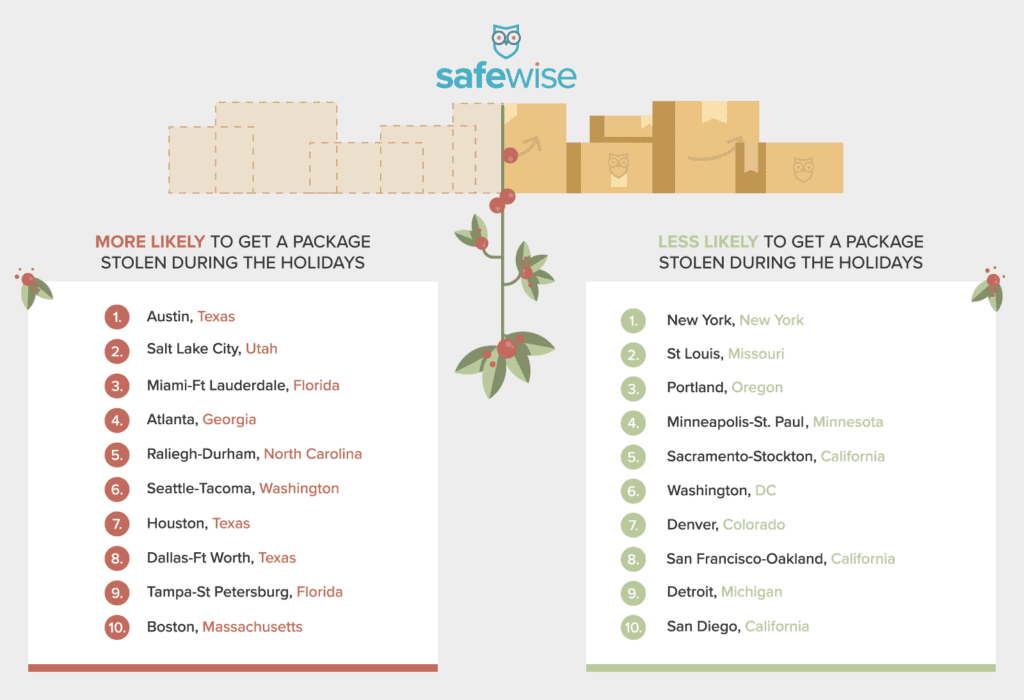
    In a study conducted by the SafeWise website, customers can check what the most attacked areas are and where the highest rate of packages stolen is. Afterward, they can decide whether online shopping is the right fit for their needs. Check out the following and see if you are living in the dangerous waters, or you can take advantage of your safe harbor and become a regular online shopper:

    Holiday Season Package Theft Data

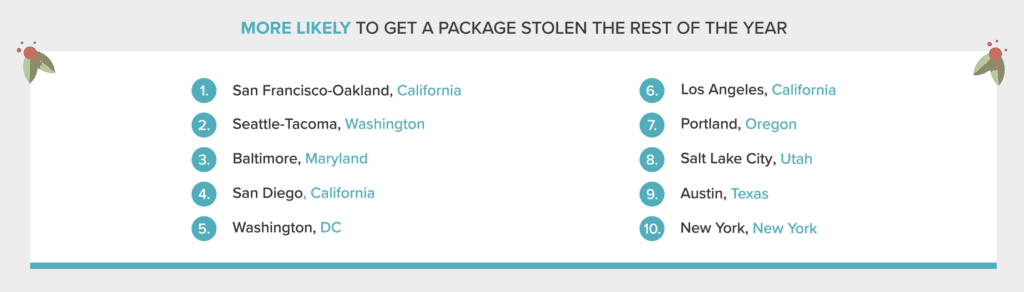
    One can’t help but notice that Texas takes three spots while Florida occupies two on the list of the affected areas. The three metro areas in the state of Texas are Austin, Houston, and Dallas-Fort Worth. It seems that Texas has the greatest incidence of package theft, especially during the holiday season. When it comes to Miami-Fort Lauderdale package theft statistics, the data varies. All year round, Florida scores zero in the package theft field, but they become the third most affected state during the holiday season.

    But what is more surprising is the following data found in the study: 

    Package Steals Likeliness

    New York earned its spot as one of the areas where you are less likely to get a package stolen during the holiday season. Regarding the rest of the year, California is more likely to become the desired state of package thieves.

    Surprising Courier Stats Compared

    So, are you a UPS, USPS, or Amazon user? The vast majority of US households have online packages delivered to their home regularly, so courier providers’ choices are substantial. 

    We’ve managed to find the data about the most popular courier providers so that we can answer the following — where is the highest rate of package theft? Check out their numbers:

    11. UPS manages to process over 15.8 million daily shipments, and 88% of those parcels see on-time delivery to recipients.

    (Bit Rebel)

    It seems that UPS manages to avoid parcel theft consequences to a great extent. However, you should bear in mind that this refers to the packages ordered via express delivery service. There are no records of package orders via free delivery or Saturday delivery mode. Also, it is important to note that many cases have ongoing UPS lost package investigation, so the numbers are unavailable at the moment.

    12. The search query Amazon package stolen was entered approximately 210 times per month.

    (Bit Rebel)

    Andry Kerns, a creative director of Digital Third Coast, conducted research to collect data for further analysis and reveal the approximate number of stolen Amazon packages. In California, the search query Amazon package stolen was inserted nearly 210 times a month across a population of 884,363. Kerns used these numbers to calculate a searches per capita value, and here is the ranking of the top 10 cities where Amazon packages were stolen:

    1. San Francisco, California

    2. Seattle, Washington

    3. Minneapolis, Minnesota

    4. Boston, Massachusetts

    5. Portland, Oregon

    6. Washington, D.C.

    7. Oakland, California

    8. Baltimore, Maryland

    9. Atlanta Georgia

    10. Sacramento, California

    It is hard to determine the safest city for packages and to rate the courier’s service, especially since, according to Amazon, the vast majority of their deliveries have reached their customers successfully and on time.

    The courier constantly emphasizes the availability of their 24/7 customer service and their stack of options, including Amazon Map feature, Amazon Locker, and Amazon Key, which help their customers battle with lost packages. Lastly, we had to drive the conclusions ourselves since we could not access the official Amazon package theft statistics report.

    Mail Theft Statistics Report

    However, package theft is not the primary concern of US households. Mail and identity theft have been reported as the number 1 white-collar crime these days. If you think about the fact that the US Postal Service handles over 207 billion pieces of mail every month, you will realize this is 207 billion opportunities for identity thieves to obtain your personal information. 

    In fact, your mailbox is the riskiest non-technological point for identity thieves. Now that we have you a bit worried, let’s share some numbers on the topic. Check out the data compiled in 2013.

    13. OIG conducted 1,514 mail identity theft investigations from October 2012 to September 2013.

     (Rapid City Journal)

    Mail and identity theft aren’t that rare as you might think. OIG performed over 1,500 investigations in less than one year, during which USPS OIG special agents arrested 339 postal employees and contractors for theft, delay, or destruction of mail in FY 2013. The overall number of mail theft arrests made by USPS OIG special agents and postal inspectors is 2,876.

    Find out how to deter identity theft.

    14. Phishing attacks grew by 27.5% in Q3 2018.

    (TechRadar, Dashlane Blog)

    Mail fishing statistics reveal that, in Q3 2018, the number of phishing attacks rose by over 27.5%. However, there were far more phishing attempts throughout the same year, as their number grew by 65%.

    15. 19.1% of breaches involved the theft of credit or debit card information.

    (ID Theft Center)

    According to the IRTC report in 2017, these numbers coincided with identity theft growth and numerous data breach reports.

    So, the numbers were gradually rising, starting from 2013 when they were extremely low. Since 2017, no matter if it was USPS package theft or Amazon or UPS failed to deliver the package directly to the customer, 19.1% of breaches included theft of credit and debit card information for the purpose of committing a credit card fraud. Throughout 2017, there were over 930 data breach incidents involving Social Security Numbers. 

    Usually, customers are not aware of how one can use their Social Security Number, their home address, or phone number. A simple USPS mail theft can easily retrieve these details since many companies still use the Social Security Number as an authenticator. That information can be extracted during simple mail theft. 

    The US Postal Inspection Service offers tips to help you protect yourself from being a victim of mailbox identity theft. However, if you become a victim, here is how to report identity theft.

    What is Mail Phishing?

    There is one more method of gathering personal information you should be aware of. Phishing is a venerable, increasingly sophisticated method of cyberattack that targets email users. You usually get a false message from a bank or company, and you need to click on some link or download the attachment.

    This way, you are providing all the information your attackers need to be able to steal your identity or access your bank details and commit internal mail theft.

    To be more aware of these widespread attacks’ severity, see the following:

    16. Nearly 30% of breaches included phishing. 

    (CSO)

    Concerning identity and mail theft statistics, almost one-third of breaches in 2018 included phishing. Regarding cyber-espionage attacks, the figure climbed to 78%. One of the most far-reaching phishing attacks throughout modern history occurred in 2016, when hackers tricked John Podesta, Hillary Clinton’s campaign chairperson, to give his Gmail password.

    17. A hacker could face five-year imprisonment and pay $250,000. 

    (Tech Crunch)

    Phishing and mail theft penalties can be higher than what people think. Hacker Ryan Collings could receive a sentence to five years in prison, together with a fine amounting to $250,000. In his phishing attack, he managed to hack Apple servers and steal celebrities’ nude photos. The hacker had access to over 120 Gmail and iCloud accounts. He was charged with violation of the Abuse Act and Computer Fraud. 

    18. 305,000 payment cards were exposed in one NY scam. 

    (Democrat and Chronicle) 

    Scams and mail fishing in NYC are quite frequent. Recently, New York residents have been warned about a phishing scam in emails coming from the city’s Department of Finance. The authorities successfully stopped the mail phishing in NYC by implementing more advanced security measures. 

    Other scams involved a well-known store operator, DiBella’s Subs. Namely, its computer systems underwent a very sophisticated data breach and exposed 305,000 payment cards.  

    Final Thoughts

    If you live in the areas shown on the package theft map, you are in great danger of becoming a package pirates victim.  Plus, you can easily become a mail phishing scam victim if you’re not careful enough. Phishers target both weak and robust victims. Implement appropriate security measures for mailbox theft prevention and stay informed about cyber trends since your attackers are surely keeping up with this information. 

    And if you’re wondering about what those measures are, make sure to read our follow-up story!

    People Also Ask

    How much mail is stolen each year?

    The US Postal Service announced that over 60,000 complaints of mail theft are reported annually.

    How many packages are stolen each year?

    The most recent parcel theft report states that nearly 29 million Americans (around 8%) have reported that their delivery package was stolen from a front porch or doorstep.

    How many packages were stolen in 2018?

    According to the Schorr report analysis, nearly 26 million package theft complaints were reported.

    How common is mail theft?

    According to the US Postal Service mail theft report, the undelivered mail number was assessed at nearly 4.7%, and the lost mail number is unknown.

    How to prevent mail theft?

    It is important to pick up your mail daily, upgrade your mailbox with mailbox fishing devices, and avoid sending cash and personal information via the mail.

    Is mail theft a felony?

    Mail theft is seen as a felony crime that is sanctioned with up to five years in federal prison, along with a penalty of up to $250,000.

    How to prevent package theft?

    Make sure to follow these measures for parcel theft prevention:
    – Add delivery instructions to keep packages off your front porch.
    – Choose the “pick me later” or “pick me up at the store” delivery method if you cannot be at home at the scheduled time.
    – Install a security camera or a video doorbell.
    – Enlist your neighbor’s house as a second delivery address or have a package delivered directly to your office.
    To prevent becoming yet another figure in package theft statistics, you should follow all these precautionary measures.

  • 29 Informative US Crime Statistics

    29 Informative US Crime Statistics

    Crime rates have a significant impact on a country’s sense of security and economy. When the number of crimes such as fraud, theft, money laundering, and embezzlement increase, it can negatively impact a country’s economy. This is why the FBI and law enforcers struggle to create programs crucial to decreasing the country’s crime rates. Equally important is to determine how effective these programs are in reducing crime rates. One way to do this is by identifying key crime statistics.

    We will discuss some essential facts, figures, and crime rates in the US to find out just how effective law enforcers are in holding back criminal activity.

    Interesting US Crime Statistics — Editor’s Choice

    • The most common property crime in 2020 was larceny-theft, with over 4.6 million cases
    • Almost 80% of Americans believe that crime rates are higher than in the past
    • The US crime rate decreased by 1%
    • In 2020, the murder cases rate increased by 21.8% in 36 US cities
    • The rate of violent crime victims was 16.4 per 1,000 people in 2020
    • The US clearance rate for violent crimes is 45.5%
    • Nearly 54% of homicide victims are Blacks
    • When the pandemic struck Chicago, the crime rate in the city dropped by 10% 

    United States Crime Statistics

    1. Crime statistics show that by 2019, crime rates in the US had decreased by more than 50% since their peaks in 1991.

    (State of the Union, Pew Research)

    Both property crimes and violent crimes in the US have seen a drastic decline in the number of cases. Their crime rates hit an all-time low in 2014, and the numbers have remained low until today.

    However, between 2019–2020, the murder rate grew 30%, translating to the largest single-year increase in over 100 years.

    2. In 2020, the most common property crime in the US was larceny-theft, with over 4.6 million cases.

    (Statista, FBI)

    In detail, theft of items from motor vehicles was the most prevalent among larceny-theft incidents. 

    Moreover, national crime statistics 2019 reveal that the larceny-theft rate was 1,549.5 per 100,000 residents in 2019.

    3. 78% of Americans believe that national crime rates are higher than in previous years.

    (Gallup)

    The belief that crime rates are consistently increasing compared to prior years is becoming a trend among Americans. However, most of the time, this public perception is out of sync with federal criminal records.

    4. Most recent data shows that the US crime rate dropped by 1%.

    (DOJ)

    The FBI proudly reports that the crime rate in the US has declined in the last three years. It appears that the bureau’s initiatives and projects, like Project Safe Neighborhood, Project Guardian, and Operation Legend, are reaping all the efforts.

    5. According to crime statistics in the USA, the crime rate significantly dropped at the onset of the pandemic.

    (USA Today)

    As the pandemic forced businesses to shut down and millions of people to stay at home, the police forces have seen a dramatic decline in crime rates across the country. The number of reported thefts and burglaries is lesser than before the pandemic as fewer stores and shops are open.

    However, the double-digit decline in crime rates doesn’t mean Americans are safer in their homes. In fact, calls reporting domestic disturbance and violence increased by 10% to 30%.

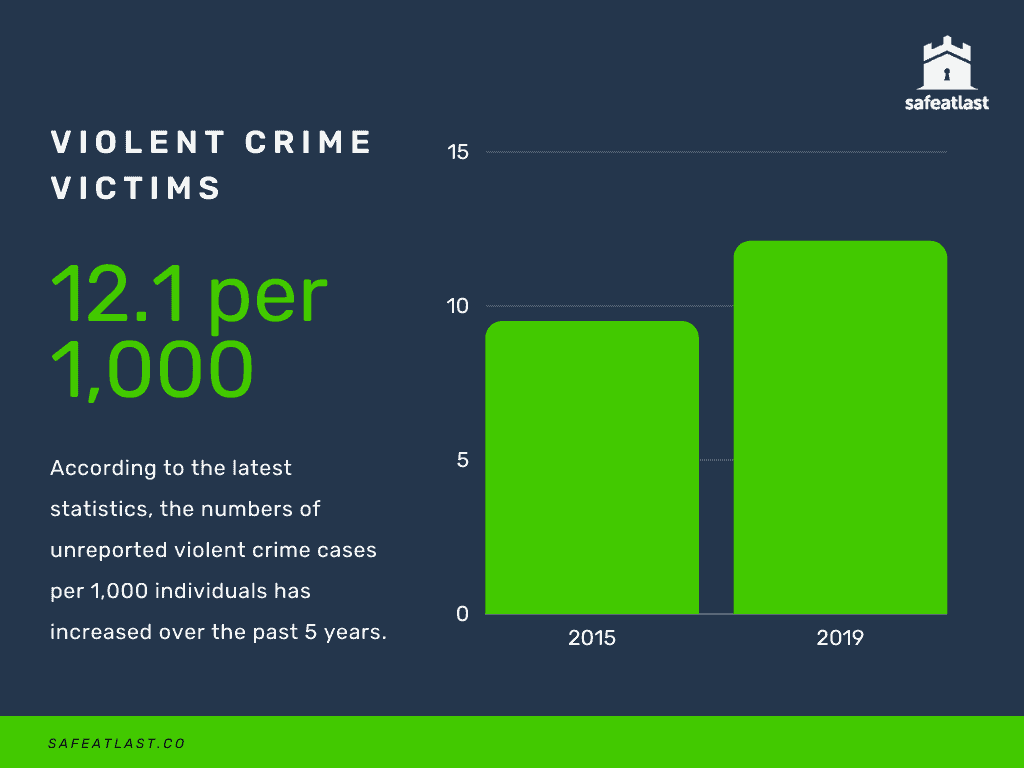
    6. In 2020, the rate of violent crime victims was 16.4 per 1,000 people.

    (Bureau of Justice Statistics)

    The number of unreported violent crime cases in 2020 decreased from 2019. According to the crime statistics for 2019, the rate back then was 21.0 victims per 1,000 persons. 

    Moreover, around 40% of violent victimization cases were reported to the police in 2020.

    7. According to the latest info, the clearance rate for violent crimes in the US is only 45.5%.

    (FBI UCR)

    The FBI’s national crime statistics indicate that more than half of violent crimes reported to the police don’t get cleared. Out of 1,147,991 reported violent crimes, only 45.5% ended with a suspect’s arrest. The clearance rate for burglary is even lower — only 13.9%.

    8. The national crime rate in the United States is 47.70 per 100,000 individuals.

    (World Population Review)

    The US crime rate is slightly higher than the world’s average crime index of 47.43. However, this is considered a drastic improvement since violent crime rates in the country have decreased in the last 25 years.

    9. The number of crimes in the US declined by 20% in mid-March.

    (Yale)

    Tobin Center for Economic Policy at Yale University conducted a study that discovered a decrease in criminal trends as the pandemic started to affect major cities. Though most people assumed that the high unemployment rate would foreshadow a high crime rate, this prediction didn’t come true, as the country experienced a 20% decline in the crime rate.

    Researchers think that lockdown and social distancing reduced criminals’ opportunities to commit violations.

    10. The murder cases rate was up by 21.8% in 36 cities in the US in 2020.

    (The Baltimore Sun)

    The recent crime statistics on violent crimes and murder reveal an unusual situation in the country. While reports indicate an overall steady decrease in the violent crimes rate in the last several years, the murder rate seems to move in the opposite direction.

    This isn’t unheard of as it has happened four times since 1960; the numbers just show how significant the disparity is. In the past, the difference between the two statistics was only 2.2%. In 2020, it was a double-digit number, as the murder rate was up by 21.8% in 36 cities across the US.

    Safe At Last - Violent Crimes Statistics 2021

    Crime Statistics by State

    11. The violent crime rate in Alaska is 885 cases per 100,000 residents.

    (USA Today)

    Most recent crime statistics by country show that Alaska is the most dangerous state to live in. The violent crime rate is more than twice the national rate of 380.6 per 100,000 people. The state also has the highest rape rate in the country, with 161.6 reported cases.

    12. Detroit, Michigan, has a violent crime rate of 1,965.33 crimes per 100,000 citizens.

    (Statista)

    Newest crime statistics by the city show that Detroit, Michigan, has the highest violent crime rate, making it the most dangerous city in the US. These cases include murder and non-negligent manslaughter, forcible rape, robbery, and aggravated assault.

    13. Franklin, Massachusetts, has the lowest crime rate of 1.9 crimes per 1,000 residents.

    (Neighborhood Scout)

    According to neighborhood crime statistics, Franklin, Massachusetts, is the safest city in America. Data shows that the total crime rate is 1.9 cases per 1,000 residents. This means that the chances of being a victim of a crime are 1 in 524.

    14. The crime rate in Chicago declined by 10% when the pandemic struck the city.

    (The Guardian)

    Chicago was one of the most dangerous cities in the US. But even this violent city saw a drastic decline in drug arrests (42%), apart from an overall decline in the number of crimes (10%). Law enforcers hope that this trend will continue even after the pandemic is over.

    Crime Statistics by Category

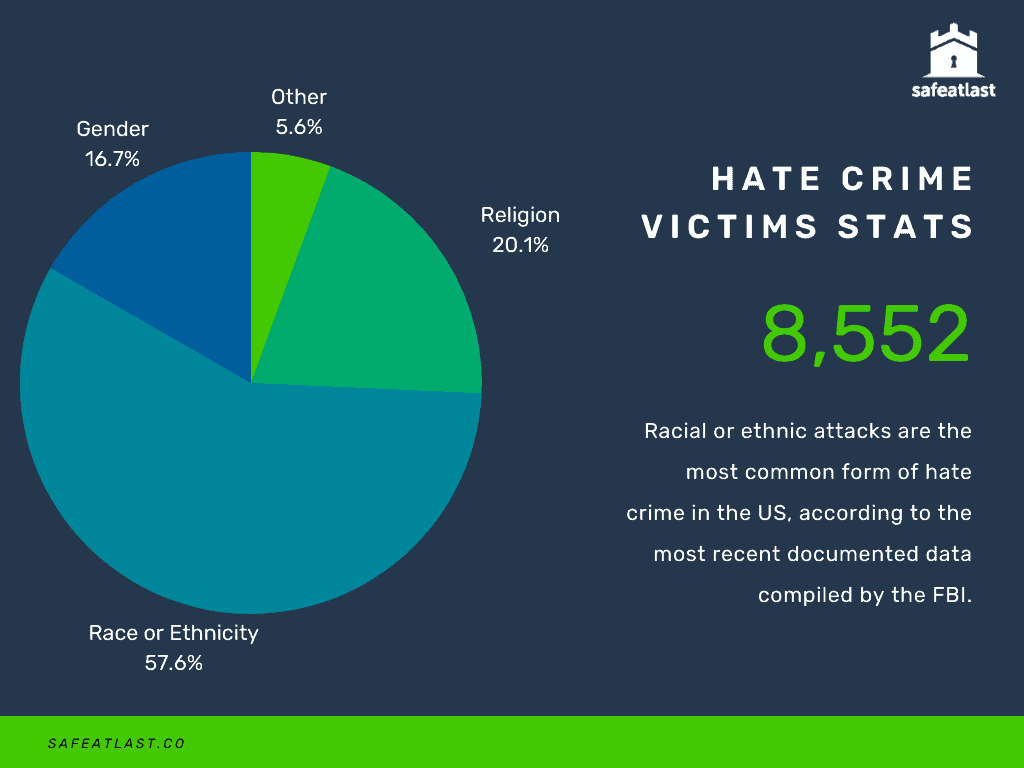
    15. 57.6% of hate crime victims were targeted because of their ethnicity.

    (FBI)

    The most recent hate crime statistics documented 8,552 victims of hate crimes. More than half of this number, or 57.6%, were the crimes committed because of the victim’s race or ethnicity. Simultaneously, 20.1% of the victims were targeted because of the attackers’ bias toward their religion, while 16.7% were attacked due to their gender.

    16. Juvenile crime statistics show that peak hours of juvenile crimes are from 2 PM to 6 PM.

    (Strong Nation)

    An analysis of juvenile crime records shows that the prime time for juvenile crimes is between 2 PM and 6 PM. Members of Strong Nation believe that these hours are crucial because they are after school hours when parents aren’t around to supervise their children’s activities. They think this problem can be solved by providing meaningful afterschool activities.

    17. According to online dating crime statistics, Americans lost $201 million due to scammers on dating apps.

    (Market Watch)

    Statistics show that more and more Americans flock to online dating apps to find their soulmates. In fact, 60% of adults regard dating apps as an excellent way to meet new people and interact with them conveniently. 

    Sadly, dating apps also make it easy for scammers and fraudsters to commit crimes. Most recent info suggests that Americans lost approximately $201 million to scammers, with a median loss of $501 per victim. To avoid this, it’s best to conduct a personal background check on your chatmate before committing to anything.

    18. White collar crime charges decreased by 41.9% compared to the previous year.

    (Trac Reports)

    White-collar crime statistics show a significant drop in the number of charges compared to the previous year. Moreover, the recorded 437 prosecutions are lower by 51.3% than the levels in 2015.

    19. The latest trends suggest that homeless people are 11 times more likely to be incarcerated.

    (Texas Criminal Justice Coalition)

    Many factors affect crime rates, and poverty is one of them. According to poverty and crime statistics, 65% of low-income households are at a greater risk of becoming homeless. Data further shows that incarceration and homelessness are inextricably linked. Homeless people are 11 times more likely to be incarcerated than the general population, and previously incarcerated people are ten times more likely to become homeless.

    20. Newest violent crime statistics suggest that the number of male and female violent crime victims was almost the same.

    (Statista)

    A graph of male vs. female crime statistics shows that the number of male and female violent crime victims was almost the same. But when the data was compared to the numbers from 2005, something troubling came up. The number of male victims decreased, while the number of female victims increased by almost 100,000 cases. It’s no wonder more and more companies are creating stun protection devices for women.

    Safe at Last - Hate Crimes in the US 2021

    Crime Statistics by Race

    21. African Americans are 3.23 times more likely to be killed during police encounters than White Americans.

    (PLOS ONE)

    Researchers from Harvard T.H. Chan School of Public Health conducted a study to determine if race and color are related to police crime statistics. Their analysis of 5,494 police-related deaths found that Black Americans are 3.23 times more likely to be killed by the police during an encounter than White Americans.

    22. Most recent black on black crime statistics suggest that offenders were black in 70% of crimes committed against Black victims.

    (Bureau of Justice Statistics)

    The research found out that an offender was usually of the same race as a victim. For instance, White people committed 62% of violent crimes against White victims, and Hispanic offenders committed 45% of incidents against Hispanic victims.

    23. According to the most recent black on white crime statistics, Black offenders murdered 566 White Americans.

    (FBI UCR)

    The FBI’s Uniform Crime Reporting program showed that, out of 3,299 White murder victims, only 566 were killed by Black offenders. The majority of the offenders were White persons. This is consistent with the FBI’s report that most homicide and murder cases are intraracial.

    24. The latest FBI data shows that 53.7% of homicide victims are African Americans.

    (FBI UCR)

    According to violent crime statistics by race, more than half of the victims are African Americans — 7,484 out of 13,927. This figure includes all Black homicide victims, regardless of their gender and age.

    25. Most recent info suggests that less than 15% of law enforcement agencies report hate crimes.

    (NBC)

    Proponents of civil rights continue to criticize the FBI’s crime reports as they don’t accurately show the national statistics on crime. Out of about 15,000 law enforcement agencies, only 2,172 reported hate crime data to the bureau; that’s less than 15% of the total number. However, even with incomplete data, the bureau still found a 20% increase in hate crimes motivated by gender-identity bias.

    FBI Crime Statistics

    26. Approximately 33,000 violent street gangs exist in the United States.

    (FBI)

    One of the functions of the FBI is to deal with threats to national security. But the Bureau also plays a crucial role in combating violent crimes in cities and states. FBI statistics on crime show that 33,000 criminally active organized groups terrorize neighborhoods in the US. These gangs use violence to control people and boost their illegal activities such as gun trafficking, prostitution, and human trafficking.

    27. The US aggravated assault rate in 2020 was 279.7 cases per 100,000 inhabitants.

    (Statista)

    That was a substantial increase from 2019. More specifically, FBI crime statistics from 2019 show that back then, the rate was 250.4 cases per 100,000 inhabitants, also indicating an increase from the year before.

    28. The violent crime rate decreased in the first six months of 2020. 

    (FBI)

    The FBI crime stats for 2020 show that the first half of the year saw a significant decline in the overall number of violent crimes compared to the same period of the previous year. Moreover, the cities with populations of less than 10,000 people reported the largest decline of 7.2%. The FBI also recorded a decrease in violent crimes in three out of four regions in the country.

    29. 26.6% of arrested individuals in 2019 were African Americans. 

    (FBI UCR)

    Crime statistics from 2019 show that 6,816,975 arrests were made that year. Out of that number, 1,815,144 people were African Americans, while the majority of arrested, most precisely 69.4% of them, were White Americans. The rest were people of different races and ethnicities.

    Safe at Last - Arrest Numbers 2021

    Conclusion

    The FBI divided crimes into two categories — property crimes and violent crimes. In recent years, the US has experienced a progressive decline in both types of crimes. However, crime stats show that the number of murders has increased in the current year compared to the previous years. This suggests that further study might be needed to understand this increase and develop strategies to lower the murder rate.

    People Also Ask

    What is the most common crime to occur within families according to statistics?

    Domestic abuse is one of the most common and pressing issues in the United States. This includes child abuse, elder abuse, and intimate partner abuse. Statistics estimate that 10 million people fall victim to domestic abuse every year. The figure is so large that, at some point, every healthcare professional and provider will evaluate or treat a victim of domestic or family abuse.

    What are the statistics of black on black crime?

    Despite the general opinion, intraracial crimes, or crimes where a victim and an offender are of the same race, are more common than interracial crimes. Moreover, data shows that Black offenders committed more than 85% of crimes against Black Americans. The same can be said about White American victims and their offenders — most offenders are also white.

    How does poverty affect crime statistics?

    Researchers have found several factors that can affect the change in crime rates, such as population density, age, unemployment, poverty, and mental illness. Out of all these factors, poverty has the most obvious influence on crime rates. If the poverty level rose by 1%, the number of total crimes would increase by 135 cases and the number of violent crimes by 25 cases.

    What can crime statistics tell us about the crime picture in America?

    The latest statistics on crime in the US show that violent crime and property crime rates have decreased in the last couple of years. Some researchers believe that this downward trend results from the collective efforts of the FBI, law enforcers, and communities across the country. Moreover, despite the widespread opinion that the US is a crime-ridden country, violent crime in the country is extremely localized.

    How to find crime statistics for an area?

    Statistics and crime levels in a certain area or community can be determined in several ways. One of the best ways to do this is by checking out crime mapping services that display information on the crimes committed in the neighborhood. These services are also able to register the types of crimes and their dates and notify you about future crimes in the area.

    Who commits white-collar crime statistics?

    White-collar crimes are classified as non-violent crimes. They usually involve money laundering, investment fraud, bribery, corporate espionage, and financial information falsification. Due to the nature of this type of crime, it is usually committed by educated, gainfully employed, middle-aged men with high social status. Many of these men commit their first white-collar crime in their late thirties or mid-forties.

    How do crime statistics help law enforcement?

    Crime statistics help law enforcers battle against criminals. They also assist them in determining the effectiveness of implemented programs designed to lower the crime rate. These statistics show a predominant type of crime in a given city or neighborhood, which helps the police lower the risk of the specific crime type and allows them to focus more on high-risk neighborhoods and efficiently allocate police forces.

    What causes the most deaths in terms of overall crime statistics?

    Murder and homicide are the leading types of crime that cause the death of people from all age groups and demographics due to their violent nature. According to the most recent crime statistics, more than 18,000 Americans have died in a single year due to assault. That’s approximately 5.8 deaths per 100,000 people. Moreover, almost 14,000 were firearm homicide cases.

  • 27 Surprising Workplace Stress Statistics

    27 Surprising Workplace Stress Statistics

    One of the leading causes of stress among adults comes from their workplace. Due to increased stress levels, anxiety, and depression that occur thanks to a workplace environment, more people are now struggling with mental health. Moreover, workplace stress statistics show that workplace-induced stress further causes troubles with employees’ happiness, relationships, productivity, and tenure at both their company and outside in the real world.

    The data we’ve uncovered can give you an in-depth insight into the challenges people face at work. Hopefully, you will find them both fascinating and alarming, which might encourage you to help someone handle their stress levels in a better way.

    Key Stress in the Workplace Statistics (Editor’s Choice)

    • 4 in 10 employees report their job as very or extremely stressful
    • More than 6 in 10 Americans claim work is their primary cause of stress
    • Up to 80% of work accidents happen due to sleepiness caused by stress or increased stress levels
    • Almost 20% of people reported both verbal and physical bullying at the workplace because of increased stress
    • A stressful working environment adversely impacts the quality of work, according to 91% of workers
    • In the US, the age group that experiences the most stress in the workplace is people 25–35 years old
    • Around 66.7% of millennials claim to skip lunch to get ahead at work
    • Almost 60% of people have considered leaving or left a job due to negative office politics

    Overall Workplace Stress Statistics 

    A working environment with a lot of stress does not harm only an employee but an employer as well. It can cause less productivity, happiness, employee turnover, and more.

    1. 80% of Americans claim their stress comes from at least one factor at work.

    (SHRM)

    Stress is a common occurrence for American workers. In fact, 33% of them report regularly feeling stressed at work. The top five factors that cause stress at work are low salaries, lack of opportunity for growth and advancement, too heavy a workload, unrealistic job expectations, and long hours.

    2. 41% of workers in medium- to high-paying jobs have reported a negative working environment.

    (SHRM)

    Moreover, people working low-paying jobs have reported that their jobs negatively affect their stress levels. A stunning 51% of employees have stated stress management at the workplace is hard to maintain due to the nature of their work.

    3. 78% of working adults report having a positive relationship with their colleagues.

    (SHRM)

    Moreover, nearly three-quarters (72%) have a good relationship with their boss. However, the quality of these relationships has declined in the last three years.

    4. 6 in 10 Americans state their work-related stress levels were higher during the 2020 pandemic.

    (APA)

    Americans have experienced increased job stress levels in 2020 due to the global COVID-19 pandemic. Around 63% of American workers have reported that the current economy causes them stress on a more significant level.

    5. Americans aged 25–35 experience more chronic stress than other age groups.

    (Everyday Health)

    That is a combination of impacted mental health, physical health problems, and a mixture of socio-economic and environmental factors.

    6. More than 20% of employees spend around five hours a day thinking about their stressors.

    (Colonial Life)

    Stress and productivity do not go together, so stress has a negative impact on both employees’ productivity levels and mental health.

    7. 40% of employees have reported their job was very or extremely stressful.

    (AIS)

    Although 80% have declared they feel stressed about their jobs, approximately half say they need help in learning how to manage stress and 42% think their coworkers need such help. Furthermore, 25% of them target occupational stress as their number one stressor.

    8. 61% of Americans claim their work is their number one stressor.

    (APA)

    When talking about the main stressors in American people’s lives, the future of the nation, the economy, and money are among the highest-ranking stressors. On the other hand, the current political climate (57%) and violence and crime (51%) are considered less important factors.

    Targeted Workplace Stress Statistics

    Work-related burnout is a serious matter that we shouldn’t underestimate.

    9. 91% of workers reveal that feeling high levels of stress negatively impacts the quality of their work.

    (Deloitte)

    Naturally, immense amounts of stress can negatively impact anyone’s workload and the quality of work. Furthermore, 83% claim that burnout they experience daily at stressful workplaces has a negative impact on their relationships.

    10. 2 in 3 millennials claim to skip lunch to get ahead at work.

    (BioSpace)

    Millennials claim that their high-pressure jobs make them work harder and stay longer to get ahead. However, 60% of recently promoted millennials claim they can take lunch breaks, which means they can afford to take them.

    11. Top five stress factors are the inability to advance, low salaries, long working hours, heavy workload, and unrealistic job expectations.

    (SHRM)

    The majority of working Americans have reported that many work-related factors influence their stress levels at work. Statistics on stress in the workplace show that it is most often caused by few to no opportunities for growth, low salaries, long working hours, and unrealistic job expectations.

    12. 15% of people admitted they were looking for a new job because of stress.

    (Colonial Life)

    Employees are aware that the stress levels they experience at their office make their performance worse. In addition, 41% claim work stress makes them less productive, while 33% think it makes them less engaged.

    13. 58% of people have thought about leaving or have left a job due to negative office politics.

    (Randstad)

    In addition, 86% would not continue to work or apply for a company that has a bad reputation with the general public or former employees, and 65% would probably leave if their employers were negatively portrayed on social media or in the news due to a crisis or employee stress. On top of that, they say they would even work for a smaller salary if that meant working for a great boss.

    Workplace Stress and Its Impact on Health

    Stress is a significant factor in people’s lives, both professional and personal. Thus, the stress in the workplace not only impacts the working environment but also harms the person’s physical and mental health.

    14. 19% of people reported both verbal and physical bullying at the workplace.

    (Stress.org)

    Unfortunately, dealing with work stress goes hand in hand with bullying, both verbal and physical. Furthermore, 35% of employees think their job affects their emotional or physical health, while 42% claim job pressure affects their relationships.

    15. 66% of people have reported having difficulty sleeping due to stress related to work.

    (Inc)

    Stressful situations in the workplace lead to people taking their stress home, resulting in a less peaceful home life. Sleep deprivation has a negative impact on the critical thinking skills and problem-solving abilities you need for success at work.

    16. 44% of people reported having trouble with their eyes.

    (CWM)

    Whether you’re a stressed office worker, teacher, writer, or your position requires any contact with computers, you will probably report having some work-related health problems. Some of the most common stress-related symptoms are neck pain (60.2%), hand pain (38%), and sleep problems (34%).

    17. 31% of male and female workers handle stress at work by consuming more caffeine.

    (ADDA)

    There are several ways employees handle causes of stress in the workplace. In fact, 27% of them smoke, 23% take prescription or over-the-counter medication, and 20% consume more alcoholic beverages.

    18. 65% of employees claim workplace stress has caused difficulties.

    (AIS)

    Moreover, more than 10% say stress can have major effects. Another 42% report verbal abuse as a common occurrence, while 29% of workers have yelled at their colleagues due to stress in the workplace. Some of the most stressful jobs even lead to physical violence (10%) and damage to machinery equipment (14%).

    19. 62% of people end their working day with neck problems.

    (AIS)

    In addition, more than half often spend 12 hours at work and the same number frequently skip lunch due to the stress of job-related duties. Nearly one in five respondents (19%) quit a previous position because of stress in the workplace, while almost one in four have been driven to tears because of it.

    Stress in the Workplace Statistics Regarding Violence and Accidents

    20. 60–80% of accidents at work happen due to increased stress levels or sleepiness caused by stress.

    (EKU)

    According to the American Institute of Health, stress affects approximately 50% of American employees. While 48% of them can’t sleep well at night because of stress, 42% have changed their job for the same reason.

    In addition, the stress in the workplace stats confirm that 52% of employees have called in sick because they were unable to cope with pressure at work, while many developed some psychological symptoms of stress like nervousness (45%), irritability/anger (50%), waiting to cry (35%), and lack of energy (45%).

    Moreover, physical symptoms of work-related stress include headache (44%), fatigue (51%), upset stomach (34%), muscle tension (30), and appetite changes (23%).

    21. 42% of employees have reported yelling or verbal assaults at work.

    (AIS)

    Current statistics about stress in the workplace report that verbal assaults and yelling are common occurrences. In fact, around 42% of people working in offices or job sites have reported that. On top of that, 29% of people have admitted to yelling at coworkers due to increased stress.

    22. 14% of people admit they have felt the need to strike a coworker but haven’t.

    (AIS)

    The latest statistics on workplace stress show that people have felt the need to strike a coworker or supervisor. That was due to the stress they felt while performing their job. In addition, 2% of workers have actually struck someone at work.

    23. About 25% of people felt the need to shout or scream due to stress in the work environment.

    (AIS)

    As numerous studies show, stress in the work environment evokes different feelings in people. Around 10% of workers state they’re afraid of a coworker and their potential violent outbursts due to increased stress.

    25. 40% of people say they need help in managing stress.

    (AIS)

    Around 80% of people feel stressed at work, with nearly half of them reporting that they would like to learn how to cope with high-stress levels. On the other hand, 42% of people have stated that they would like their coworkers to learn how to manage stress.

    People Also Ask

    How is workplace stress measured?

    Naturally, stress levels are challenging to measure, but the most commonly used tool for measuring them is the Perceived Stress Scale (PSS). It is a widely used psychological instrument for measuring the perception of stress. It measures the degree to which situations in one’s life are evaluated as stressful, meaning it can be applied to workplace situations and further help determine workplace stress levels.

    What percentage of the population is stressed?

    According to recent data, around 33% of adult Americans feel extreme stress, while 77% experience stress that affects their everyday life. Moreover, 73% of workers claim stress affects their mental health, while 48% have trouble sleeping due to stress. People who experience particularly high rates of stress are women, ethnic minorities, single parents, and people responsible for their family’s health care decisions.

    What are the 3 signs that you are stressed about your work?

    There are plenty of signs that can help you determine whether you’re stressed about work. Some of the most common indicators are insomnia leading to tiredness, irritability or outbursts of anger, and low productivity accompanied by feelings of low achievement. Other signs might include consuming too much caffeine or alcohol, low mood, regular absence, a higher sickness rate, and being accident-prone, cynical, or defensive.

    What do I tell my doctor to get stress leave?

    If you want to solve your problem, it’s best to be completely honest about your symptoms with your doctor. You should note that it is crucial to be upfront and open about your feelings and work-related stress. Remember not to leave out any details, and listen to your doctor’s advice. Give an example of a work-related stress incident and explain why you’re feeling that way.

    Can I quit my job due to stress?

    Naturally, you can quit your job for any reason, one of them being stress. Stress has a detrimental effect on health, so if you feel it is starting to affect your health, it might be time to quit or even ask for fewer responsibilities. If a simple break from work doesn’t help you manage your stress levels, then you’d better seriously think about what you should do, workplace stress statistics show.